Cast Your Vote for Picture Books about Elections

Lynn and Cindy: Unless your pandemic shutdown has included no access to electronic media, you will have noticed that the U.S is fast approaching an important election. Adults everywhere are talking about politics, candidates, and elections and for children, it can all seem mystifying. Happily, authors and publishers have stepped up and there are a lot of picture books currently being published on the subject. Here’s a round-up of a few that we think will help kids make sense of this important topic.

I Voted: Making a Choice Makes a Difference (Holiday House/Neal Porter, 2020) by Mark Shulman.

This book focuses on the idea of making a choice. It starts with the most basic of choices by asking what the reader likes best: ice cream or onions and apples or oranges? The concept slowly broadens by asking the reader to imagine a choice being made by more people such as choosing a class pet. In the simplest of terms that kids can easily understand, the book discusses facts about voting such as sometimes not getting what you want, ways to help people vote for what you want, and how a vote can be held. Broadening more, the topic shifts to grown-ups voting for leaders of their cities, towns, or states, why that is important and how to decide who to vote for. Kid-friendly and very accessible, this is a terrific vehicle for introducing the concept. Back matter includes Five Easy Steps for Voting and information on How Our Government Works. Serge Bloch’s cartoon illustrations make the book very appealing.

Natasha Wing’s The Night Before Election Day (Grosset & Dunlap, 2020) by Natasha Wing

This cheerful book is part of an extensive series told in the tradition of Clement Moore’s Night Before Christmas poem. Each book in the series tells the story of the night before a special event or festival. Here the event is Election Day and the children in the family are reminding their parents that school will be closed the next day so people can vote. Their classes have been decorating, everyone has been getting ready for months, and now the election is here. The basics of what is an election and the voting day process are covered here. Clearly stated yet retaining a child’s perspective, one of the chief joys of the book is the well-conveyed sense of excitement and importance of an election. This will be great to use in the classroom or at home in the fall as election time draws near. Extra nice to have a family of color at the center of the story. We love the idea of helping kids to understand how important AND exciting elections should be.

Vote for Our Future! (Schwartz & Wade, 2020) by Margaret McNamara

A diverse cast of children (and teaching staff) have the day off school in order for their elementary school to transform into a polling station. The children aren’t old enough to vote, but they figure out ways to perform other civic duties in this Get Out the Vote story. Their actions leading up to election day explain voting practices like registration, making a plan for election day, voting early or by mail, and the importance of voting. A gatefold shows a large crowd of people heading to the school to cast their votes in an effort to affect change. In addition to Micah Player’s colorful and lively illustrations throughout, the endpapers include images of political buttons encouraging voting. The end matter includes a list of Acts of Congress that improved life in the United States starting with the 1792 Postal Service Act signed into law by George Washington, and acts to protect national parks, Indian citizens, control air pollution, and protect civil rights, provide protection for Americans with disabilities, and access to affordable health care.

Grace Goes to Washington (Disney/Hyperion, 2019) by Kelly DiPucchio

The first book in this series, Grace for President (Little, Brown, 2008), explained the Electoral College as Grace tried to become the first female US president in her class’ mock election. This second book takes on the three branches of government as Grace’s student council struggles with deciding how to spend their fundraiser profits to best benefit their school. Everyone has a special interest (sports equipment, library books, or musical instruments). We all know how many adults in charge deal with these issues, but perhaps the kids can teach us something? Illustrated by the talented LeUyen Pham and including a field trip to Washington, D.C., an author’s note explaining the branches further, and a list of ideas for becoming an involved citizen, this book has a lot to offer an elementary classroom.
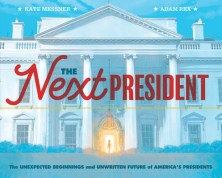
The Next President (Chronicle, 2020) by Kate Messner

And, while we wait to learn who our next president will be, take a stroll through presidential history with Kate Messner and Adam Rex. At any one time, we have approximately ten people alive who will become one of our next presidents, some who are still children and have no idea it will be them one day. Starting with George Washington, there were nine future presidents in the wing. In 1961 there were ten also, four of them just children (Bill Clinton, George W. Bush, newly born Barack Obama, and teenager Donald Trump). The following page has stirred some controversy, but careful readers will understand that Kennedy and Obama, and on another wall in the illustration, Hillary Clinton, are representing this text:

“The truth is America’s earliest presidents weren’t all that different from one another. Most were wealthy, white, Protestant men who might have been surprised if they’d been around to see a Catholic or an African American man elected president…or a woman nominated by a major party for the highest office in the land.”

An empty frame labeled “46” awaits the “next” president either this November or another four years from now. Adam Rex’s illustrations are magnificent and complement the interesting details and timelines that Messner researched and threaded together about what each president was doing earlier in their life before becoming America’s Commander in Chief. It’s an inspiring collection for children who wonder what their futures might hold.
A Bounty of Board Books

Lynn and Cindy:

We are in awe of the creativity at work in creating books for young people. That creative spirit begins with books for our very youngest readers too. We’ve been sent some terrific board books lately that are an absolute delight to share with babies and toddlers. Sturdily constructed to withstand tough treatment, these wonderful books are cleverly designed, smartly age-appropriate, and highly entertaining. In short – a perfect recipe for enticing the earliest readers among us. Here is a round-up of a few that have arrived at our doorsteps lately.

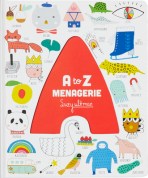
A to Z Menagerie by Suzy Ultman (Chronicle, 2019)

Little fingers will delight in tracing the die-cut alphabet letter on each page and then pull a tab to replace the center of the letter with a colorful illustration of an item that begins with that letter. O reveals a round owl face inside the O and is identified with a full body picture and the word “owl” on the pull-out page reveal. Scattered around the featured letter are a variety of colorful line drawings featuring familiar and more original vocabulary items. O includes onion, overalls, octopus, opal, oboe, orca, and an ocelot in an oxford shirt.

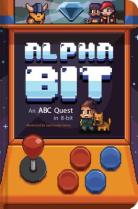
AlphaBit: An ABC Quest in 8-bit by Juan Carlos Solon (Chronicle, 2019)

The next generation of gamers may get their start with this seek-and-find alphabet board book with a quest, illustrated in the pixilated 8-bit style of the 80s and 90s video games, or the more recent Minecraft. Each page features a capital letter and four or five items to find in the scene that moves the adventure along. Level up!

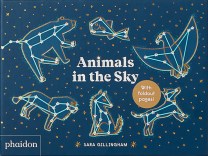
Animals in the Sky by Sara Gillingham (Phaidon, 2020)

Whether or not the board book set will be able to find the constellations in the night sky, they will enjoy looking at this introduction to six of the constellations that are identified as animal shapes. Each constellation is presented first as a riddle with the constellation outline. A gatefold opens to identify the animal that answers the riddle. The constellation is superimposed over a drawing of the animal. Another drawing identifies major stars or other shapes within the featured animal. Ten additional animal constellations are included on the final fold-out pages for the overachievers, along with the suggestion for adults to consult a star smartphone app if needed.

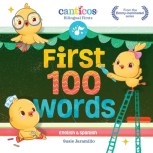
First 100 Words: English & Spanish by Susie Jaramillo (Encantos, 2020)

We are past our Nick Jr. television days, but parents of young children will undoubtedly be familiar with the Canticos bilingual sing-along programs. This book is the first in the Canticos Bilingual Firsts board book series to supplement the brand. Thematic double-page spreads introduce vocabulary such as Frog/Rana, Tree/Árbol, Butterfly/Mariposa on the Nature/Naturaleza pages. School, Transportation, Sports, Music, Beach and other themes continue the bilingual vocabulary building with the familiar Canticos characters appearing on the pages too. Colors, opposites, numbers, shapes, feelings, and letters round out the rest of the concepts in the new series.

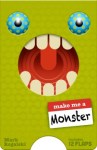
Make Me a Monster by Mark Rogalski (Chronicle, 2020)

This board book is an immediate eye-catcher as it features a monster face and a circular opening lined with teeth as its cover. Flip the cover upwards and each simple page directs readers to fold out monster attributes like bulging eyes, horns, or a green twisty tale. By the book’s end, readers will have created their very own monster.

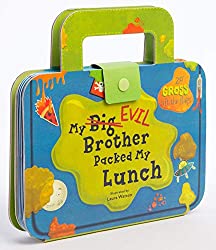
My Evil Big Brother Packed My Lunch by Laura Watson (Chronicle, 2020)

Here is a board book “packed” with jokes guaranteed to make young readers groan with delighted horror. Open the lunch box-shaped book to learn that the narrator’s brother has volunteered to pack lunches for the week. On each lower page, see what the boy has requested for lunch. Flip up the fold and discover what was ACTUALLY packed that day. A ham sandwich, carrots, and a cupcake turns out to be a frosting sandwich, a ham cupcake, and carrots with mustard! Funny notes from the brother and disgusting combinations will bring kids back to this fun book again and again.

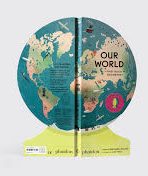
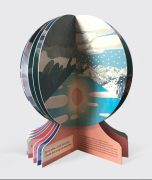
Our World: A First Book of Geography by Sue Lowell’s  Gallion (Phaidon, 2020)

This uniquely shaped board book opens up to create a 3-D globe that will stand. Simply rhyming text on the left side of the spread is supplemented on the right by more detailed information about the biomes, climate, continents, and our planet. This might be the only globe this generation gets their hands on!

Birding Adventures for Kids: Bird Identification & Activities

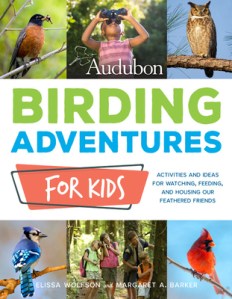
Cindy: At the public library, Lynn found this great new birding guide for children getting started in this rewarding hobby that gets them outside and active. Audubon Birding Adventures for Kids (Quarto, 2020) by Elissa Wolfson and Margaret A. Barker is more than just an identification guide. It’s divided into three sections: Meet the Birds, Outside with Birds, and Inside with Birds, the last two provide ideas and directions for games, activities, and adventures to have in order to learn more about the birds.
Most of the 25 birds selected for the Meet the Birds section are ones that are found throughout the United States at one season or another. A range map is provided for each species, just as is provided in identification books published for adults. A color photo of a single or pair of the species is included along with a “fun fact.” Did you know that Hummingbird eggs are the size of peas? Each species is identified by common name, scientific name, field marks, length (in inches and centimeters), and voice descriptions for songs and calls. There’s also information on feeding (what they eat and how they consume it), conservation issues, tips for helping the species (food or plants to provide), and similar species. There are also a few groan-worthy bird jokes thrown in for fun. “What kind of crows always stick together?….Vel-crows!” HAHAHAHA.

Lynn: Following the section Cindy describes are two more sections that the parent/grandparent in me loved. These are the sections that get kids moving, learning, and entertained. These two chapters provide well-designed activities, one set for outside and one for inside. Each activity clearly lists materials needed, directions, follow up, and discoveries. Some are more involved than others but most require just simple materials. One does require binoculars but I liked this one too as a good basic lesson on how to use binoculars. Glossary and an appendix have related bird information.

I learned a lot myself from the information on common birds despite being a life-long birder. Did you know only the female duck “quacks”? Or that Chickadees hide seeds and go back to them months later? This appealing book will help create more birders and will keep kids nicely occupied with science and bird-related activities. This is an ideal book for kids and caregivers both and may be of special interest to everyone with children doing virtual school in this time of Covid-19.

Facts vs. Opinions vs. Robots: a Fun Information Literacy Primer for Children

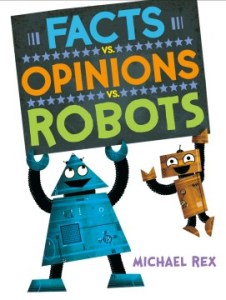
Lynn: You’d have to live in a cave in the wilderness not to know that far too many Americans have a very sketchy concept of what a fact actually is or how to verify it. The need to understand this important issue is one of national importance these days as it is clear that millions of adults don’t grasp the difference and the impact on our culture is stark. Here, with a great way to start addressing the issue, is Michael Rex with a fabulous picture book, Facts vs. Opinions vs. Robots (Penguin/Nancy Paulsen, 2020). With brightly colored cartoon-style robots, Rex’s appealing book takes on this topic with our youngest readers. The question is posed on the very first page.
“Do you know the difference between a fact and an opinion?

It can be a hard thing to understand. Even these robots get confused.

But maybe if we work together, we can figure it out.”

Taking it step by step, the robots define the two concepts and then provide simple examples to practice. The examples are engaging and child-centered with plenty of humor. The robots are goofy but Rex does a wonderful job of presenting the information in a clear, understandable, and appealing way. Kids are going to WANT to read this book all the way through thanks to the level of humor but more importantly, they are going to grasp and remember this idea. The story also includes the concept of needing to search for more information sometimes and also reminds readers that while we need to respect other people’s opinions, we can’t argue with facts.

If I could, I’d buy this book for every classroom and library in America!

Cindy: What a great way to introduce an important skill in information literacy. Elementary librarians, take note! What if you read this book aloud and then had your students write a declarative sentence and have them present it for the other students to respond with Fact or Opinion? This could work in a virtual class meeting as well. Students could make a 2-sided notecard with the FACT on one side and OPINION on the other and hold them up to their cameras. Lots of ways to use this in an elementary classroom as well.

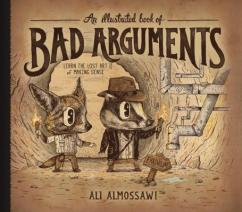
This book for the very young audience brings to mind a book for older students that we reviewed over at Booklist Reader during the last presidential election cycle and it’s worth mentioning again as the facts, opinions, and faulty logic arguments ratchet up. Read our blog post about Bad Arguments: Learning the Lost Art of Making Sense (The Experiment, 2014) by Ali Almossawi if you missed it the first time around. It’s a good time to separate facts from opinions and to do it without faulty logic.


Truth According to Blue – Sunken Treasure, Diabetes, Service Dogs and Friendship

Lynn: Some books have a special place in your heart and Eve Yohalem’s first book, Escape Under the Forever Sky (Chronicle, 2009) is one of them. My middle school readers LOVED it and I loved to booktalk it. So I was really excited to see Yohalem’s new book, The Truth According to Blue (Little, Brown, 2020), and what a treat it is!
Blue is 13, school is out, and she has a secret plan for her summer—hunting for a family treasure her grandfather had spent his life looking for. Pop Pop has passed away recently and Blue’s Dad won’t even talk about any hint of the treasure being real. Blue has another reason to find the treasure. Blue has juvenile diabetes and she desperately wants something more than being seen as Diabetes Girl, especially as she is the actual poster child for a huge Diabetes fundraiser being held at the estate of a famous movie star.

Blue is careful and responsible about her illness. She tests regularly, pays attention to her numbers, and to her service dog, Otis. She can hardly wait to get out on the water and start the search when two huge obstacles enter the picture. Jules, the incredibly spoiled daughter of the movie star becomes Blue’s responsibility to take along and a famous greedy treasure hunter arrives searching for Blue’s treasure! Now for the first time, Blue finds herself keeping big secrets from her parents and taking some serious risks. Is the treasure worth losing their trust?

Endearing characters and a really exciting plot were the high points of the book for me but there are a lot of additional elements that added interest and heart to the story. Blue and Jules are terrific characters, each yearning for the chance to be more than the labels people stuck on them. Blue’s voice is terrific especially and I loved the depiction of a responsible kid trying to do the right thing while making some big mistakes. There is a lot of information about juvenile diabetes woven into the book very skillfully and Blue’s condition is just one piece of who she is. Every reader will fall for Otis. There is also a lot of interesting history, some information on boating and scuba diving, and a setting that makes an intriguing backdrop.

I was rooting for Blue and Jules all the way, cringing at some of their mistakes and smiling at the girls’ growth and developing friendship. The satisfying and surprising ending was the icing on the cake. It was lovely to see such a wonderful parent/child relationship portrayed too. This book had it all and I loved every word! Yay for Blue, Jules, Otis, and Eve Yohalem!

Picture Books Go Camping

Lynn: I know summer is drawing to a close but there is still time to get outside and camp and hike with kids! In fact, the crisp air and colorful beauty of fall may be even better for enjoying nature. Of course, books should ALWAYS be a part of whatever we do. I have two delightful picture books that will be a perfect way to lead up to an outdoor adventure. Read these and smile, and then pack up your tent and lace up your hiking boots!

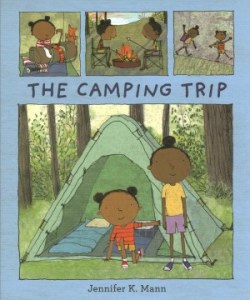
In The Camping Trip (Candlewick, 2020) by Jennifer Mann, Ernestine, a young city girl, excitedly tells readers that she is going on her first camping trip with her Aunt Jackie and cousin Samantha. She and her Dad are packing up everything she needs and the trip begins. Ernestine is sure she will love camping but there are some surprises. The tent is not one bit easy to set up, swimming in the lake is not at all like swimming at the Y—there are fish in there—and maybe her backpack is a bit too full for hiking without getting really tired! But a campfire supper is really fun and s’mores are delicious. At first sleeping in a tent is a little scary. It is REALLY dark and Ernestine misses her dad. But smart Aunt Jackie takes the girls outside to see the stars and make a wish on a shooting star. The next day, Ernestine bravely tries more new things and when it is time to go she can’t wait to camp again.

Mann’s illustrations are adorable, cartoon-type stick figures with big heads and packed with wonderful small details. The book is a charming mix of graphic novel with panels and speech bubbles and picture book with large spreads. The text is delightful and there is such an authentic feel both to the dialog and to Ernestine’s thoughts and reactions. I especially love the packing scene and the hike. Anyone who has walked ANY distance with young children will laugh at the progression from energetic to exhausted. Use this book to introduce camping to kids or as a wonderful reminder of the fun to be had. Oh, and don’t miss the endpapers!


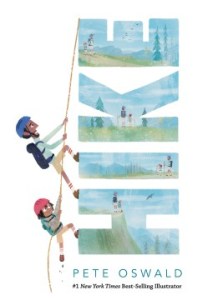
My second book is Hike (Candlewick, 2020) by Pete Oswald and while it shares some characteristics with The Camping Trip, it is a nearly wordless book, telling its story completely with illustrations and a few sound effects. Here a dad gently wakes his sleeping child in a bedroom showing evidence of preparations for a hike. As the story unfolds in expressive small vignettes balanced with full-page illustrations, the reader watches the pair experience a day hiking through woods, walking across a fallen log by a waterfall, climbing a rocky cliff, and planting a tree. Charming details make each scene a small story all its own as they observe animals, take pictures, and share a very special day.

Oswald uses a peaceful palette of greens and browns in this quiet but rewarding account not only of the joys of spending time in nature but also of a parent and child spending time together. Back home together at the end of the day, the pair snuggle together on the sofa looking at the drawings and photographs of their special day. This quiet book rewards paying attention to the many details and will be one to read and share over and over.