Lynn: 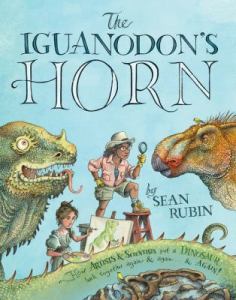 If you describe a book as being a terrific educational book, most kids will RUN the other way! Happily, for all of us who hope kids will love science and learning, there are a lot of deeply educational books that are so much fun that kids will demand to read them over and over – even in the summer! Sean Rubin’s The Iguanodon’s Horn (Clarion, 2024) is a wonderful example of such a treasure. That it is about dinosaurs is a special bonus.
Author/illustrator Rubin examines a critically important issue in this appealing book: how does scientific thought work? In a time when so many people disdain science and the scientific process, this understanding is crucial for humankind. Rubin uses a child-favorite subject to illustrate the topic and kids will learn so much and hopefully come away with a firm grasp of the fact that science is a process that never ends.
In 1822 – not THAT long ago – Mary Ann Mantell was strolling the beach with her husband and she stumbled over a curious bone. Her husband shared the odd bone with other scientists and they concluded it came from something unusual, which they called an Iguanodon. As they found more bones, they wondered what a whole iguanodon would look like. Their guesses were wildly wrong as were the many scientists who tried to solve the puzzle. As more bones were found and more information gained over the years, theories about Iguanodons – and dinosaurs in general – changed drastically.
Rubin fills his pages with a glorious array of the many ways iguanodon’s appearance changed over time as scientists gained more information that altered their ideas. Full of comedic details, the illustrations are a delight that will entrance kids for hours. Rubin used graphite pencil, digital and physical watercolor washes, and paint splatter to great effect. Author Endnotes provide more information about what is featured on each page and is as much fun to read as the book itself. Rubin concludes the book with challenges to young readers to think about how what we know about the Iguanodon and other dinosaurs could change in the future.
The book’s overall appearance is an irresistible kid magnet and is sure to fly off the shelves. I think kids will absorb the important teaching of the book while enjoying every page! This is a must purchase for libraries, STEM classrooms, and for little dinosaur-enthusiasts everywhere.
 bookendsblog.net