Do You Know Dino…and the Scientific Process?

Lynn: Do you think you’ve added enough dinosaur books to your collections and don’t really need another? Think again! This new National Geographic book by Sabrina Ricci and Garret Kruger is not only great for dinosaur enthusiasts, but it is also an outstanding book for STEM and classroom use to illustrate the process of scientific inquiry. I Know Dino!: Amazing Breakthroughs, Mega Mistakes, and Unsolved Mysteries in Dinosaur Science (National Geographic Kids, 2025) is a roaring success in many ways.
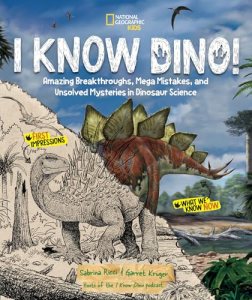
Organized into 6 chronological periods, each chapter introduces the history of that period, the discoveries made, and the evolution of theories about dinosaurs. Each chapter then features a series of 2-page spreads, each about a particular dinosaur. One page, First Impressions, discusses what scientists thought the dinosaur looked like, how it behaved, and even how the bones were positioned. The facing page, What We Know Now, shows what we understand now and how our knowledge has changed. And boy, have most of our first impressions changed!

The oversized book is beautifully designed and features illustrations by Franco Tempesta, period and contemporary photographs, and plenty of sidebars and charts with additional information. It is a dinosaur-lover’s treasure trove. And, importantly, readers will come away with a rock-solid grasp of how the nature of science is always changing as new information is discovered. The book ends with pages featuring “unsolved mysteries,” a Dino-Map, and a Glossary.

It is full of kid-appealing topics such as “Big Weapons Aren’t Just for Predators.” There is also “Majestic Crests” and “Dino Animation” that has a list of dinosaur animated movies. Young readers will delight in poring over the pages, but it would also be a terrific way to illustrate the scientific process in a classroom by featuring and discussing some of the pages.
Big Boy 4014 Roars Back to Life

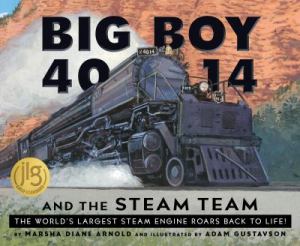
Lynn: Train-lovers, big and small, will love Marsha Diane Arnold’s new picture book, Big Boy 4014 and the Steam Team: the World’s Largest Steam Engine Roars Back to Life (Sleeping Bear Press, 2025). The Big Boys, 25 huge locomotives, were built between 1941 and 1944. They were used to pull extremely heavy loads through the Wasatch Mountains in Utah and were critical in hauling soldiers and military supplies during WWII. So long at 132 feet, the Big Boys had to be articulated to manage curves on the tracks. After the war, diesel locomotives began to replace steam, and Big Boy 4014 pulled her last load in 1959. Eventually, all but 8 were scrapped. 4014 sat in a museum in Pomona, California, for over 50 years.
But in 2013, something amazing happened. The Union Pacific Railroad wanted to celebrate the 150th Anniversary of the Golden Spike – the completion of the 2 ends of the first transcontinental railroad. A Big Boy was needed, and the “Steam Team” had only 6 years to get 4014 operational once more!

Since she sat more than a mile from any track, the first huge task was to move her somehow to the tracks. New tracks and a huge loader got 4014 connected to tracks, where two diesel engines then pushed and pulled her all the way to Cheyenne, Wyoming, and the Union Pacific Steam shop. The Steam Team went to work!

The story chronicles their efforts and ultimate success in getting 4014 rolling once again. Not only did she make the Celebration, she also started on a series of cross-country tours. allowing people around the country a chance to see her roaring past.

Adam Gustavson’s glorious illustrations take full advantage of the extra-wide pages with dynamic scenes and nearly steal the book. He uses perspective wonderfully, providing extraordinary views from above, below, close up, and far away.

Arnold’s text is perfectly suited for young readers but provides ample information for train fanatics. The sound effects make the book a wonderful read-aloud, as does the large size. A lengthy and fascinating Author’s Note with much more historical information and photos is included.

Let your readers roll with this outstanding book, which will be loved by readers of ALL ages.

Island Storm – a Moment in Time

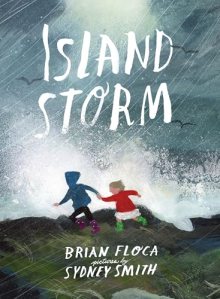
Lynn: In Brian Floca and Sydney Smith’s new book, Island Storm (Neal Porter/Holiday House, 2025), a boy and his small sister set out to “see the sea” as a large thunderstorm brews offshore of their island home. As the clouds gather and the wind increases, the pair, holding hands, push further and further along the coast, past boarded-up vacation homes and into the strangely empty town. At each pause, they push and pull each other and decide to go on. When a thunderous boom shakes the ground, the children turn and race for home as the wind picks up and the rain begins. Cold and wet, they see their mother, searching for them, and fling themselves into her arms. Safe, to be comforted and warmed as the storm rages. The concluding pages depict a calm, beautiful day that follows as the pair explores their beach together.
This gorgeous lyrical book is definitely one of the year’s best for me. Floca’s dynamic evocative text thunders with the sounds of the approaching storm, yet softens with the undercurrent of love and reassurance the children feel for each other and their home. That exciting, slightly scary feel of pushing boundaries is beautifully depicted, as is the undercurrent of a solid understanding of love and protection that surrounds them.

Sydney Smith, whom I deeply admire too, shines here with stunning watercolor and gouache illustrations, all with a deeply affective use of colors, perspectives, panels, and full-page designs. The two children are small against the towering storm, never quite sharply drawn, but clearly the focus of each page as they test their courage, always supporting each other.

Brilliant in every aspect, these two artists create a powerful snapshot of a brief experience, but one that reveals volumes about relationships, experiences, emotions, and childhood.

Frybread and Love at Sandy June’s Legendary Frybread Drive-In!

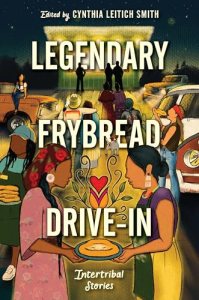
Lynn: 17 Indigenous teens, struggling with a variety of problems: unrequited love, grief, yearning for a future opposite a mother’s dreams, a young singer ready for his first gig, jealousy, stage fright, and more. The stories, each by a different indigenous author, are found in the new anthology, The Legendary Frybread Drive-in (HarperCollins/Heartdrum/2025), edited by Cynthia Leitich-Smith. The stories are tied together by one magical realism element. Manned by legendary elders, Sandy June’s Legendary Frybread Drive-In appears when and where it is needed to  Indigenous teens from reservations all over the country.
Made of plain concrete block with a faded neon sign, Sandy June’s doesn’t look like much, but the food is delicious! Descriptions of frybread, Indian tacos, Buffalo stew, and other dishes made my mouth water!  The food is as healing as the tender, caring guidance of the elders who offer the teens a path to understanding their roots, their inner strengths, and their path – all based on generations of the love and experience of their ancestors.

I am a great fan of short story anthologies! Each new tale is like opening a surprise gift. I often have a chance to meet authors new to me and to discover something by a much-loved author. I especially enjoy anthologies with a theme and watching how the various authors play with that. Critics often deride them as “uneven” but to me, that is code for not liking some of the stories as much as others. That, it seems to me, is also a strength – there is something there for every taste. This charming book checked all the boxes for me. I especially loved the dual themes of the drive-in and the value and caring knowledge of the elders. As a doting grandmother, I highly appreciate this last one.

The stories are united in providing a hopeful ending to the searching teens, something that is important to teens of whatever culture, and especially to those of the indigenous nations. All are sweet without being cloying. They represent many tribes and many areas, and a glossary by chapter is provided for the various languages represented. Short biographies of the 17 authors are also added.

This is a definite purchase for all teen collections and a welcome addition everywhere. It is also just one great fun read! Bring on the frybread!

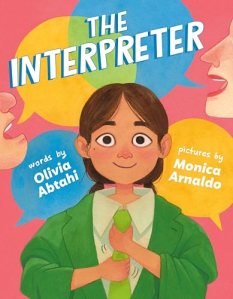
One kid – Two Jobs! The Interpreter by Olivia Abtahi

Lynn: Some background here. I spent my career in a district with a very large ELL population. We’re not big – 7000 kids but 1200 of them are English Language Learners. Over 33 different languages other than English are spoken in our kids’ homes.
SO, I am familiar with searching for resources for our kids, their teachers, AND their families, and there hasn’t been a lot out there. I am heartened by what is being written lately! But, having said that, this extraordinary book touches a chord that will be so deeply heard by kids like ours across the nation. Children are often more capable of learning a new language than their parents, and they are frequently called upon to interpret for them. It is a fact of life in schools and towns in our country, and it puts an immense burden on these students.

Olivia Abtahi nails the issue with her new picture book, The Interpreter (Kokila/Pengin Random, 2025), and while she does it with humor, the truth of it is anything but funny. As she says from the first page, ” Some kids had one job: to be a kid. Cecelia had two.” The young girl in our story loves helping her parents and doing this important job. But it is hard to be this grown-up “professional” interpreter AND be a kid! It is exhausting – and maybe she should have said something earlier. The resolution is hopeful and offers other helpers out there, with parents realizing that their child needs to be a child too.

This is getting long, but I don’t want to leave without highlighting the brilliant illustrations by Monica Arnaldo. Created with watercolors and crayons, Arnoldo uses color masterfully. Pay attention to the color of the speech bubbles, the color green that dominates in the over-reliance on Cecelia in an adult role and in the exaggerated perspectives on the end papers. This is a very kid-appropriate book, but the depth offered in both text and illustrations takes it to another level. I hope the committees are watching this one because it is stellar. Please note too that Cecelia’s oversized green suit waxes and wanes as her responsibilities alter.

This is a book that will speak to so many kids and that librarians and teachers have been wishing for. A must purchase, whether your population is non-English speaking or not.

Can Composting be Fun?

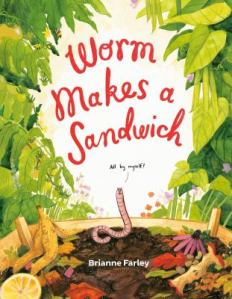
Lynn: I would have thought composting would be one of the last subjects that could make an engaging picture book but Brianne Farley has done just that with Worm Makes a Sandwich (Putnam/Penguin Random, 2025). Farley comes at the subject somewhat sideways but this approach takes a potentially muddy subject and makes it funny and appealing to a young audience.
Pink and very polite, little worm asks readers if he can make them a sandwich.

“I know what you’re thinking…Worms don’t have hands. Worms cannot make sandwiches!”

Worm starts making the sandwich with delectable garbage, Sorry – NOT for your sandwich, the garbage is for me he tells us. And over the next pages, worm narrates while a little girl goes through the processes of adding garbage to a compost pile, then insect poop and the resulting dirt to the garden. Seed planting is next, and a lot of waiting for the plants to grow.

At one dark moment, worm has deep self-doubts about the success of this sandwich, but a red ripe tomato on the vine saves the day. And, indeed, the child makes a delicious sandwich with the tomato, allowing the worm to preen. A comic little touch at the end is a perfect dessert to follow.

Kids will love the story and the illustrations, which are created in watercolors, gouache, and colored pencils, and have wonderfully varied perspectives. Along the way with all the giggles, kids will learn a LOT about composting and how to do it.

Helpful back matter includes more information on composting, how to do it, what to use, the equipment needed, and why we should all be doing this.

The story is a fun read-aloud for classrooms, story hours, and laptime reading, and is an ideal STEM book. If you had no hands, could you make a sandwich?

Readers Will Agree – Everything is Tuberculosis

Lynn: John Green is angry and by the time readers finish this new venture into adult non-fiction, Everything is Tuberculosis: The History and Persistence of Our Deadliest Infection (Crash Course/Penguin Random, 2025), they will be angry too! Green, a true star of YA literature, has moved lately into adult books and this non-fiction examination of tuberculosis, its history, impact, and on-going global dominance, is eye-opening and disturbing. It is also a very personal story about Green’s meeting with Henry, a young TB patient in Sierra Leone. Green becomes friends with Henry and the progression of his disease is a centerpiece for the book.
TB has been part of the human story for as long as humans have been around. Signs of it were found in Egyptian mummies and it was present in ancient China and the pre-Columbian Americas. It affected culture, fashion, politics, and literature and it was not clearly understood until the late 1880’s when its cause was identified as a bacteria. It took until the 1950’s before it was curable with antibiotics and the number of cases dropped sharply.

And yet, TB is still present and over one million people will die of tuberculosis this year alone! The disease, its evolution to an antibiotic-resistant strain, and its ongoing stigma are horribly impacting large populations of the world – especially places with war, poverty, racism, and scarce medical facilities. People are dying who shouldn’t, and by and large, the Western world doesn’t care enough to send help. That situation has intensified with the Trump cuts, and Green’s frustration is sure to be shared by every reader.

This is a fascinating story and a horrifying one. It is packed with historical and medical details that demand to be shared. It is a “listen-to-this” book and anyone reading it will start to see how tuberculosis is indeed everything in our past and current history.

While published adult, this is a great choice for teen collections.

A Touch of Fun Helps the Learning Go Down – in The Iguanodon’s Horn

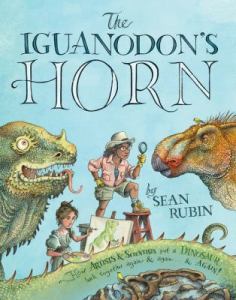
Lynn: If you describe a book as being a terrific educational book, most kids will RUN the other way! Happily, for all of us who hope kids will love science and learning, there are a lot of deeply educational books that are so much fun that kids will demand to read them over and over – even in the summer! Sean Rubin’s The Iguanodon’s Horn (Clarion, 2024) is a wonderful example of such a treasure. That it is about dinosaurs is a special bonus.
Author/illustrator Rubin examines a critically important issue in this appealing book: how does scientific thought work? In a time when so many people disdain science and the scientific process, this understanding is crucial for humankind. Rubin uses a child-favorite subject to illustrate the topic and kids will learn so much and hopefully come away with a firm grasp of the fact that science is a process that never ends.

In 1822  – not THAT long ago – Mary Ann Mantell was strolling the beach with her husband and she stumbled over a curious bone. Her husband shared the odd bone with other scientists and they concluded it came from something unusual, which they called an Iguanodon. As they found more bones, they wondered what a whole iguanodon would look like. Their guesses were wildly wrong as were the many scientists who tried to solve the puzzle. As more bones were found and more information gained over the years, theories about Iguanodons – and dinosaurs in general – changed drastically.

Rubin fills his pages with a glorious array of the many ways iguanodon’s appearance changed over time as scientists gained more information that altered their ideas. Full of comedic details, the illustrations are a delight that will entrance kids for hours. Rubin used graphite pencil, digital and physical watercolor washes, and paint splatter to great effect. Author Endnotes provide more information about what is featured on each page and is as much fun to read as the book itself. Rubin concludes the book with challenges to young readers to think about how what we know about the Iguanodon and other dinosaurs could change in the future. 

The book’s overall appearance is an irresistible kid magnet and is sure to fly off the shelves. I think kids will absorb the important teaching of the book while enjoying every page! This is a must purchase for libraries, STEM classrooms, and for little dinosaur-enthusiasts everywhere. 

The Artful Science of Cooking – Fannie Farmer Brings Measurement to Recipes

Lynn: I love how science can be found everywhere! The importance of ratio, reactions, and measurement is as important to great food as the ingredients themselves. But that understanding wasn’t considered important until a young cook named Fannie Farmer started thinking about recipes and culinary instruction in the late 1800s.
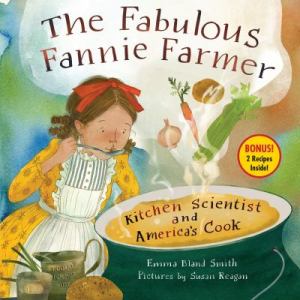
Emma Bland Smith brings Fannie’s story to readers in her fascinating new picture book, The Fabulous Fannie Farmer: Kitchen Scientist and American Cook (Astra/Calkins Creek, 2024). There is so much to talk about here, but I’ll try to stay with the best ingredients and let your interest rise. Fannie Farmer grew up in a time when home cooking was considered a woman’s activity and therefore not really worthy of the respect shown to the great male chefs. Girls learned to cook from their mothers with recipes passed down through the generations and cooking was considered a womanly instinct. A lump of this, a pinch of that, as many egg yolks as necessary were all the measurements anyone needed!

Young Fannie’s dreams were of becoming a teacher, but those evaporated when Fannie, at age 16, contracted polio and was bedridden for several years. Cooking was her therapy and Fannie became an excellent cook as she recovered. With encouragement from friends, 31-year-old Fannie decided to enroll in the Boston Cooking School in 1888, and there, her talents as a teacher, cook, and scientist came together. Wanting to help home cooks produce reliable, excellent, and nutritious meals, Fannie began to measure, test, observe, and record her recipes. Students flocked to her classes, and in 1894, Fannie approached publishers with the Boston Cooking School Cookbook, which she had revised and rewritten. The publisher was skeptical but Fannie’s cookbook was an instant success, selling over 300,000 copies in her lifetime and over 7 million to date.

Emma Bland Smith’s clear, age-appropriate writing manages to be fun and fascinating while incorporating historical background and making this a terrific book for starting discussions on the scientific method, women’s roles in history, and the science of cooking. The book’s appeal is heightened by the charming watercolor illustrations by Susan Reagan. As to be expected with a Calkin’s Creek book, the back matter is outstanding, providing additional information on Farmer and her legacy, the science of measurement, polio, the development of the American recipe, resources for young readers, a Timeline, and wonderful historic photographs.

This is a great choice for all elementary libraries and STEM classes while still being an excellent read-aloud and discussion starter. Enjoy!

Want to Escape? Try The Zebra’s Great Escape!

Lynn: zebra's great escapeMany of us may be looking for books about escapes, good over evil, and with touches of humor, now more than ever.

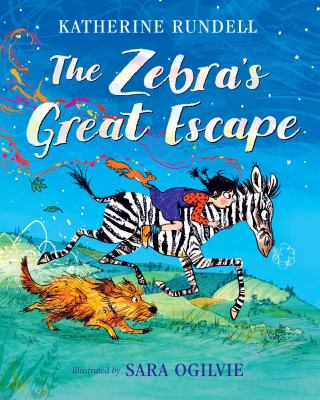
Katherine Rundell’s latest, The Zebra’s Great Escape(S&S, 2024), is a perfect example, her first for a younger audience, and it is a delight. Longer than the usual picture book, this is divided into 3 parts, which makes handy stopping points for a younger child’s bedtime reading. But who will want to stop???

Meet Mink, a child who doesn’t believe in bedtimes. Out late playing, she meets a baby zebra and discovers he and all animals can talk through colors and feelings in her mind. When the baby begs for help, Mink takes him home where he tells her his story of his parents being stolen by an evil man and taken away in a cage. Gabriel, for that is the zebra’s name, has been searching ever since.

Mink, with the help of the grumpy dog next door and other nearby animals, discovers the zebras are being held in a faraway country house by an evil man, Mr. Spit. They are off to the rescue.

Rundell uses words with magical skill. She respects her young readers and her vocabulary choices are challenging but the meaning is made clear through context. The story is paced to increase the readers’ engagement and suspense and she provides a terrifically evil villain they will love to hate. The conclusion is delightfully satisfying.

Enhancing the story are Sara Ogilvie’s illustrations, which have a slightly Edward Gorey feel to them. She uses digital and hand-drawn illustrations, rich colors, and details with a perfect humorous touch.

The entire package is a delight and one that is bound to be read over and over. I missed this one when it came out but please grab this for a your own great escape.