Peter Reynolds’ Be You! – Inspiring Even for Curmudgeons

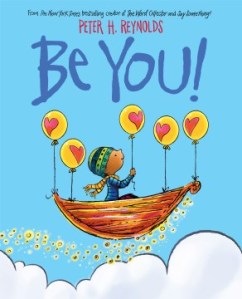
Lynn: One of us here at Bookends is something of a curmudgeon when it comes to “inspirational” books. Ahem, I will leave you to guess which one of us it is but let me just say that one of us usually finds such books waay too sweet, gooey, and simplistic. Eye rolling is also quite often occurs during reading them. However, a notable exception to this prejudice happened when I, oops, when WE read Reynolds’ wonderful new picture book, Be You! (Scholastic, March 2020).

Yes, it is bright and cheery. Yes, it is filled with positive aphorisms. Yes, it is encouraging and uplifting. It even has hearts on the cover and teachable moments in the text!  But, happily, it is also fun, quirky, genuinely sweet and yes, quite inspiring!  Somehow it avoids being treacly and neither of us rolled our eyes once. The text manages to be encouraging but straightforward. The illustrations expand the text with real charm and humor and the attributes addressed are those kids will respond to.

I have a grandson who definitely marches to the beat of his own tambourine Reynolds’ book is made for kids like him. Yay!

Cindy: It’s true, Lynn’s idea of a self-help or inspirational book is a hard-core science fiction read. 😉 She leans to the escapist vs. introspective rule of thumb. But she knows a gem when she sees one and I shouldn’t pick on her further as everyone should be encouraged to “Be You!” The advice here to “Be Curious” or “Be Adventurous” or hardest perhaps, to “Be Patient” is delivered with a charming illustration and an additional suggestion of just how to do that. For instance, “Be Patient” has a young girl lounging on a big clock and the wise advice we all need at such times:

Being more you takes time.
Take a deep breath. Relax.
Let your future unfold at its own pace.
It will be worth the wait.

This book is one for all ages. I’m eager to give it to my middle school counselors. It’s also one that would make a great graduation gift book. Coincidentally, my library secretary saw our review copy of Say Something and thought we should encourage our middle school students to find positive things to say. We created a bulletin board based on his book. We hope to get some teachers to play along and have their students create their own speech bubbles to post around the school. We can all use a little inspiration during the bleak winter days, right?

Celebrating Pluto in Out-of-This World Picture Books

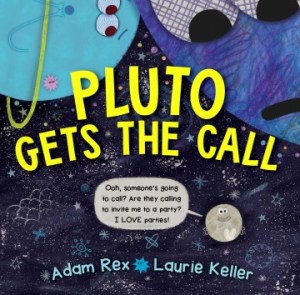
Lynn: Who doesn’t love an underdog or in this case an underplanet? Lots of us have been rooting for Pluto ever since it got reclassified as an ice dwarf a while ago. Adam Rex tops my planetary chart though with his hilarious AND informative new picture book on Pluto, Pluto Gets the Call (S&S/Beach Lane, 2019). Cindy and I were lucky enough to get to see illustrator Laurie Keller’s artwork for the book at a preview luncheon at ALA and we fell in love with the book way back then. The finished copy is now out and the wait has been worth it!
Pluto is all set to take us on a tour of the solar system when he gets a call. Yes, THE call from scientists on Earth with the distressing news that our googly-eyed tour guide has been demoted. Sadly but gamely, Pluto goes on with the tour, introducing us to the “real” planets and providing solid information on each one along the way. Skipping Earth because he “doesn’t want to talk about humans right now,” Pluto finally makes it to the Sun who cheers him up and reminds him that scientists are still arguing about him. Solar System facts are incorporated throughout the story in a way that kids will delight in and remember. A two-page spread as back matter also provides a wealth of additional information from the number of moons each planet has, the distance from the sun and what the planets were named after and more. Adam Rex’s bubble-speech dialog is snappy and packed with great one-liners kids will love. Laurie Keller’s terrific comic-style illustrations are colorful and funny and a perfect extension of Rex’s text.

This is a must-have addition to collections everywhere needing updated information on Pluto and the Solar System! This one is truly out-of-this-world.


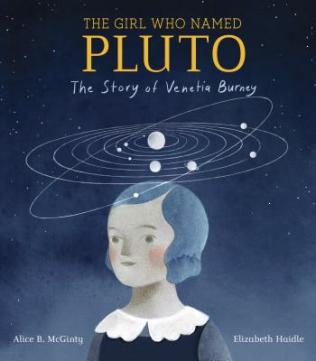
Cindy: Pair Rex and Keller’s book with The Girl Who Named Pluto: The story of Venetia Burney (Schwartz & Wade, 2019) for a little history about Pluto. Author Alice B. McGinty tells the story of Venetia, a young British girl, who was fascinated when she learned in 1930 that a new planet had been discovered. The granddaughter of the Oxford head librarian and great-niece of a science master who named the two moons that orbit Mars, she came by her curiosity and love of science quite naturally. The book opens with a classroom walking/measuring demonstration of the distance between planets that many elementary teachers still use today. When Venetia learned about the new planet from her grandfather, she thought of how “frozen, dark, and lifeless” Pluto must be and she was reminded of the Roman myth underworld, ruled by Neptune’s brother, Pluto. Her grandfather likes the name and writes a letter to put it forward as a suggestion. Elizabeth Haidle’s illustrations provide the right atmosphere and an author’s note provides more history about Venetia, including a great connection to a recent student-built instrument aboard the New Horizons robotic spacecraft that has several connections to the young girl who named the Pluto.

Broken Strings – Healing Hearts: A Middle Grade Holocaust Tale

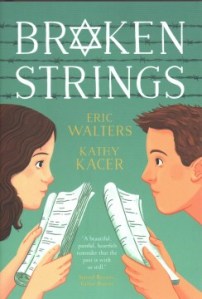
Lynn: Veteran authors Eric Walters and Kathy Kacer have joined forces in their new middle-grade novel, Broken Strings (Penguin/Puffin Canada, 2019) and the result is a complex, layered and very moving story that shouldn’t be missed.
There is a lot going in this book! Set in 2002 in the aftermath of the attack on the towers, Shirli Berman, a 7th grader, is disappointed to learn that she has been cast in the role of Goldi instead of Hodel in the musical Fiddler on the Roof. Shirli rallies though and goes looking for possible costumes and props in the attic of her grandfather’s house. There Shirli is shocked to discover an old violin and a poster showing her grandfather as a young boy with what looks like a family group all posed with instruments. Zayde had never allowed music in the house nor had he ever attended any of Shirli’s recitals or performances. When she takes her discoveries down to her grandfather, he is deeply shocked and then angry. Confused and hurt, Shirli goes back a few days later with her father and then for the first time, Zayde begins to talk about his family and his past.

Slowly over the course of the next few months, the family learns about their Polish family who were a traveling Klezmer band, moving from village to village. When the Nazis took over Poland, the family managed to stay unnoticed at first and then hid in the forest until they were eventually captured and sent to Auschwitz. Stubbornly carrying his violin during the capture and transport, Zayde was conscripted in a camp orchestra and forced to play as each new transport arrived and the Jewish prisoners were sorted with most sent to their deaths. Shirli’s Zayde was the only survivor from his family and after the war, he put music aside forever until Shirli’s discovery opened the door to the beginnings of healing.

The authors do an outstanding job of providing this history for young readers, connecting it to the history of the Sept. 11th attack and examining issues of prejudice, hatred, and oppression in a way that is never heavy-handed but thoughtful and relevant for today. Plot threads of the middle school musical production and a sweet first crush provide a bit of lightness and help keep the interest high. The role and power of music is also a theme that flows throughout the story and young musicians will find much here to think about.

This piece of Holocaust history was new to me too and with Fiddler on the Roof being a personal favorite, I too learned and was deeply moved by the story. An Author’s Note at the end provides additional historical information.

Celebrating the Book – Picture Books for Bibliophiles of All Ages

Bibliophiles come in all ages. Young or old, we share a common bond, a deep and abiding love of books. Even in this fast-paced digital age, we bibliophiles prosper, enriched and strengthened by this mutual ingrained passion. Don’t believe the current folk wisdom. Kids still love books. We see this in our book club and in our schools. Kids still want to hold books, absorb them, collect them, read them over and over, and protect them. Here are two heartfelt picture books that celebrate books and the readers that love them. The holidays are coming fast and these would make treasured gifts to the bibliophiles, both young AND old, on your list.

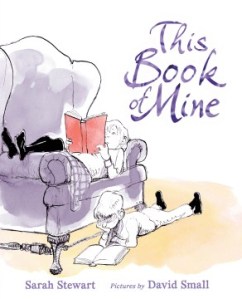
Lynn: This Book of Mine (Farrar, 2019) is by the renown writing-illustrating team Sarah Stewart and David Small. Stewart’s simple rhyming text celebrates the many ways that readers use books: to be a friend, to comfort after a scary dream, to spark imagination or sometimes just to smell that wonderful booky smell. Small’s charming and humorous illustrations fill the pages in warm shades of purple with a bright splash of color highlighting the book on each page. The cast of characters is diverse in age and race but clearly linked in their shared love of books. A New York Public Library lion is featured on the first and last page of the book in a lovely coda. Appropriate for our youngest bibliophiles as well as those of us who have been turning pages for many decades.


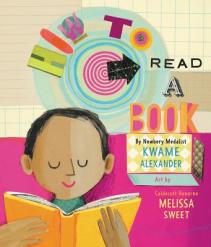
Cindy: You won’t be able to miss the neon-bright cover of How to Read a Book (HarperCollins, 2019) by Kwame Alexander and illustrated by Melissa Sweet. This dream team creates something new and fresh with Alexander’s encouraging how-to poem for experiencing a book with all of your senses paired with Sweet’s electrifying collage art. I’m an unabashed fan of Sweet’s artistry, and she stretches yet again with this one. The color palette wakes the reader to the joys of reading. This is no passive act, but one that wakes you if you dig into that clementine and let the juices drip down your chin! A number of creative paper delights await in the turning of these pages. Lynn and I were lucky enough to see some of the original art at a publisher event at the American Library Association and we were in awe. I so want to play in Melissa’s studio!
Don’t miss the author and illustrator notes that provide lovely stories about the creating of this special book.

Kwame’s advice is appropriate for any book, but certainly especially so for both of these visual poetic treats celebrating the wonder of books.

“Don’t rush though:
your eyes need
time to taste.
Your soul needs
room to bloom.”

Picture Books about SCARY Appetites

Stories about scary appetites seem especially fascinating to kids – and if it is all a little gross all the better! Just think for a moment about how many fairy tales you know that have eating terrible things at their center? Remember the witch in Hansel and Gretel, fattening up Hans for the oven, the giant in Jack and the Beanstalk who is going to eat men’s bones or the troll under the bridge who wants the 3 Billy Goats Gruff for breakfast? We’ve recently found two terrific new picture books that take the theme of scary appetites and run with it.

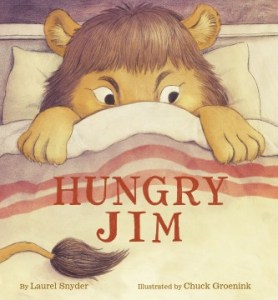
Lynn: Hungry Jim (Chronicle, 2019) by Laurel Snyder is a tale about Jim who wakes up as a lion one morning AND a beastly appetite. When his mother calls him for breakfast, Jim discovers she looks delicious! He didn’t want to eat his mother but… and she WAS delicious! But he was still hungry and the more he ate, the hungrier and wilder he gets until he meets something as big and wild as he is.

This is a hilarious story about the hungry beast we sometimes wake up as and a wonderful tribute to Maurice Sendak who first understood about the wild beast inside all of us. Laurel Snyder’s text is pitch-perfect with an opening sentence that will grab the attention of every kid in the room! Chuck Groenink’s illustrations are equally terrific using lots of 2-page spreads, warm tones, and different perspectives. There is definitely a wild-things feel to the book but it is also very definitely it’s own creation.

Wonderful to use with a group or as a lap book, to use as a discussion starter or writing prompt or simply to enjoy!

Cindy: Families, food, and storytelling combine in this wild tale about Octopus Stew (Holiday House, 2019) by Eric Velasquez. Based on a family story of the time that Eric’s father had to rescue Eric and his grandmother from an overflowing octopus pot, the character Ramsey puts on his superhero cape and finds a way to defeat the ginormous octopus that has his grandmother wrapped in its tentacled arms. The text is infused with Spanish phrases, listed in a glossary in the back. Velasquez’s vibrant action-packed scenes and crazy adventure move the story along quickly, although a foldout spread adds a new dimension to the storytelling. The book jacket blurb presents the option of opening these fold-out pages or skipping them. The choice is yours, but, really, who could resist? The yellow endpapers with white octopus slice rings are a nice touch to the package. (The octopus might not agree!) The back matter also includes an author’s note encouraging the sharing of food and stories and the recipe to try making your own Octopus Stew…grab your copy now and switch up the turkey leftovers with something different!

Cindy and Lynn: As we publish this food-rich post the week of Thanksgiving in the U.S., we want to extend our thanks to our readers who followed us to our new blog home here at Bookendsblog.net. We’re also grateful for those of you who have found us recently. If you find our posts valuable, please share our link with a friend, a teacher, a librarian, or a parent who might enjoy them as well. Thanks!

The Moose of Ewenki: A Picture Book for All Ages

Lynn: One of the great joys of the children’s publishing world today is the small publishers bringing us books from other countries and cultures. This is such a gift to young readers whose understanding of the world will be enriched and expanded by these wonderful books. One of those publishers is Greystone Kids, a Canadian publisher of books by both Canadian and international authors. We have fallen in love with a new book from them, The Moose of Ewenki (Greystone, 2019) by Chinese author, Gerelchimeg Blackcrane and illustrated by Chinese artist Jiu Er.

Set in far northern forests of Mongolia, the story tells of an elder of Ewenki people, a hunter and herder of reindeer, who shoots a moose only to discover sadly that she had a young calf. The little creature follows the old hunter back to his campsite where he feeds and cares for it. Gree Shek names the calf, Xiao Han or Little Moose and raises the baby, including him in his daily life of caring for the reindeer herd, foraging for food and visiting the local village. Little Moose thrives and grows – and grows! In time he grows to adult size but thinks he should still sleep in Gree Shek’s tent, follows him everywhere and doesn’t seem to understand how big he is. After a series of mishaps and dangers, Gree Shek, who is growing older and frailer, realizes that for Little Moose’s own safety he must go into the forest. In some sad scenes that follow, he drives the young moose away and then the old man dies one night in his sleep. The hunters who find him, honor the old hunter by freeing his reindeer herd to join the moose in the forests.

This bittersweet story is full of both humor and tears, an evocative reflection of the life of the Ewenki people. Gree Shek and Little Moose stole my heart and no one who sees Jiu Er’s stunning illustrations will be able to resist this gorgeous book. But, I’ll let Cindy tell you about those!

Cindy: Animal-human bonding stories are popular in children’s literature but this one is a surprise. First, the setting…Inner Mongolia…a region we don’t see often in children’s literature. And then Xiao Han, “Little Moose,” who isn’t so little for long. I couldn’t help but get a flashback to one of my childhood favorites, The Enormous Egg by Oliver Butterworth, but it didn’t linger as this is a very different book, of course. Little Moose peeks out from a bush on the title page but when he steps out from the bush a few pages later his timid gaze will melt the reader’s heart. The illustrations enhance the powerful story beautifully. Full-page spreads are interspersed with smaller vignettes that bring the landscape and its inhabitants to life. Creamy colored paper is perfect for the muted nature palette drawings that convey the humor and the sadness in this gentle story. A Junior Library Guild Section. Don’t miss it.

Graphic Novel Round-Up – Something for Every Reader

Lynn and Cindy: A flock of fabulous graphic novels has swept onto our doorsteps lately and we’ve been happily flying through them. There’s something here for every interest and every age and we’ve been loving them all. Here’s a quick round-up of some of what we’ve been enjoying, starting with graphic novels for high school readers and moving on through to one for our youngest readers.

Laura Dean Keeps Breaking Up with Me, by Mariko Tamaki (First Second, 2019)

This is an absolutely brilliant look at love in a toxic relationship. Charismatic Laura Dean flies in and out of Freddie’s life, bewitching and beguiling her, taking complete advantage of Freddie’s adoration, stomping on her heart whenever she feels like it and leaving Freddie diminished at every turn.

We’ve all watched relationships like this. Maybe we’ve been IN a relationship like this. Tamaki nails the dynamics, the helpless attraction, the hurt that grows bigger and more destructive each time and the hope that THIS time will be different. Masterfully nuanced illustrations heighten the sense of being there and watching a dear friend walk back into the buzzsaw once again. High Schoolers exploring relationships will love and learn from this story.

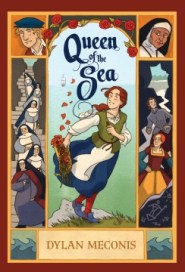
Queen of the Sea, by Dylan Meconis (Walker, 2019)

A stunningly beautiful graphic story loosely based on the history of Elizabeth I and Mary Queen of Scots. While it was fun to notice the parallels, it isn’t necessary to know the history as Meconis creates her own richly immersive story full of period details, evocative characters, and vivid setting. The main protagonist, Margaret, an orphaned child who came to the island surrounded in mystery, is instantly endearing and readers experience the unfolding events along with her.

Meconis’ illustrations are gorgeous but they are also a brilliant part of the storytelling. Each panel has its own part to play in carrying the tale forward, providing important details and developing the characters. This is a visual treat but it is also masterful graphic storytelling. Readers ranging from high school to upper elementary will love the characters, the warmly human touches of humor, the historical feel, the fascinating political intrigue and the feel of an illuminated manuscript. Outstanding book design adds to all these masterfully done elements to make this an imaginative and immersive reading experience.

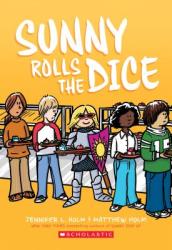
Sunny Rolls the Dice, by Jennifer L. and Matthew Holm (Graphix, 2019)

Middle school is fraught with changing friendships as tweens shift interests, alliances, and struggle to be “cool.” Some mature more quickly than others, some don’t care what others think, and some long for acceptance by a popular group, or are distraught when good friends leave them by the wayside. As a middle school librarian, I’ve watched these friendship struggles for decades. The Holms have captured the essence of this passage in this newest book in the series that started with Sunny Side Up. Sunny’s best friend has discovered boys, fashion, and makeup while Sunny doesn’t understand why they can’t pursue those interests while still playing Dungeons & Dragons with boys they are only trying to slay in the game. 70s memories of the perils of hot rollers and smelly rental roller skates bring the setting alive for those of us who lived through it…and it’s fun historical fiction with a timeless look at friendship for the intended audience.

Guts, by Raina Telgemeier (Graphix, 2019)

Does this book need promotion? Probably not, but given the reception it’s received in my middle school, not because it is Raina’s new book, but due to the subject matter, it’s worth highlighting to be sure you don’t miss it. Telgemeier continues her graphic memoir series with this new entry about what anxiety can do physically and mentally to a child (or an adult). Scholastic published an initial print run of 1 million copies, according to this Forbes! article about the release. Grab your copies quickly, they are already thinking of a second run to meet demand.

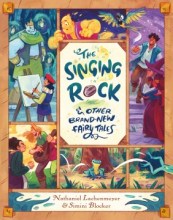
The Singing Rock & Other Brand-New Fairy Tales, by Nathaniel Lachenmeyer (First Second, 2019)

Here’s a graphic novel that is great for the Gr. 2-6 set. Bright, funny and also gorgeously illustrated stories tell four slightly twisted fairy tales that are joyful hoot.

Perfect for the young child who will appreciate the humor and I think middle school kids would love it if they’d be brave enough to look past the young appearance of the book. Besides being wonderful fun, this would make a GREAT writing prompt.


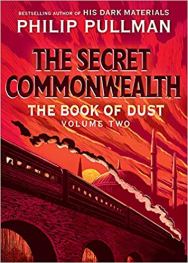
Book of Dust: The Secret Commonwealth – Masterful Storytelling

Lynn:  Ask a reader what they are looking for in a book and you will get a myriad of answers. Some want to be informed, others seek to be uplifted, diverted, or entertained. Some readers want a thriller, or a mystery, while others want romance, a good laugh, or a satisfying cry. But I am convinced that what is basic to all readers is the love of story. There are few writers working today who tell a better story than Philip Pullman. Since The Golden Compass (Random/Knopf, 1995) burst into the children’s book world, Pullman has enthralled readers. He has also challenged, enraged, confused, and astonished readers at times but his richly inventive books have never failed to weave a story like no other.
His latest, The Secret Commonwealth (Random/Knopf, 2019) has just published and I dropped everything else to read it. I will admit to groaning when I first got it and discovered that it was 633 pages long! As a book reviewer with towering stacks of books waiting to be read, that 633 pages meant that 3 other books got pushed way back in the queue! But Pullman worked his magic again and I was snared from the first word, sinking with exquisite pleasure back into Lyra’s world. I speak from the heart here when I say that I was immediately deeply immersed in the story. 633 pages flew by. I hated having to put the book down, thought about it when I wasn’t reading it, and found every reason to return to it. I’m thinking about it still. Philip Pullman is a master storyteller and this book should not be missed.

Plot??? I can’t begin to do it justice. Let’s just say that this is 8 years after The Amber Spyglass (Random/Knopf, 2000) and 20 after the events of La Belle Sauvage (Random/Knopf, 2017). Lyra is now 20, a student at St. Sophia’s College, and deeply miserable because she and her daemon Pantalaimon have quarreled seriously and are barely speaking to each other. Can you hate your own soul? Authoritarianism is rising, there are desperate immigrants fleeing horrors in their homeland, once benign governments shaping information to manipulate their citizens, brutal terrorists, and cynicism and scorn rule. There are journeys and mysteries, love and sacrifice, hope and despair, good people and bad, and of course, the question of the secret commonwealth. This is a magnificent sweeping story and I loved every word. There is also a whopping cliff-hanger that has left me bereft as I try to calculate how long I have to wait till the next book. This reader cannot wait.

Cindy: A few weeks ago, before even realizing that The Book of Dust, book 2, was imminent, I showed the HBO His Dark Materials book trailer to my 8th graders before book talks. Every copy of The Golden Compass circulated, something I hadn’t achieved through my booktalks. The first episode of the HBO series airs November 3rd. Then Lynn alerted me to her reserved library copy of The Secret Commonwealth and I ordered the audiobook immediately. I am happily immersed in the story, about halfway through, and can’t wait to get back in my car each day. Lyra and Pantalaimon’s arguments are fierce and heartbreaking and the narration makes them come painfully to life. Michael Sheen did such a beautiful job narrating La Belle Sauvage that I knew I wanted to listen again. It will take me longer to read it, but as Lynn said, we don’t want this story to end.

Games of Deception – Basketball and History on the Brink of War

Lynn: Did you know the championship game of the first Olympic Basketball game was played on a converted tennis court and so much rain fell, the court looked like a “kiddie swimming pool?” Or that the inventor of the game, James Naismith, came to the Olympics but was refused admission to the first game? Or that while the male athletes had luxurious quarters with fantastic plentiful food, the female athletes were housed in a dormitory and fed on a sparse diet of boiled cabbage and sausage?

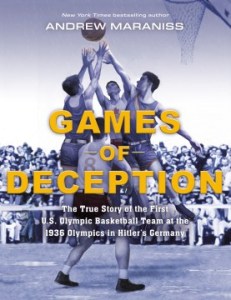
Andrew Maraniss packs Games of Deception: The True Story of the First U.S. Olympic Basketball Team at the 1936 Olympics in Hitler’s Germany (Penguin/Philomel 2019) with fascinating sports tidbits like this and provides a breathless sense of being an eye-witness at these pivotal games. While the sports information is terrific, Maraniss is doing a lot more than historical play-by-play. The modern Olympics have always given us a window on the social and political events of their time but the 1936 games especially so. A crippling economic depression still gripped the world, Germany was preparing for war, the forces of racial, religious and gender prejudices and systemic discrimination afflicted people everywhere and the growing fanaticism of nationalistic hatred was intensifying. The Germans deliberately used the games to create a benign image of Nazism and while many were fooled, the truth was seen by a worried minority.

Maraniss does an excellent job of providing the complicated background of this intense and fraught period of history for young people, including information on the political, social, and economic situation as well as the origins of the game of basketball, the state of the game, and its inclusion in the Olympic games as a medal sport. And in a subject that will stand out to teen readers, he paints a horrifying picture of a state deliberately manipulating the truth to deceive the entire world.

With a broad array of primary sources, Maraniss includes the recollections of the team members, coaches, other athletes, and sportswriters of the day and their stories add a lively personal touch to the book. Often humorous, sometimes rueful, these accounts do a wonderful job of giving readers a sense of the attitudes and experiences of the moment. And in important concluding chapters, Maraniss also includes the stories of what happened to the athletes when they returned home. I especially enjoyed the Afterword chapter where the author writes about the origins of the book and his extensive research. Back matter includes excellent documentation and statistics.

This fascinating book will interest a wide range of readers, celebrating the first Olympic basketball competition, and placing it vividly in a critical moment of history.

Bringing Down a President – A History for Today’s Teens

Lynn: With the term impeachment on everyone’s minds, Bringing Down a President: The Watergate Scandal (Roaring Brook, 2019) by Andrea Balis and Elizabeth Levy couldn’t be more timely!

In chronological order, the authors take readers step-by-step through the events of the unfolding Watergate scandal and the resignation of President Nixon. Beginning with the day Nixon installed the secret recording devices in the White House that became so pivotal, the authors then move to the break-in of the Democratic headquarters and follow the chain of events that brought down a presidency. The narrative device used by the authors called “Fly on the Wall” is chatty and irreverent but it clearly distinguishes between actual quotations and clarifying expositions that will help teen readers to sort through the convoluted issues of what was said in public, what was said in secret, and what lay at the heart of the actions of the Nixon staff.

For all of its light approach, the book is very clear on the moral and constitutional elements at the heart of the scandal and it is startling how many of these same elements are in play today on the national scene. Nixon’s statement that “When the President does it, that means that it is not illegal” is strongly disputed here with a legal and constitutional basis for this contention. Balis and Levy do an excellent job of presenting a clear accounting of who did what when and why it mattered. Having lived through this unfolding scandal, I remember the confusion, doubt, and fear that afflicted most of us and I think the authors do an excellent job of conveying the prevailing culture of public trust in the government that had mostly existed at the time and the impact of the scandal both then and on today’s cynical climate of distrust and suspicion.

Back matter includes a terrific Timeline (how I wish I’d had THIS at the time) and outstanding Source Notes. Throughout the book, the authors make it clear why accurate sources are critical to the accounting and in this time of political ambiguity, the authors are also clear on what is morally and legally right and what is not. Wonderful black and white illustration add to this lively you-are-there accounting. Fascinating and important!