Who Doesn’t Love Sloths? Check Out these New Picture Books

Lynn:Happy Sloth Day I’ve yet to meet anyone who doesn’t smile upon seeing a picture of a sloth and I guarantee the two books in today’s post will spend very little time on the library shelf! There is something about these unique and fascinating creatures that we humans respond to immediately.

Happy Sloth Day (S&S/Beach Lane, 2022) by the acclaimed author April Pulley Sayre and photographer co-author Jeff Sayre. This wife and husband team spent 8 years photographing sloths in the Panamanian rain forest and learning about this truly amazing animal. The book is a terrific blend of poetry, eye-catching photographs and solid factual information. It is wonderfully child-centered in every way. The poetry is a delight to read aloud, loaded with vivid colorful language.

A tree is a sloth salad

Rip! Snip! Chew. Chew”

Jeff Sayre’s photographs are masterful and a real joy to see. Since these creatures live high in the rain forest canopy, the sheer difficulty of the photographic work is especially notable. Sidebars provide extensive factual information about the sloths and the creatures they interact with. In the back matter, two pages of additional sloth science is presented. This is an absolutely delightful book to read for pleasure and equally well suited to non-fiction reading and reports.

Adventures of Dr. SlothThe Adventures of Dr. Sloth: Rebecca Cliffe and Her Quest to Protect Sloths (Millbrook, 2022) by Suzi Eszterhas.

Another outstanding wildlife photographer and author, Suzi Eszterhas also has a fascinating book with enchanting photographs and solid factual information about sloths. Her book, however, focuses on a scientist who is currently doing ground-breaking work studying this complex animal. Very little was actually known about sloths, partly because studying them is a difficult challenge. Eszterhas and Cliffe have become friends and the book presents an excellent look at what the work of a biologist is really like from examining sloth poo, to scaling giant trees to creating sloth backpacks to track and record daily activities of a wild sloth.

Cliffe, who wanted to be a scientist from a very young age, is also deeply involved in sloth conservation as these amazing creatures are threatened in their habitats.Information is provided on how young readers can help protect sloths and back matter includes a glossary, and list of additional resources.

These two outstanding books are must purchases and will have instant waiting lists!
“A Double Dose of Hard” – a New Middle Grade Book About Figuring Out the Rules of Life

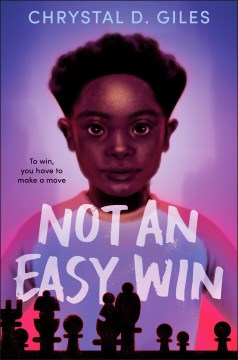
Lynn: Not an easy winLawrence and his family have had a “double dose of hard” lately. In Chrystal D. Giles new book, Not an Easy Win (Random, 2023), Lawrence’s dad is in prison, he, his mom and sister have had to move three times since and now are staying with their unwelcoming grandmother. In his new school, where Lawrence is a rare boy of color, the bullies line up to beat him up and as the story opens he is expelled for fighting. His mother negotiates his finishing 7th grade in an online program and he has to spend the day working at the rec center, an after-school program for kids. There, Lawrence discovers a chess program, a group of friends, and an enemy who might have been a friend..
Giles puts readers squarely in the shoes of 12-year-old Lawrence, doing a masterful job of walking us through the painfully authentic emotions of this endearing tween struggling to understand his upside down world and find his way. Lawrence feels that somehow everything that has happened to his family is his fault while at the same time, he is sure he is being blamed unfairly for everything – a feeling that will connect with 6th graders everywhere. Fascinated by the game of chess, Lawrence develops not only the skills for the game but for managing his temper and dealing with the issues in his life. It is done with great finesse and Lawrence’s progress and set-backs feel true.

The entire cast of characters is vivid and fully rounded from his stressed cranky grandmother, to the kids at the rec center and even to his absent father. Lawrence and his hard-fought wins are as heart-warming as they are believable. I was rooting for him from page one and so will very reader! Check!

A Grandmother’s Love – Jordan Scott’s New Picture Book

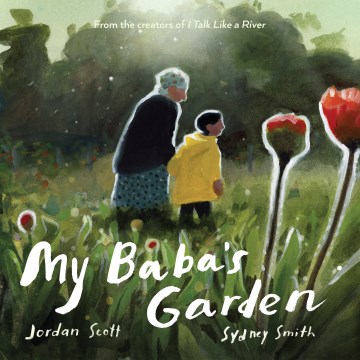
Lynn:My Baba's Garden There is a saying that goes, “If nothing is going well, call your Grandmother.” Cliches develop for a reason. There is usually real truth behind each saying and as a Grandmother myself, I am here to tell you that the love between a grandparent and grandchild is a special thing. Each relationship is unique of course but for many that bond is as fundamental as breathing and bone deep. There are countless picture books about this relationship and I am continually awed by their sheer range of creative exploration. Proving my point is the new book by poet Jordan Scott and illustrator Sydney Smith, My Baba’s Garden (Holiday/Neal Porter, 2023). This is the team that created the award-winning book I Talk Like a River (Holiday/Neal Porter, 2020).
Here, a young boy remembers being taken each morning to his Grandmother’s small house to eat breakfast and then be walked to and from school. The two talk little but much is communicated between the pair in gestures and small moments. Told in beautiful simple sentences, the boy relates his Grandmother’s habits of scooping up bits of spilled oatmeal, kissing the food, and placing it back in the boy’s bowl. Together they slowly walk to school, stopping to pick up worms they find on the sidewalk and placing them safely in a carried jar of dirt. In the garden after school, they gently release the worms into the rich soil.

Some time later, the boy’s grandmother moves into the house with them. Now the boy brings her breakfast and in a heart-melting series of panels, he kisses an apple slice and hands it back to her, returning her gift of tenderness.

Scott relates in a preface that his grandmother came from Poland where she suffered greatly and had little food. Like so many of that generation, love was expressed through cooking and sharing food and in the small gestures of caring. The text reflects these evocative glimpses of memory: a bowl of oatmeal so large he thinks he could swim in it, the cozy kitchen filled with food stored everywhere, the sights and scents of the garden in the sun. In turn, Sydney Smith’s illustrations also capture these memories in panels of varied sizes: two hands clasping, one old, one young, a slicker-clad boy waving to a figure gazing down from a window. Several of these sequences are wordless, as Smith skillfully extends the story, illuminating the bond between the two.

My Baba’s Garden is an exquisite and deeply moving book for all generations and a brilliant example of how words and pictures can work together to form something bigger than both. And—I dare you to read this without crying!

Moira’s Pen – Revisiting a Fantasy Classic World

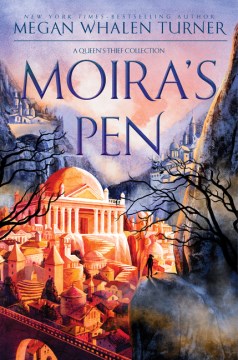
Lynn:Moira's Pen Just before the holiday, a package arrived from a publisher—a not unusual and yet always exciting event. Moira’s Pen (Harper/Greenwillow, 2022) by Megan Whelan Turner was inside. I saved it to savor till the quieter days of January and I’ve been sauntering blissfully through. It is a true gift for all readers who love the series, The Queen’s Thief.
Moira’s Pen is a collection of short stories, musings on past real-life experiences, and reflections by the author about some of the inspirations for the elements in the books. None of the new stories change the overall satisfying conclusion of the series but rather they provide more insight into the events and characters readers have loved. Turner’s writing is so evocative that I was instantly able to settle back into the world of the Thief and I enjoyed every word. This IS a gift to readers who know the world and love the series.

What prompts me to write about this book though is a complaint I read on Goodreads from a young reader who had not read the series and was more than a little confused by this collection. There are masses of fantasies being published and I am sure there are many readers who have not read Turner’s award-winning series. It began with The Thief (Harper/Greenwillow, 1996). It won a Newbery Honor and the Mythopoeic Fantasy Award for Children and it set the stage for a remarkable series of seven books, each one building on the last and expanding the reader’s understanding of the world and its memorable characters. There isn’t much that Megan Whalen Turner doesn’t do well in her writing: complex plots, richly developed characters, and superb world-building. As the series moved along, its themes and character studies deepened. Each new book was a gem and never once did Turner underestimate her readers.

So—if this series is one you’ve missed, FIND it and begin reading. If you have read it, get Moira’s Pen and revisit it. Like me, I’m sure your next step will to be start again at the beginning of the series and read it all over again. If you miss me, I’m busy with Gen and the world of Attolia!

One Last Shot – Introducing Gerda Taro to YA Readers

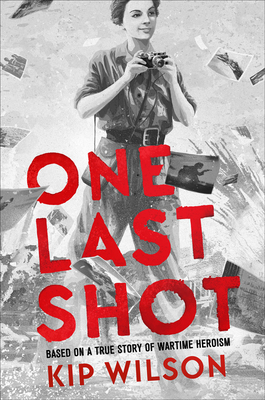
One Last Shot by Kip WilsonLynn: One important tenet of reviewing books is that you review the book you have not the book you WISH you had. I’m running aground a bit on staying with that in my consideration of Kip Wilson’s new verse novel, One Last Shot: The Story of Wartime Photographer Gerda Taro (Harper/Versify, 2023).
Wilson introduces readers to a young Gerta Pohorylle who has immigrated with her Jewish family to Germany. Gerta was a bright student who learned early to live two very separate lives, downplaying her Jewish faith, but keenly aware of a feeling of being “other.” Gerta was drawn early to oppose the growing repression of the fascism coming to power in the 1930s and worked actively for workers’ rights. After being arrested and held for 3 weeks by the Gestapo, Gerta and her family made the decision for her to leave Stuttgart and move to Paris. Struggling to survive, Gerta met and connected with other leftist young people, growing more and more involved with working against fascist regimes. It is during this time that she met and fell in love with Andre Friedmann. Andre sparked her passion for photography and the power of photojournalism and she practiced intensely with any camera she could borrow. It was during this period they adopted the names Gerda Taro and Robert Capa.

Wilson uses free verse to tell Taro’s story and the verse is wonderfully written. Vivid and evocative, it is written in present tense and provides snapshots of time, Gerda’s feelings, and reactions to the intensity of the events unfolding around her. Wilson does an excellent job of presenting Taro as a fierce, independent, and exuberant spirit determined to make her own way. She also provides the extremely complicated historical background of the time. Is there ANY period in history more convoluted than the Spanish Civil War??? I think Wilson gives teens an excellent grasp of the major issues of the period without slowing the pace of the narrative. So—I see real value in this book in that I think Wilson introduces an extraordinary talent to another generation and I hope they will be motivated to seek more information.

And here is where I veer from the path of reviewing. Wilson discusses in the back matter that while “sticking to the basic facts she has fictionalized Gerda’s thoughts, feelings, interactions, and correspondences.”  For me, this emphasizes a perception of her spirit and the result is that so much is left unexplored or only briefly mentioned and those things are large in importance. Taro is pivotal in the development of modern photojournalism, she was a major talent in news photography and many of the philosophical decisions she and Capa made shape our view of photojournalism today. I would have liked to see this explored much more. And there is something missing when a book about a photographer contains no photographs!

I would like to suggest pairing this verse novel with the brilliantly written and documented book by Mark Aronson and Marina Buhos, Eyes of the World: Robert Capa, Gerda Taro, and the Invention of Modern Photojournalism (Henry Holt, 2017). Suggest this book to students wanting a deeper look at Gerda Taro, and some of her revolutionary photographs.

Scieszka’s Dada Nonsense to Send Off 2022

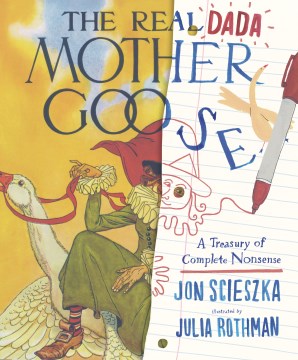
Real Dada Mother GooseLynn: I have a tendency toward morose reflection in the last week of a waning year. An antidote is needed and I found an outstanding one in Jon Scieszka’s The Real Dada Mother Goose: A Treasury of  Nonsense (Candlewick, 2022). This delightful book is just what the reading doctor prescribed for diverting gloom and eliciting laughter.

Just to refresh: Dada is creating art through humor and absurdity. And what could be better to take us smiling into the New Year? Scieszka takes his start with the classic collection The Real Mother Goose by Blanche Fisher Wright, published by Rand McNally in 1916. Trust me, it is just the platform for an incredible dive into what imagination and humor can do. Scieszka chose 6 well-known Mother Goose Rhymes. He begins each of 6 chapters with the original rhyme and then follows with Dada word play on the rhymes. Hey Diddle Diddle, for example, has the Dada treatment applied with a Haiku, a recipe, a Pop Quiz and a map.  Hickory Dickory Dock appears in Egyptian Hieroglyphs, a Crossword puzzle and an “N + 7” code. Each new poem is a puzzle and each is a wonderfully clever.

Julia Rothman’s illustrations are done in mixed media. They are created in the style of the original Mother Goose book but, using Dada style, she includes whimsical touches including a yellow goose that appears throughout the book. The book design too is masterfully done making it appealing, easy to read and to appreciate the many details while also giving a nod to the reader’s sense of the absurd.

Also provided are Notes on all the forms, puzzles and codes used throughout the book. These are really fun to read and it is impossible not to want to instantly start creating your own versions. Included here too is a Mother Goose history and information about Blanche Fisher Wright.

This would be a fantastic book to use in a language arts classroom to read aloud, as a sponge activity with real value and as a writing prompt. I guarantee it will take you into the New Year smiling.

Matt Phelan Soars with The Sheep, the Rooster and the Duck

Lynn: sheep, the rooster and the duckDid you know that a sheep, a rooster, and a duck (with a little help from Ben Franklin) saved a young America from a potential French usurper? At least that is the tale according to Matt Phelan in his new illustrated chapter book, The Sheep, the Rooster and the Duck (Harper/Greenwillow, 2022). This charming alternate history is packed with humor, plenty of wonderful real historical tidbits, wacky secret societies, evil plots and brave daring-do. Add mesmerists, Marie Antoinette, 2 bright young French servants, spies and a balloonist mouse and you have quite an adventure.
To begin: Ben Franklin really was living in France in the 1780’s lobbying France for assistance. He really was inventing all sorts of things and a sheep, a rooster and a duck really were the first living pilots in the first hot air balloon flight in 1783. And there really were spies and secret societies all over the place. What more could you want?

So Matt Phelan and his ever-inventive imagination takes all these things and gifts readers with a story. Bernadette, an inventive Sheep, Jean-Luc a military tactician Duck and Pierre, a swashbuckling swordsman Rooster, are the foundation of a secret society trying to prevent Franklin’s notebook full of dangerous designs from being stolen, turned into weapons and endangering France and the world. They enlist the aid of Franklin’s young caretaker and servant Emile. Before you can say Mon Dieu, Franklin and his notebook fall into the hands of the Franz Mesmer and the dastardly Count Cagliostro who is scheming to become the King of America! Zounds!

This delightfully wacky story is peppered with Phelan’s charming black and white illustrations that add wonderfully to the book. And – take heart, although Emile’s quite life is changed forever, the world was saved  – at least for a while.

A wonderful Author’s Note explains the where the origin of the story came from and provides many historical facts.This is a great choice for a classroom read aloud or to enjoy a chapter at a time at bedtime.


Madani’s Best Game – a Story of the Beautiful Game

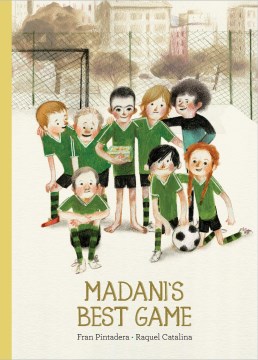
Lynn: Madani's best gameI hope this World Cup, despite its many issues, is bringing love of the Beautiful Game to more Americans and bringing a clearer understanding of how it is loved around the world. I know many American children now play soccer on recreational and school teams but the book I am writing about today is about how millions of kids really play the game and what it can mean. Madani’s Best Game (Eerdman’s, 2022) is by Spanish author Fran Pintadera and translated from Spanish.
A young narrator confides the story of his neighborhood team where the best player was the one who could kick the ball the hardest – until Madani arrived. Not only is Madani the best football player anyone has ever seen but he stands out because he plays barefoot. Madani can do everything with a ball: slide it, twirl it, pass it and SCORE! When Madani has the ball, the whole world stops to watch. The team knows Madani has been saving his money. He walks instead of taking the bus, he gives up his afternoon snacks and his tells the team that when he has enough he is going shopping downtown. With an important game coming up, the team hopes his going to buy a pair of cleats. With cleats, Madani would be unstoppable! 

I will leave it for you to discover what Madani uses his saved money to buy but the result will melt every reader’s heart.Truly this is the story of a game often played barefoot, on dusty ground or city streets, sometimes with patched balls or balls made of anything available. But wonderfully, this is also a story of a game uniting people from all over, breaking barriers of immigration and poverty. And, it is also a story of love.

Raquel Catalina’s warm illustration are done in pencil, colored pencil and gouache and they beautifully bring the energy and spirit of the story to life. This is a terrific book to read aloud during this World Cup season, or any football season, and to use as a discussion starter.

A is for Alphabet Books…and Oboe

Lynn:A is for oboe I can’t celebrate Picture Book Month without reviewing an Alphabet Book! Long-time readers know it is one of my favorite types of picture books. My love of them began farther back than I’d like to admit and in fact, I still own my battered copy of Hillary Knight’s ABCs purchased for me by my father before I was even born. I’ve loved them ever since and have quite a collection. For me, alphabet books are a testament to the extraordinary creativity that illustrators continue to bring to what could be a mundane genre. They continue to be ever-fresh and brilliantly original.
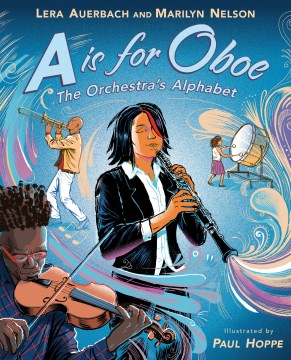
A Is for Oboe: The Orchestra’s Alphabet (Penguin/Dial, 2021) by Laura Auerbach and Marilyn Nelson proves my point! Like all outstanding books, this is far, far more than an alphabet book. In the talented hands of composer, conductor, and pianist Auerbach and multi-award-winning poet Nelson, this remarkable lyrical book is an introduction to the orchestra, its sections, musical terms, and instruments. It gifts readers with lyrical poems for each letter of the alphabet, each cleverly delivering its assigned letter in unusual ways. For example, A is for the note A played by the oboe to tune the orchestra and W is for the new and exciting music written by today’s young composers. Each poem is a little puzzle to unlock and each begs to be read aloud.

Illustrator Paul Hoppe uses ink on paper with his dynamic and energetic drawings, reinforcing the message that the orchestra of our time is diverse in race, ethnicity, age, and gender and is a living experience for all to enjoy.

The vocabulary is often challenging but in accessible ways and is a valuable addition to music and English language classes as well as being terrific for shared reading with an adult. This is a gem and belongs in all collections. It will certainly be in mine!

The Sweetest Scoop – What’s Your Flavor?

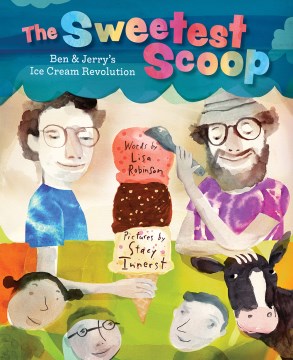
Lynn: sweetest scoopWhat kid doesn’t love ice cream? And who hasn’t heard of or tasted one of  Ben and Jerry’s crazy flavors? The new picture book The Sweetest Scoop: Ben and Jerry’s Ice Cream Revolution by Lisa Robinson had me smacking my forehead and wondering, “Oy! Why didn’t I think of that????” It’s a kid-perfect book, right? Could there be a better book for a classroom intro to biography or nonfiction?

Well, I didn’t think of it so thanks to Lisa Robinson who did! Ben and Jerry were childhood pals and even though they had different skills and interests, their friendship remained strong as they both struggled to find the right path. The friends decided their best plan was to go into business together. But what? The two tried several things. Bagels came first but they settled on a true love—Ice Cream. The boys bought an old gas station in Burlington, Vermont, rolled up their sleeves, and started to work. First, they had to fix leaks and resurrect the furnace, and then came the challenges of actually making great ice cream. And then there were the flavors! How DO you break up enough toffee bars to put Coffee Bar Ice Cream into production? Well, our boys persevered, created their signature wacky flavors to stand out, and Ben & Jerry’s was a huge success. Were there challenges ahead? You can bet your waffle cone it was often a Rocky Road! Have you ever heard of the Flavor Graveyard or the Pillsbury Boycott that aimed to put them out of business? I hadn’t and this sweet book filled me up with fascinating facts.

The Sweetest Scoop is a delicious book, combining an inspiring story of two hard-working men who wanted to succeed at something they loved and do it in a way that upheld their strong beliefs such as sustainable manufacturing and activism. Robinson’s text has a breezy grooviness appropriate for the boys’ 60’s spirit and sprinkles plenty of humor throughout, including groan-worthy riddles here and there. “How do you make a milkshake? Give a cow a pogo stick!” Stacey Innerest’s chalk and watercolor illustrations are totally chill too.

Back matter includes an Author’s Note, Timeline, and Sources. My only wish was for a list of flavors used over the years—AND for a great big cone to eat as I read!

Whatever your favorite flavor, Cherry Garcia, Chunk Monkey, or Save Our Swirl, you’ll love this perfect treat of a picture book!