Saris and Bindis

My Bindi by Gita VaradarajanCindy: In My Bindi (Scholastic/Orchard 2022) by Gita Varadarajan, Divya’s parents encourage her to start wearing a bindi, a small colored ornament, on her forehead as part of her Hindu culture, but she isn’t so sure. She’s nervous of what her classmates will say. When her mother presents her with a bindi box to select from, she has the final push she needs to be brave. She knows that the bindi is like a third eye that can see inside her and she will feel its protection. When the young girl gets to her diverse classroom, she is met with questions and positive responses, including from her teacher who lets her explain what she is wearing to the class. This warm, positive story will not only provide a mirror for many young girls, but a window to boys and girls alike who are unfamiliar with the tradition. This #ownvoices book with its vibrant illustrations by Archana Sreenivasan is recommended for all elementary libraries and classrooms.

How to Wear a Sari by Darshana KhianiLynn: Unlike Divya, with her concerns about a bindi, the heroine of How to Wear a Sari (Houghton/Versify, 2021) by Darshana Khiani has no such reservations! She’s tired of being “treated like a little kid,” too small to do things the big kids get to do. Her solution is to wear the beautiful silky saris the adults wear. This seemingly simple idea turns out to be loaded with problems. First, she has to find all the pieces, as well as the pieces that will fit. Then she has to master the folding, tucking, draping, adjusting, and accessorizing! The results, of course, are disastrous, but the little girl’s loving family assures her that she is not the first in the family to make mistakes.

This charming book plays on a universal wish of small children to be considered more grown up and will delight a large audience even if a sari is not a family choice. Along the way, children will gain an understanding of how a sari is worn and just how complex the dressing process is.

Joanne Lew-Vriethoff’s colorful illustrations are warm and humorous and kids everywhere will yearn to try on a sari too—with some grown-up help!

Geography Nerds Rejoice!

Lynn: Weprisoners of geography have a treat for all the map-loving kids you know! Each of the books we’re highlighting today bring a fascinating new look at maps, the impact of the often arbitrary lines drawn to created country boundaries and so much more.

The first is Prisoners of Geography: Our World Explained in 12 Simple Maps (The Experiment, 2021) by Tim Marshall. The book is a Young Reader’s adaptation of Marshall’s best-selling adult book. Marshall, a globe-trotting reporter for many years, takes a fascinating approach to providing an introduction to the geopolitics of our world. He touches on history, physical geography, resources of the region, trade, politics, and their impact today. The maps are engagingly drawn and packed with information presented in a way to interest kids and draw them into exploring more. It is a book to read a few pages at a time in order to linger over the wealth of information on each map. Choices had to be made for an adaptation so not all countries are included but those chosen are of definite current interest. As a life-long map nerd myself, this is a book that would have enthralled me as a kid and still does today. Don’t miss it!

Africa Amazing Africa by AtinukeCindy: We have raved here in the past about Atinuke’s beginner reader books featuring Anna Hibiscus, a young girl from Africa, amazing Africa, but this book was completely off the map for me in 2020 and we want to make sure you don’t miss it as well. Africa, Amazing, Africa: Country by Country (Candlewick, 2020) by Atinuke is just that, a look at Africa, country by country. After a few pages of introduction and a full colorful continent map, the book is arranged by region with a regional map accented with images of foods, animals, and other features, a short text introduction to the area as a whole, and the word “Welcome” in each of the languages spoken in that region. Each country in the region is then presented in alphabetical order with a page that includes illustrations, information that varies depending on the country, and highlighted facts of interest. Throughout, Atinuke shares the traditions and history, but also is sure to highlight the large cities, technology, and contemporary features of Africa and its people today. Did you know that some nomads of Eritrea now “use GPS and cell phone apps to check where the rain and the grass are?” A must purchase for all libraries and a great addition to elementary classroom resources.

Doing the Impossible – Neal Bascomb’s The Race of the Century

Lynn:race of the century Did you know that 70 years ago most people believed that running a mile in 4 minutes was impossible and beyond the limits of the human body? “It was something that God himself had established as man’s limit,” said one writer. But suddenly in 1952, three runners were poised to do just that. It did happen, of course. Two of the three broke the 4 minute mile in 1954. Today’s record is 3.143.13 seconds. How did mankind achieve this “unbreakable” speed? I am not a runner. My idea of exercise is a daily walk with my camera. But it is amazing the unfamiliar paths that a wonderful nonfiction writer will coax a reader to trod and thanks to Neal Bascomb’s latest book, The Race of the Century: the Battle to Break the 4 Minute Mile (Scholastic, March 2022), I have become fascinated with the amazing story of this ongoing battle of man running against the clock.
Bascomb chronicles the stories of 3 individual racers, Roger Bannister of England, Wes Santee, a Kansan and Australian John Santee. Each one found himself poised on the threshold of a ground-breaking achievement. All were amateurs in the strictest sense of the word. Bannister was finishing his medical training to become a physician, Landy was studying science at university and Santee was working his way through Kansas University while running on both the track and cross country teams. All three expected their athletic efforts to end on graduation. Suddenly all three were facing intense attention from the press and huge national expectations.Who would break the record first and how would he do it?

Bascomb follows each runner through their unique racing careers and experiences, detailing each man’s training regimes. Even to a non-runner, this was fascinating as each runner was remarkably different from the others. Imagine trying to do elite intense training in the little free time left available to a medical student in his last year of training and working as an intern! The moment by moment accounts of the pivotal races, each runner’s race strategies, physical struggles and mental preparations are presented in clear prose and for young runners, this part of the book will be especially absorbing.

For me as a non-runner, it was the individual personalities and their approaches to the challenge that were the most compelling. The stark contrast between the elite amateur runner in the ’50’s and the world class runners of today also stood out for me.

I read this book in galley and the included black and white photographs added so much. Bascomb, as always, does an excellent job of citing his sources in detailed chapter notes and the back matter also includes an Author’s Note and an intriguing bibliography.

Hand this book to young runners and to those teens who love historical nonfiction.

Picturing a Nation – Introducing a Photographic Treasure to a New Generation

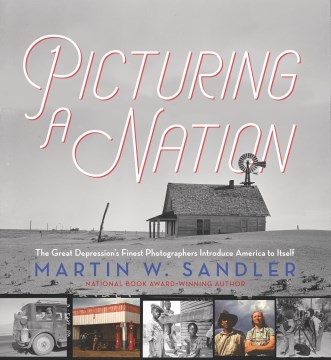
Lynn:picturing a nation I grew up awed by my parents’ stories of growing up during the Great Depression and, as a child in the 50s, I also have strong memories of the photojournalism of weekly periodicals such as Life and Look. I’m an amateur photographer too so all my interests were piqued when I learned of Martin Sandler’s upcoming book. It has been a long wait but Picturing a Nation: the Great Depression’s Finest Photographers Introduce America to Itself (Candlewick, 2021) is more than worth it!
In 1935 with the Great Depression raging and the Dust Bowl drought ravaging the plains, Roy Stryker was appointed to head The Farm Security Administration. In a brilliant move, he decided to hire a group of outstanding photographers to cross the nation and photograph America and Americans—the way of life and the desperate struggle that was occurring in so many places. His goal was to sell the agency to leaders in order to secure more funding but also to ” introduce America to Americans.” He was successful at both and in Picturing a Nation, Martin Sandler celebrates the photographers who produced the powerful and ground-breaking photographs that have become icons in both photographic and national history.

Sandler wisely chooses to let the photographs tell the story – as they were always meant to do. He provides brief captions to each that identify the photographer, locations and circumstances of the photo. The book is divided into the FSA regions and introductory chapter texts provide the important background and historical information. The last section of the book, Profiles, are biographical sketches of Stryker and 11 of the photographers who created the lasting historical legacy.

The book design and photographic reproductions are outstanding! Many of the photographs are full page sized and several of the first color photographs are included. Candlewick has done an outstanding job of showcasing this important collection.

While this is a book about the work of these extraordinary artists, young readers will also absorb an enormous amount about the history and impact of Great Depression and the Dust Bowl. These pictures are stunning in their ability to convey emotional power even almost 90 years later. The humanity shines through and it is what makes these images so important. Readers will come away awed, deeply moved, and perhaps with a new understanding that history is the story of people’s lives.

PHEW – A Picture Book About a Stinky Subject

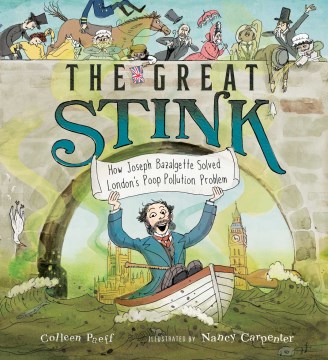
Lynngreat stink: Say the word “poop” and you get every kid’s attention. But of course, the management and disposal of poop is a critically important health issue for people everywhere.  So how do you help kids learn about the serious facts behind this stinky subject—all the while acknowledging that the giggles are inevitable? Colleen Paeff has the answer with her wonderful picture book, The Great Stink: How Joseph Bazalgette Solved London’s Poop Pollution Problem (S&S/Margaret McElderry, 2021). Paeff’s fascinating story of the brilliantly innovative engineer Joseph Bazalgette who truly saved London from its offal self is guaranteed to captivate and inform young readers—all without anyone having to hold their noses!
Told with a smile and engaging language, the history will make kids laugh but at the same time clearly delivers important facts about health and history. For most American kids, plumbing is a given and the protection the system provides us mostly out of mind with each flush. The reality for both history and many countries even today, is of course, another story.

Paeff focuses her story on London, beginning in 1500 with an introduction as to what passed for sanitation then. People in those days put human waste into deep cesspools in their basements and hired “nightsoil men” to come dig out and carry away the poop when it got too deep. Yuck!!! In 1819, when Bazalgette is born, flush toilets were just beginning to catch on but all the sewage goes directly into the Thames. A series of cholera outbreaks kills many Londoners who blame the disease on the bad air or misasmas while continuing to drink the polluted water. By 1850, Joseph Bazalgette, now an engineer, disagrees and he thinks he knows how to help.

But the city fathers didn’t agree and it took a lot of years, Bazalgette’s persistence, and a summer heat wave that produced an event called The Great Stink in 1858 to get his plan approved! But soon, thanks to Joseph Bazalgette, the London sewer system is flush with success!

Cindy: I don’t think I can keep up with Lynn’s stream of sewage metaphors but I do agree with her assessment of this important book. It’s hard to make such a putrid topic a joy to read, but Paeff has done it and Nancy Carpenter’s illustrations are the perfect touch to keep young readers flipping through the filth. The watercolor and ink artwork depict detailed scenes starting with the title page showing the royal “throne” occupied by the queen reading a newspaper! Plumbing pipes snake across later pages while earlier pages show Londoners using umbrellas to protect more from chamber pots being emptied than rain falling. Gross! But history isn’t always pretty, eh?

Knighted Sir Joseph Bazalgette’s story comes to an end in this book in 1874, but added backmatter includes an update on “Poop Polution Today” with tips for readers that include building a rain garden, planting trees, and touring a wastewater treatment plant, small acts to help prevent water pollution. There’s also a “Detailed Timeline,” a list of “Further Reading, and a “Selected Bibliography” for children and adults who want to learn more. My husband works in the wastewater industry, and we live on the water downriver from a large city that still struggles with sewage overflow into the river after big storms. Bazalgette was a hero, but it will take many more heroes to keep our waters safe. It’s never too early to be informed, and reading The Great Stink is a great start. 

Hurricane – Weathering a Storm with a Picture Book

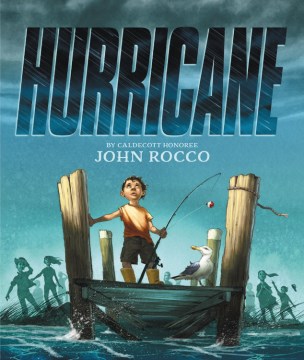
Lynn:Hurricane As he has done in other books, Rocco tells a story of a large event affecting a child and a community. Like Blackout (Disney/Hyperion, 2011) and Blizzard (Disney/Hyperion, 2014) these events are largely unexpected and out of a child’s ability to control them. And, like the previous books, the events result in a community coming together. This latest picture book, Hurricane (Little, Brown, 2021) begins calmly like the weather before a storm. Told in first person, a young boy confides to the reader that his favorite place is the neighborhood dock. “It’s old and splintery, ” he says, and the double-page spread that follows shows a delightful depiction of the many joys the old dock provides.
But when he walks home through the peaceful night, the boy notices that something feels different. Everyone is acting strangely, including his father. A hurricane is coming and the neighborhood is boarding up windows and getting ready. The scary storm roars through in the night and in the morning the little boy grabs his gear and rushes outside to discover that his neighborhood looks like “a giant angry monster stomped through it.” Worst of all in the boy’s view is that his beloved dock has been destroyed. Looking for help to fix it, the boy asks his father and the neighbors but they are all too busy with their own repairs so the little boy pitches in to help them first. As the neighborhood returns to normal, he decides to fix the dock himself  but the results are disastrous. Happily the neighborhood rallies around and in a lovely series of scenes, they not only repair the dock, but improve it, making it a neighborhood gathering place.

I am always charmed by the hopeful encouraging perspective that Rocco brings to his stories of big issues. He sees a bright side to events when those involved unite to make that happen. It is a story arc that never fails to inspire and delight. I love Rocco’s slightly nostalgic illustrations too but I’ll leave those to Cindy. This is another winner from Rocco and guaranteed to enchant his many fans.

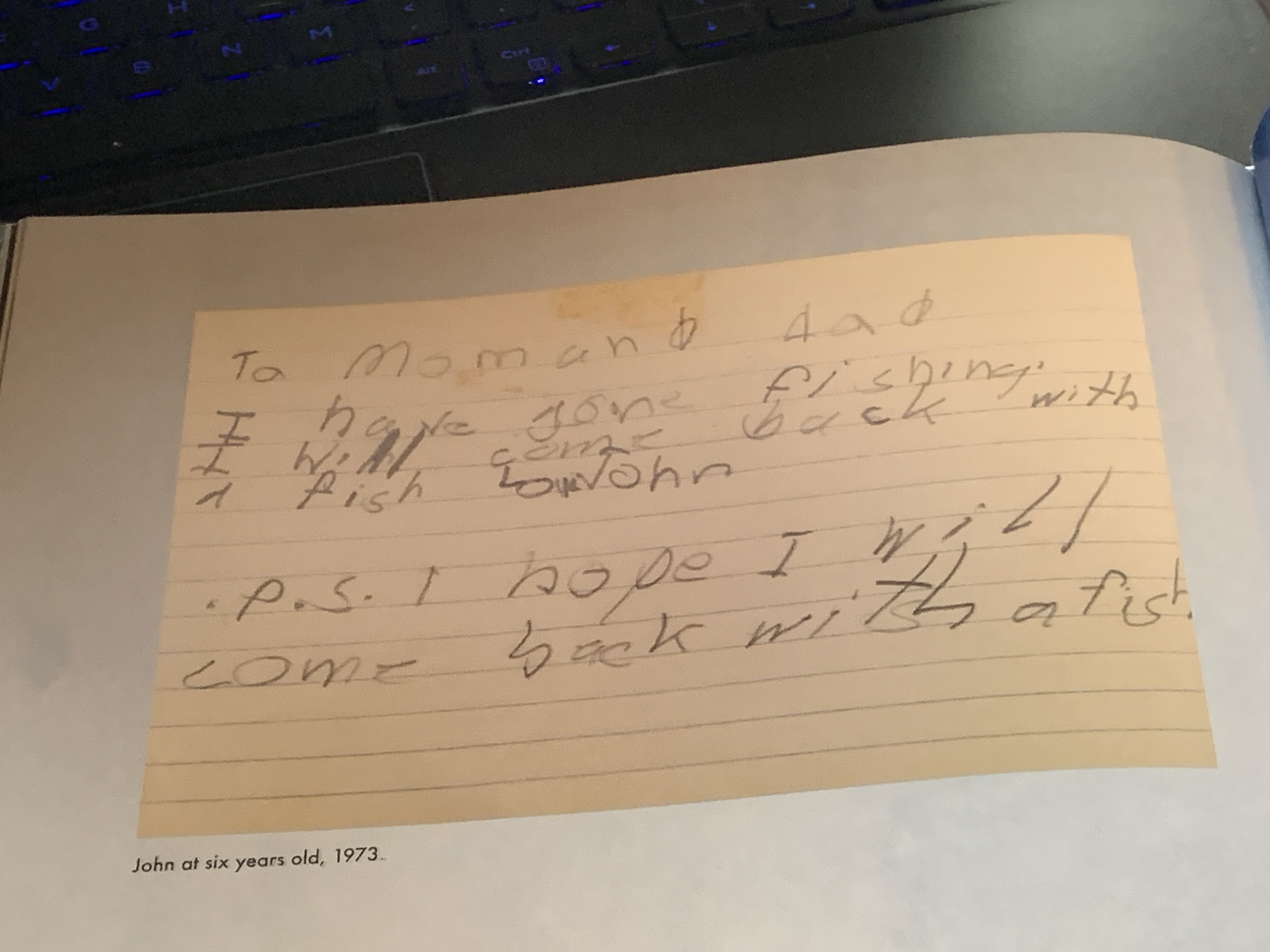
Cindy: To learn about the illustrations in this moving book, I’d recommend going straight to the source, John Rocco. Victoria Stapleton interviewed Rocco for the release of Hurricane, and his answers and accompanying slide show is fascinating. Watch the interview here, and learn about Rocco’s use of shapes and color to help tell a story of destruction and rebuilding. A story of hope. Not shown in the video are the fabulous end papers. The opening papers show the science and movement behind how a hurricane forms. The final end papers illustrate the parts of a dock and the installation of pilings. Another treat is John’s 1973 note left for his parents in his six-year-old handwriting. Hope applies to young fishermen as well. Don’t miss this one!

John Rocco fishing note

Let Me Fix You a Plate – a Picture Book of Love, Family and Food

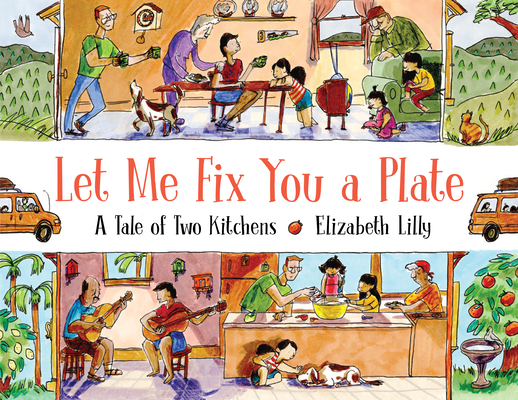
Let Me Fix You a Plate by Elizabeth LillyLynn: The holiday season is beginning and many families are preparing to journey to family celebrations. No matter the culture, families will share food and love—the heart of any gathering. Elizabeth Lilly’s new picture book, Let Me Fix You a Plate: a Tale of Two Kitchens (Holiday, 2021) chronicles the experience of so many of us whose families are a mix of cultures.
A young girl tells the story of her family rising early and driving “hours and hours” to arrive in the mountains of West Virginia. Her Mawmaw opens the door and says, “Let me fix you a plate.” The warm scenes that follow are full of sharing, food, and love. In the bright kitchen, the family enjoys blackberry jam on toast and banana pudding. The child notices that her father and grandfather drink their coffee in just the same way. Then the family piles back in the car, traveling on to Florida where they are greeted by their Abuela inviting them to “come and eat.” Here the delights are tostones, flan, and arepas with queso blanco. The cultures may be different but the sharing of love through food is the same.

At the end of the week the young family journeys home again, arriving late and tired—and hungry! Following their own tradition, the family celebrates home with waffles before drifting off to sleep.

Lilly’s evocative book wonderfully depicts the way so many families share their love—through food. Her charming illustrations are warm and bright and enhance the text beautifully, helping with terms that may be unfamiliar. It is impossible not to smile while reading the book. An added pleasure are the end pages which show the sights and objects found in each of the kitchens that the family visits.

This brought back so many childhood memories for me although my family visits involved kuchen, rindsrouladen and spatzel, then matzoh ball soup, latkes and brisket.  Whatever your culture, food is love and this lovely story tells that so well.

Fallout – Sheinkin’s Terrifying Look for Teens at How Close the World Came to Destruction

Lynn: FalloutWhere were you in October 1962? I know a whole lot of you weren’t even on this planet yet but how much do you know about how close we came to annihilating this place we call home? I was a young teen at the time, going to junior high in Belmont, MA and I remember those days quite well. I think I especially remember them because I realized my father was grimly worried, even scared. We watched the reports on the news and when I asked my dad if there would be a war, all he would do was shrug. I remember too, the sigh of relief when Russia “blinked” but I also remember an overwhelming sense of helplessness at these events that could wipe out the world and there was nothing I could do.
That is a long way of saying that if you read any historical nonfiction book this year, make sure it is Steve Sheinkin’s Fallout: Spies, Superbombs, and the Ultimate Cold War Showdown. (Roaring Brook, 2021). Yes, it was 1962 but there are parallels here that need to be understood by all of us who inhabit this same fragile wanderer in space.

Sheinkin is a master of narrative nonfiction, of careful research, and is a compelling storyteller. He takes an event for which we know the trajectory and manages to keep readers hanging on by a thread as his chronicle unfolds. And in this book, he relates a tale as complex, convoluted, and shrouded in secrecy as anything in history. It is a tale of personal courage, thoughtful reflections, and a willingness to resist the pressures of other dominant opinions. It is equally a tale of luck, bungling, and terrible timing. I paused with awful frequency to shake my head in wonder and horror at the incredible chain of events that we call the Cuban Missile Crisis.

How close did we come to nuclear war? Closer than any of us outside of a very few people knew. There are true heroes in this story as well as reckless fools and power hungry zealots. This is a marvel of nonfiction writing. Succinct, wonderfully researched and cited, and thoughtfully recounted. It is also has the terrible fascination of watching a train wreck. If you were around then or are just now encountering the story, this book will hold you captive and maybe haunt your dreams with what could have been. As Robert McNamara, then Secretary of Defense, said, “At the end we lucked out. It was luck that prevented nuclear war.” See if you agree.

Cindy: Besides being stellar works of nonfiction, Steve Sheinkin’s books are a booktalker’s dream. Here’s the opening paragraph of the prologue, titled: “The Paperboy.”

“The kid hiked up the dark stairwell to the sixth floor, hoping only for a decent tip, maybe fifteen cents. Busting up a Russian spy ring was an unexpected bonus.”

Read that sentence to your students and stand back, hoping you’ve purchased a lot of copies! One of the nickels the paperboy received was a hollow coin that popped open after falling on the stairs and the boy discovered a tiny piece of film inside. Hmmmm….and away we go!

Bomb by Steve SheinkinI couldn’t turn the pages fast enough, and I was holding my breath in places (when I wasn’t gasping) even though I knew the outcome. What I didn’t know was many of the details and stories behind the Cold War build-up, the dangerous rescue efforts after the Berlin Wall went up, and the last hour unlucky mishaps during the Cuban Missile Crisis, any one of which could have could have been more than disastrous, but for some added good luck. Obviously, this is a natural sell to teen readers who were fascinated by Sheinkin’s earlier YA book, Bomb: The Race to Build–and Steal–the World’s Most Dangerous Weapon, but adults will want to read this as well.
The Power of Style – an Inclusive Guide to Fashion

Lynn:

Power of styleLynn: Most of us have grown up with the sort of fashion and style books that showed us how we SHOULD look within a very very narrow definition: thin, tall, white, shiny hair, clear-skinned and perfectly coordinated from head to toe. I gave up reading them as a teen, knowing I would never measure up. For many teens who didn’t fit that narrow mold, those guides often felt cruel and demeaning.
Christian Allaire’s Power of Style (Annick, 2021) is a fresh look at fashion. The wonderfully written book by Allaire, an Ojibwe writer who is now the Fashion and Style writer for Vogue, sets out the philosophy right from the first page.

“This book is for anyone who has never felt represented, who has felt inferior or less beautiful, and who has questioned their roots.”

While acknowledging that fashion has great power, he goes on to introduce readers to people who are using fashion and beauty to promote cultural activism, empowerment, diversity, and inclusivity. It is a powerful and inspiring message and it should be heard by all of us, young or old, and of any culture, size, or race. The book is absolutely gorgeous and inviting with outstanding photography and layout. Divided into 6 broad categories, the chapters examine Sewing Tradition, Hair, Cosplay and Size, Hijab and modest clothing design, Men’s Heels, and Makeup.

There is so much to think about and celebrate in these pages and readers will come away with a new interest and respect for what fashion and style can do for all of us. Of particular note for me was a small section on Cultural Appropriation VS. Appreciation that was respectful and extremely helpful as many of the fashions shown throughout the book are incredibly beautiful and readers may yearn to wear them. This is a book that should be on the shelves of every high school and public library. Don’t miss it!

This Very Tree – a story of hope and resilience following 9/11

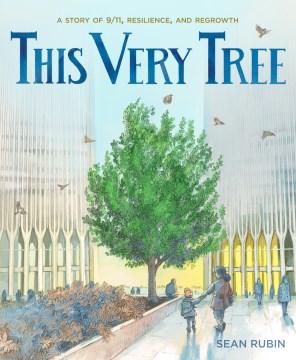
Lynn: This Very TreeLike so many adults, the memory of that day in September 2001 is harshly strong. And like many of us, I find it difficult to talk about the enormity of the experience to children. I’ve approached the growing number of picture books on the subject with mixed feelings. Sean Rubin’s new picture book. This Very Tree: A Story of 9/11, Resilience and Regrowth (Henry Holt, 2021) doesn’t try to explain the event. Instead he takes the event as a given and focuses instead on the strength, determination and resilience of the people of New York City and America to restore their city.

He does so by using the voice and perspective of the very real Callery Pear tree that stood by itself in the World Trade Center Plaza. Planted in the 1970’s the tree heralded spring each year with early blossoms and provided welcoming shade. Rubin addresses the issue of the attack with these simple sentences, “It was an ordinary morning. Until it wasn’t.” The peaceful green scene is replaced by a series of dark and angular panels that gradually lighten with a view up to light and firefighter faces looking down. No explanations are used here but the sense of something dark and catastrophic is clear.

The tree itself was seriously injured, with broken limbs, roots snapped, and branches burned. The tree relates how it was transplanted and gradually began to regrow. The New York Dept. of Parks tended the tree carefully for 9 years before it was finally returned to the Memorial Plaza where it now thrives among over 300 other trees. Called the Survivor Tree, the pages chronicling the healing and regrowth of the tree itself and the city are full of green life and a hopeful spirit. And I dare you to read them without tearing up! Yes, this is a story of 9/11 but it is also a story of resilience and hope and coming together and perhaps this is what we all need right now.

Cindy: Trauma and recovery are serious subjects for picture books, but so many children have experienced big and little traumas that even if they are too young to understand the world-changing event that was the terrorist attacks of 9/11, there is a healing story here that may help them. There is plenty for adults here, too, including the opening poem by E.B. White from Here is New York, that ends with the titular line, “This very tree.” Rubin’s art illustrates not only the storyline but the emotional path from trauma to recovery and hope. Along the way are lots of details of city life, construction equipment, and pockets of nature for young readers to explore. 

An author’s note explains how Rubin came to tackle this difficult story with its survivor tree, and a double page spread gives a brief history of  the World Trade Center, 9/11, and the Survivor Tree for older readers. Many tiny details (such as using the same typefaces as those used on the cornerstone of the One World Trade Center) make this a lovely tribute to New York City, its people, and to hope.