Lynn: 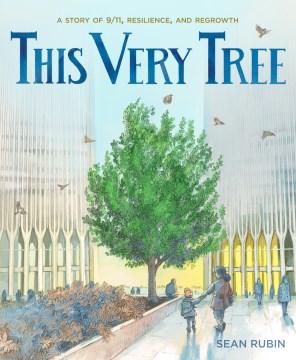 Like so many adults, the memory of that day in September 2001 is harshly strong. And like many of us, I find it difficult to talk about the enormity of the experience to children. I’ve approached the growing number of picture books on the subject with mixed feelings. Sean Rubin’s new picture book. This Very Tree: A Story of 9/11, Resilience and Regrowth (Henry Holt, 2021) doesn’t try to explain the event. Instead he takes the event as a given and focuses instead on the strength, determination and resilience of the people of New York City and America to restore their city.
He does so by using the voice and perspective of the very real Callery Pear tree that stood by itself in the World Trade Center Plaza. Planted in the 1970’s the tree heralded spring each year with early blossoms and provided welcoming shade. Rubin addresses the issue of the attack with these simple sentences, “It was an ordinary morning. Until it wasn’t.” The peaceful green scene is replaced by a series of dark and angular panels that gradually lighten with a view up to light and firefighter faces looking down. No explanations are used here but the sense of something dark and catastrophic is clear.
The tree itself was seriously injured, with broken limbs, roots snapped, and branches burned. The tree relates how it was transplanted and gradually began to regrow. The New York Dept. of Parks tended the tree carefully for 9 years before it was finally returned to the Memorial Plaza where it now thrives among over 300 other trees. Called the Survivor Tree, the pages chronicling the healing and regrowth of the tree itself and the city are full of green life and a hopeful spirit. And I dare you to read them without tearing up! Yes, this is a story of 9/11 but it is also a story of resilience and hope and coming together and perhaps this is what we all need right now.
Cindy: Trauma and recovery are serious subjects for picture books, but so many children have experienced big and little traumas that even if they are too young to understand the world-changing event that was the terrorist attacks of 9/11, there is a healing story here that may help them. There is plenty for adults here, too, including the opening poem by E.B. White from Here is New York, that ends with the titular line, “This very tree.” Rubin’s art illustrates not only the storyline but the emotional path from trauma to recovery and hope. Along the way are lots of details of city life, construction equipment, and pockets of nature for young readers to explore.
An author’s note explains how Rubin came to tackle this difficult story with its survivor tree, and a double page spread gives a brief history of the World Trade Center, 9/11, and the Survivor Tree for older readers. Many tiny details (such as using the same typefaces as those used on the cornerstone of the One World Trade Center) make this a lovely tribute to New York City, its people, and to hope.
 Lynn: A bright cheerful cover of a new book on display at the public library recently caught my attention. Even with summer fading fast, the cover of Sunrise Summer (Imprint, 2021) by Matthew Swanson made me smile and I grabbed it thinking I was in for one last trip to the beach via picture book. Well, I was but this is not like any summer beach vacation picture book I have ever read! What surprise this book was to me and it is one I’m eager for kids and adults to be amazed by too.
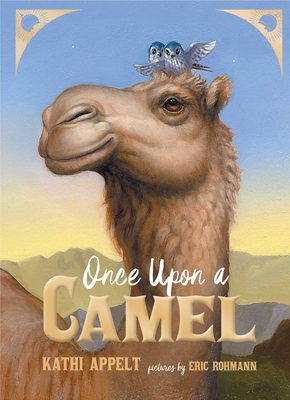 Lynn: Once upon a time there was a camel named Scheherazade, who was called Zada. Kathi Appelt tells us Zada’s story, in her charming new book,
 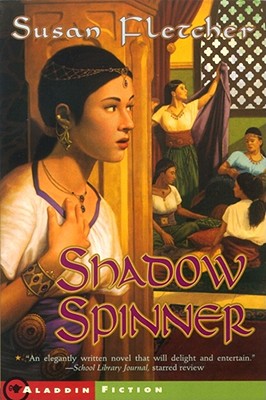 I agree with Lynn about this being a great read-aloud, whether in a classroom or between parent and child. The time-shifting plot and stories within stories structure will require a strong reader or a little explanation from an adult, but the payoff is delightful. My middle schoolers were always fascinated by my booktalk for Susan Fletcher’s Shadow Spinner (Atheneum, 1999), because I started with an introduction to
 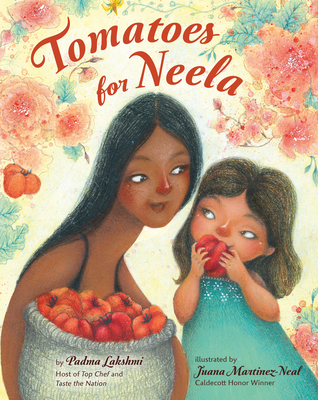 Cindy: My husband rarely gets credit for his support of Bookends Blog or his suggestions for my to-read list. He saw an interview with the host of Top Chef and Taste the Nation, Padma Lakshmi, on
 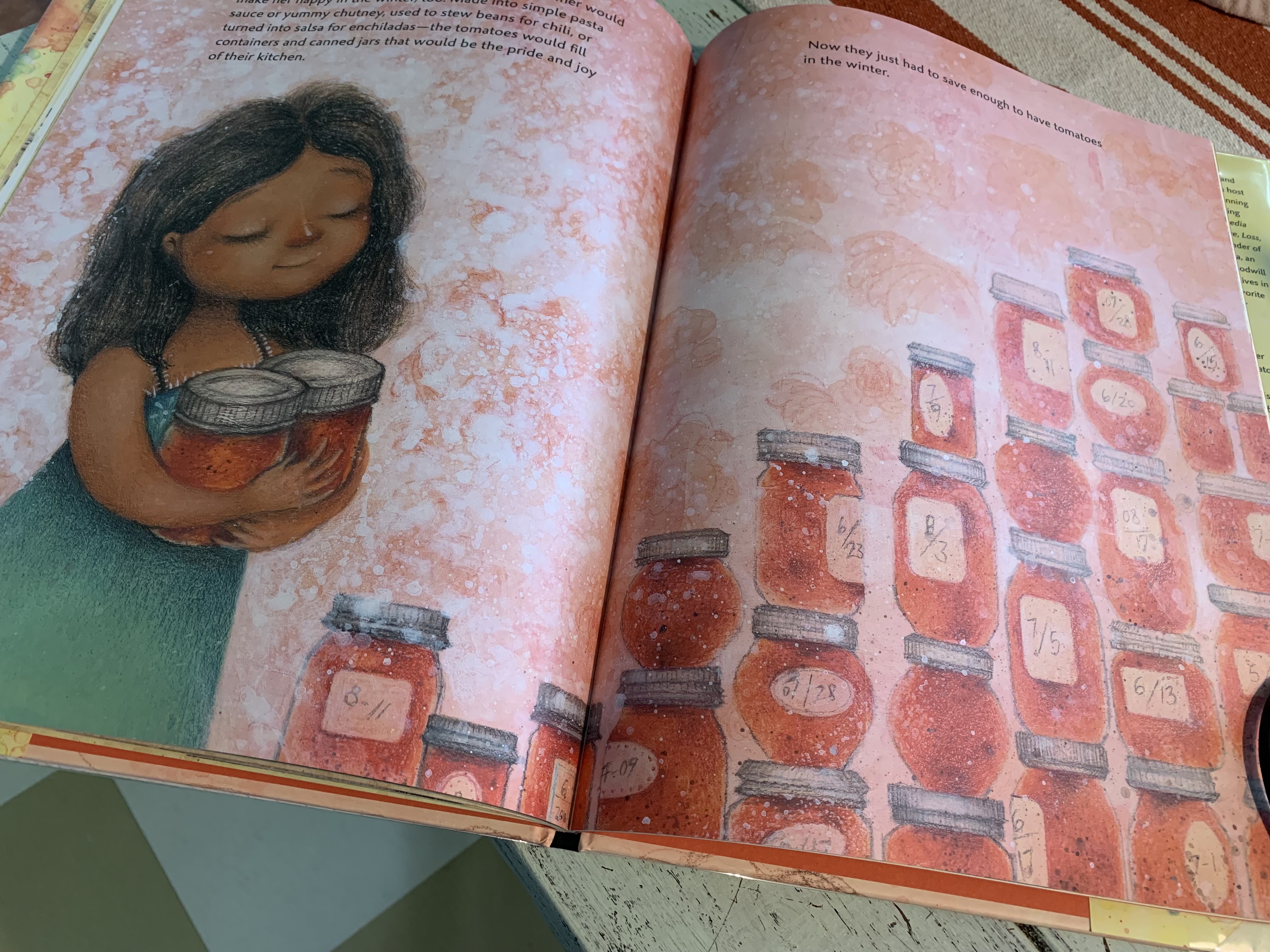 Young Neela loves to cook with her amma (mother) and copies their recipes in her own notebook just like her amma and her paati (grandmother) have always done. To Neela, these books seem magical, like a wizard’s spell book. A trip to the green market that day is highlighted by a stunning display of tomatoes in all sizes, shapes, and colors. I could hang that spread on my tomato red kitchen wall and never tire of looking at it. The acrylic and colored pencil illustrations beautifully showcase the the fruit and the love between Neela and her amma and their joy in purchasing such treasures in season.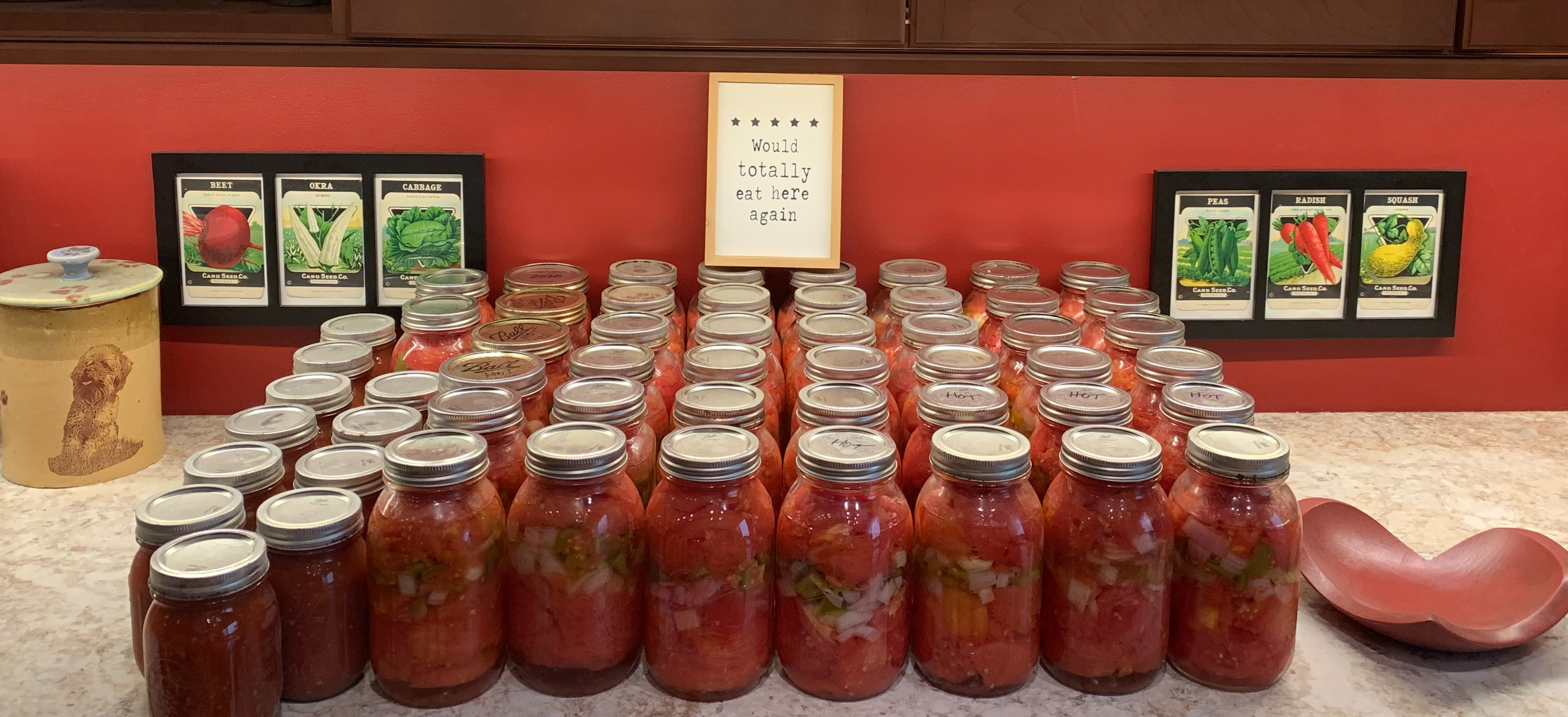
 Lynn: My introduction to Lewis Hine came through Russell Freedman and his memorable book,
  Nice things often land on my porch and recently something especially nice arrived. It was an unexpected surprise too—one I didn’t even know was coming. Inside the box was an advanced reader copy of
  (Candlewick/Templar, 2020) by Dawn Casey.
 by Sibylle Delacroix.
 This gentle, spare picture book story will help many young children who have lost a parent. In the story, a gorilla follows a young boy home from his mother’s funeral. The boy asks the gorilla questions like “How do you know when someone has died?” Or “Will we all die?” The gorilla answers in short, truthful sentences, “Yes. We all do. But you have many more kites to fly.” The gorilla stays with the boy through the dark days as he and his father struggle to rise from their own grief to connect fully with each other. Eventually, the boy and his father find their way back to each other and that connection is wrapped in a big hug surrounded by a gorilla hug before he wanders off, perhaps to help the next child who needs him. Cindy Derby’s expressive watercolors highlight the moods and emotions with a mostly somber palette that lightens on the brighter days. Even in the darkest times, though, there are tiny sparks of color…a red cardinal, red and blue kites, bright crayons, hinting that while the dark is overwhelming, there is still joy to be found. This is simply a beautiful book to share in hard times.
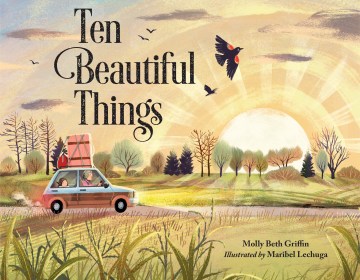 Lynn: Something has happened in young Lily’s life. Molly Beth Griffin’s Ten Beautiful Things (Charlesbridge, 2021) opens with a scene showing a young girl in a car seat. She has an Iowa map open on her lap and a backpack and stuffed animal ride beside her. The scene on the next page widens to show a small car rolling through the dark night, an older woman at the wheel. “Let’s try to find ten beautiful things along the way,” says Gram. Griffin never reveals what has happened but Lily’s chest is “hollow” and her eyes and posture are sad. “There’s nothing beautiful here,” she says. “Lily felt the complaints starting in her belly again, coming up her throat and nearly out her mouth.” But one by one, slowly the world provides a different answer for Lily.
 I’ve baked hundreds of gingerbread people in my day, but I’ve never been able to make them rise from the cookie sheet and dance or fight off invaders, like Mona does in
  Hardworking people in the trades are center stage in
  bookendsblog.net