Unsolved Case Files: D.B. Cooper

Cindy: Have we got a new series for you to put on standing order! Escape at 10,000 Feet (Balzer+Bray/HarperAlley, March 2020) by Tom Sullivan is the first book in the new Unsolved Case Files series based on real FBI cases. This graphics-intensive nonfiction title features the D.B. Cooper case, the only unsolved U.S. airplane highjacking case. On Nov. 24, 1971 a man in his 40s wearing a business suit and carrying a briefcase entered the Portland International Airport and bought a $20 one-way ticket to Seattle. Once seated in the back of the plane he lit a cigarette and handed a note to a flight attendant. The note?

Miss, I have a bomb here and I would like you to sit next to me.

From there, readers not familiar with the case learn about D.B. Cooper’s demands, the heist of $200,000, and the decades-long search for Cooper and the money. Young readers will be riveted with the details, including the astounding discovery of $5800 of the marked bills by an 8-year-old boy in 1980. Did Cooper survive the jump? If so where is he, and where is the rest of the money? A year or so ago a sixth-grade boy asked me if I had any books about D.B. Cooper. I wish I’d had this book then. The next in the series is Jailbreak at Alcatraz (Sept. 2021). I can’t wait!

Lynn: I know that there is crime and possible death at the heart of this unsolved crime but honestly, what a total hoot this book is!! Today’s kids are far too young to remember the show Dragnet but Tom Sullivan writes with a terrific deadpan Dragnet’s “Joe Friday” voice that is perfect for the topic. OK—most of you faithful readers are probably way too young to remember Dragnet too. So just take my word for it, this is Joe Friday with a sly sense of humor. Since this unsolved crime took place in 1971 when a LOT of things were different, Sullivan had to provide some background information for kids. The hijacker, for example, simply carried his briefcase/bomb on board with him, so one sidebar explains that, yes, in 1971 you just walked on a plane without ever having your baggage security checked. After settling into his seat, the hijacker ordered a drink, lit a cigarette, and handed a note to the stewardess. Here the sidebar assures readers that in 1970 people could smoke anywhere as astonishing as that sounds today. Sidebars also add a wild assortment of related ephemera that is irresistible, such as a diagram of the critically important rear staircase or what all the markings are on a $20 bill or a map of where the 3 bundles of marked bills were found nine years later by some campers.

I love the illustrations in this graphic novel too. Not to mix my references but the style reminds me of another icon of my childhood, the comic Dick Tracy, the crime-fighting hero with a geometric square jaw and unsmiling visage. The drawings are a perfect match to the just-the-facts, ma’am text. I read this in galley so I haven’t yet seen the promised photos from the FBI Files on the case that are to be included in the finished copy but I’m eager to.

Elementary and middle school librarians—you are going to need a zillion copies of this book to meet demand once the kids see it!


And Baby Makes Three – With Free Shipping! Picture Book Stories of New Families

Lynn and Cindy: Babies sometimes join families in unusual ways. We love these two recent picture books with stories about two very different babies bringing joy to their new families. One is a sweet story sure to melt reader’s hearts and one is a hilarious look at a truly out-of-this-world family. Both are stories that young readers are sure to love and both present a reassuring of love and acceptance, no matter the method of arrival. Enjoy!

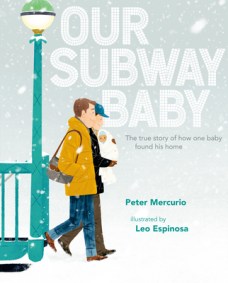
Cindy: First up is a nonfiction adoption story told by father to son.   On the way home from work as he is leaving the NY subway, Danny spots a bundle in the corner and discovers a baby just a few hours old wrapped in a sweatshirt. The police were called, the newspapers covered the story, but Danny wasn’t allowed to visit the baby to check on him because he wasn’t family. Our Subway Baby (Dial, 2020) by Peter Mercurio tells the story of his partner Danny’s first encounter with the baby, a special judge, and the path to their adoption of Kevin so he could have a loving home. These two young fathers experience all the emotions of first-time parents, nervousness, excitement, and love for their new son. The author’s note has family photos including one of college-age Kevin who is studying mathematics and computer science. It also tells of another special event they had with Judge Cooper in addition to their adoption process. It’s a heartwarming story that will make you smile and a nice addition to the dearth of adoption stories for young children considering the adoption numbers in our country.
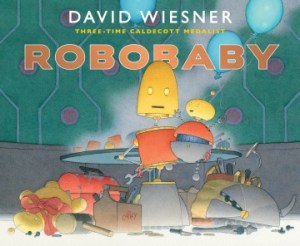
Lynn: Our second story is about a baby who gets delivered—right to the front porch! The robot family introduces little Cathode (Cathy) to her new baby brother. All he needs is a little assembly since he arrived in a box. Robobaby (Clarion, 2020) by David Wiesner is a 278 lb. bouncing baby robot, but Houston, we have a problem! Apparently, robots don’t read directions any better than we humans, so increasingly disastrous attempts to assemble the new member of the family are hilarious failures. Little Cathy knows just what to do but the grown-ups just won’t listen! This family truly needs a Dr. Spock! Happily, Cathy knows just what to do and little Flange is finally “Brmmming” happily in his crib. But wait! What’s that package on the porch?
Wiesner is the master of space, panels, and subtle visual jokes and each colorful page is a joy to explore carefully. Speech bubbles and lots of sound effects make the book a fun read-aloud but this is best suited as a lap book where the many clever details can be discovered. Kids will love this and their caregivers will too.

I Talk Like a River – A Perfect Pairing of Text and Illustration

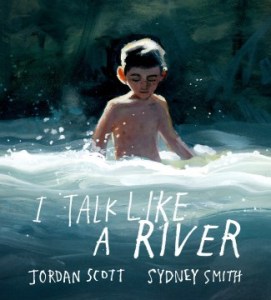
Cindy:  It mystifies me that people can still be mean to others for their looks, their disabilities, and other things out of their control. Little is more isolating or heartbreaking than the loneliness of being singled out or mocked or bullied for something that is just a part of who you are. No matter how many “Kindness Matters” or “Be Kind” movements there are, we still have work to do to spread compassion. I Talk Like a River (Holiday/Neal Porter Books, 2020) by Jordan Scott and illustrated beautifully by Sydney Smith, shines a light on one such effort. The young boy in this book stutters. With poetic metaphor, Scott writes of words that take root and stick and turn to dust in his mouth. Speaking aloud in front of a class often makes for a “bad speech day.” His father can tell and offers to “go somewhere quiet.” They head to the river, a favorite place, where his father one day points out the movement in the river, the bubbling, churning, whirling, crashing. But after the rapids are calm places where the river flows smoothly and he tells his son, “You Talk Like a River.” That line comes from Scott’s own father, who helped him with his own stuttering. This will make a beautiful read aloud in a classroom and would pair well with Jacqueline Woodson’s Each Kindness.
Lynn: We were lucky enough to see this book in galley at a Midwinter preview a year ago and it has been on my to-read list ever since. The finished copy is even more outstanding than I remembered. Sometimes the text of a picture book and the illustrations aren’t always equal in quality but that is not the case here. Rarely have I seen a case of the two coming together so perfectly. The text is deeply moving with writing that is ideal for a young audience and metaphors that every child can grasp.

“The P in pine tree grows roots in my mouth and tangles my tongue.

The C is a crow that sticks in the back of my throat.”

The illustrations are perfectly partnered with the text. Some are luminously beautiful, especially the scenes of the river. Some are ominous and threatening such as when the class has turned to stare when the boy is called on to answer in the classroom. Using watercolor, ink, and gouache, illustrator Sydney Smith’s art doesn’t just extend the text, it amplifies each emotion and experience. There is a gatefold center spread that opens to a shimmering image of the boy standing in the river backlit by the sun that is stunning! There are no words here but the images refract the overall healing sense of the place, the experience, and the father’s love and support.

Readers will come away from this book with a clear sense of the struggles the child experiences with his stutter and that is valuable. Perhaps more valuable is the underlying knowledge that the child is loved, supported, and understood and the strength that provides.

Update: We had this post in the queue and missed getting it published before the book was honored at ALA Midwinter with a 2021 Schneider Family Book Award for Younger Children. Congratulations!


A Pura Belpre Honor – An “Army Kid” and the Vieja

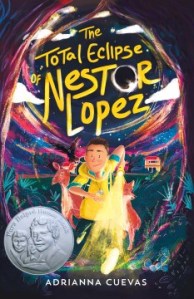
Lynn: Nestor’s dad is deployed to Afghanistan and Nestor and his mom have moved AGAIN. This time they’ve moved in with Nestor’s abuela instead of to another army base. Nestor loves his abuela (and she is a great cook!) but this is the 10th time he’s been the new kid in school. How long before he has to move again? In The Total Eclipse of Nestor Lopez (Farrar, 2020), debut author Adrianna Cuevas explores the worries and struggles of kids with an active-duty military parent but also spices her story with a nail-biting supernatural adventure.

Nestor misses his dad deeply and worries about him, writing him letters that he keeps bright and positive but he also resists getting too comfortable in this new school, knowing he will have to move again. But this time might be different. Nestor quickly makes some friends and just as quickly gets drawn into a scary situation. Animals in town are disappearing, there is something terrifying in the woods and the townspeople are suspecting Nestor’s abuela of being a witch. Nestor and his friends set out to rescue the animals and solve the mystery. And, oh yes, Nestor has a secret gift – he can talk to animals and that just might be the key to everything.

Fast-paced and quickly immersive, this is a real treat to read. Well developed characters and an intriguing plot will keep kids racing through the pages. Nestor’s voice is immediate and authentic. South American folklore adds a terrific element to the tale. Readers from military families will appreciate Nestor’s struggles as will kids from so many families across the US who change schools often. A great addition to library collections, this will make a great book talk! Congratulations to Adrianna Cuevas for winning a Pura Belpré Author Honor Award!

Young Readers Meet the “Maestro of Glass” – World of Glass: The Art of Dale Chihuly

Lynn: The team of Jan Greenberg and Sandra Jordan have brought a wonderful array of artists to the attention of young readers in their many books including Andy Warhol, Louise Bourgeois, Frank Gehry, Martha Graham and Vincent Van Gogh. I’ve found all the team’s books fascinating but their new book has to be my favorite yet. World of Glass: The Art of Dale Chihuly (Abrams, 2020),
This visually spectacular book is an excellent meshing of biography, introduction to the singular creative process of glassblowing, and an exploration of Chihuly’s work and series. The authors do an excellent job of presenting a complex and unusual subject in terms appropriate for younger readers without oversimplifying it. Greenberg and Jordan were able interview Chihuly extensively in his studio and the result is a fascinating look at this extraordinary artist. The text is peppered with Chihuly’s comments and reflections and has a terrific in-person feel to it.

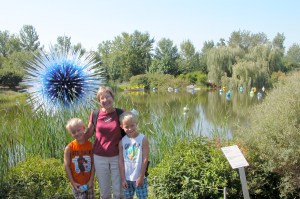
And as it should, the book is as much photographs of Chihuly’s work as it is text. It is a stunningly beautiful book and masterfully designed, featuring color photographs, many full page. Some show Chihuly and his team at work, some are historical from his early life but most are of the gorgeous glass artwork in sites, installations, and museums. To see something created by Dale Chihuly is an unforgettable experience and this book will delight those already familiar with his work and will surely create new admirers. I learned a lot and esteem this artist all the more. I will never forget the Chihuly installation at the Frederick Meijer Gardens. It drew throngs of people and my young grandsons and I made multiple visits. They begged for repeat visits and what Grandmother could say no to that?
Cindy: Imagine with me. A family visits an outdoor exhibit of Dale Chihuly’s art and then spots this book in the gift shop. Mesmerized like Lynn and her grandsons, they buy the book and discover it is one that the whole family will look at again and again. They learn about the whole team behind Chihuly who help create his visions in thousands of pieces of blown glass. Glimpses into the studio of the glass blowing process are fascinating and often look more like circus acts than artistic creation. They see the protective suits worn to carry the new HOT creations to an annealing oven where they might cool for twenty-four hours. They read about the team of 30 that travels with him and the 100 local workers he hires to help install the many pieces of glass into the stunning completed work. Included in the story is the heartbreak of Chihuly losing his brother, his father, and one eye in tragic events and the loving support of a mother who encouraged a wild young boy to be who he needed to be. It’s a book to return to as many times as you long to return to a Chihuly Exhibit once you’ve seen one. I had the joy of seeing some of his same works exhibited in two very different environments, first at the Phoenix Botanical Garden, and then again in Grand Rapids, Michigan with Lynn at our exemplary Frederick Meijer Gardens. It was fascinating how different the glass looked among cactus with desert mountains behind compared with our green, wooded, and water landscapes. If you get out our way, you can see “Lena’s Garden” a glass flower ceiling in the cafe and the “Gilded Champagne Glass Chandelier”, both worth the visit. Of course, not every kid will have the opportunity to see these sculptures in the wild, or to purchase the book, so libraries, once again, will open new worlds and ideas and experiences for everyone. Stock up. Jan and Sandra, we already can’t wait to experience your next book! 


Chance – Uri Shulevitz’s Story of Survival and Hope

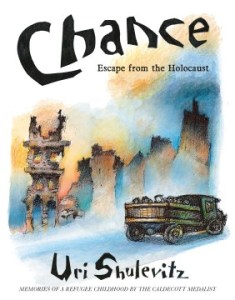
Lynn: Survival in desperate times is often a matter of chance as Uri Shulevitz says in his new book, Chance: Escape from the Holocaust (Farrar, 2020). But as in all things in life, there is much more to Shulevitz’s story. This book is a searing tale of horrifying privation but it is also about determination, love, and the start of an artistic life.
When Uri Shulevitz was only 4, the Nazis attacked Poland. Uri’s father fled into Russia and the plan was for Uri and his mother to join him later. In a brief period when the borders remained open, Uri and his mother traveled by smuggler’s truck from German-occupied Poland into Russia, joining his father in Bialystok. Escaping from the Nazis was an incredibly fortunate act but this still was the beginning of 10 years of horrifying oppression, extreme poverty, disease, and starvation. Denied employment except in labor camps, the family traveled to a settlement north of Arkangel on the Baltic Sea, east to Turkestan, and in 1945, an equally harrowing journey back to Warsaw and eventually to Paris.

Shulevitz writes for a young audience and he forges a remarkable combination of an honest picture of the reality in language and images appropriate for the audience and manages somehow to never be overly graphic. Shulevitz speaks straight to the reader and his choices of small vignettes move the story forward while also skillfully giving youngsters the tools to understand the unimaginable.

“Hunger is hard to describe to someone who hasn’t experienced it,” he writes.

He goes on to describe being so hungry that his mother made and cooked a patty of grass for him. Uri devoured every bit and then, unable to process it, he suffered intense diarrhea, having to flee to a maggot-ridden outhouse with no roof and wipe himself with stones because there was no toilet paper. Shulevitz also provides the moments that kept him going. Drawing was his lifeline and his love of the stories his mother told.

“My poor loving mother couldn’t feed my body but she did magnificently feed my mind.”

It is the masterful use of these and other brilliantly written moments that make this a book that readers will never forget. This is a truly inspiring story of deep suffering and amazing survival. It is a look inside a mind and soul who somehow came out the other side of a living hell and triumphed after all. This book is a gift to us all.

Cindy: We know Uri Shulevitz from his long, successful career authoring and illustrating award-winning picture books. Departing from this format, at age 85, he has written a memoir that will find a wide audience age range, starting with the upper elementary students who can handle the painful experiences. For the older students and adults who read this, it will be a book they won’t forget. The painful events and the sweet, simple joys that helped Uri and his family and all of those with shared experiences, are chronicled not just in words, but in Uri’s art. He started to draw at the age of three and encouraged by his parents, continued to use his art as one survival strategy. The scenes include touches of architecture and his surroundings but feature the vivid expressions of the many emotions, illnesses, and deprivations he experienced. Photographs and mementos that miraculously survived the wartime travels are included as well. Farrar, Straus, & Giroux deserve mention for giving this book the quality bookmaking that it deserves. It is a beautiful volume that will become a classic.

This past year as many have endured family loss and true hardships and others have complained about less serious deprivation like toilet paper shortages and mask-wearing, this memoir shows another time in our history in which true suffering was faced, and if you had good fortune or chance, you endured. Ingrid Roper interviewed Mr. Shulevitz for this July 17, 2020 Publisher Weekly article, and at the end, he speaks of what he hopes will help others through our current pandemic:

“My mother’s stories and drawing were a lifeline for me during that time as a refugee,” he says. “And I hope readers will seek their own lifeline now. Everyone is different, and it will be different for everyone. But finding that is critical. And if this book helps them do so, my book will be happy and so will I.”

A Classroom Gem – Dictionary for a Better World

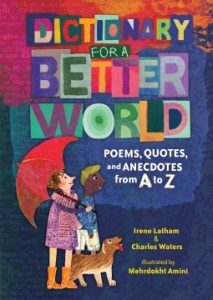
Lynn: What words would you use to describe a better world? That is what Irene Latham and Charles Waters have done in Dictionary for a Better World: Poems, Quotes, and Anecdotes from A to Z (Carolrhoda, 2020). They use words like hope, humility, and empathy as well as more unexpected words like laughter, exercise, and netiquette. The opening page shows an abecedarian style poem using all the words they’ve selected. From there, the book moves to an alphabetic dictionary using the words.

But it is not just a simple definition that the reader finds. Rather, each entry features a poem in a wide-ranging number of forms, a note that identifies the form, an inspiring quote related to the word, a personal reflection on the word by one of the authors, and a suggestion for an activity.

This is a book to be sauntered through, enjoyed, and reflected on. It is a gem for the classroom with a multitude of uses. It is thoughtful, playful, earnest, and challenging. The quotations are wonderfully selected, rich, varied, and thought-provoking and from such diverse sources as Oprah Winfrey, Hippocrates, and a glorious wealth of youth literature. It was a personal delight to find The White Darkness quoted here.

Mehrdokht Amini’s illustrations add a lively interest to each page turn. The excellent back matter includes a wonderful Authors’ Note, a list of the books, poems, and speeches referenced, additional recommendations, an index of the poetry forms used, and the authors’ Gratitude List, one of the activities suggested. The more you look at this treasure of a book, the more wealth you find. Language Arts teachers especially, don’t miss this!

Furia – Following Her Dream

Lynn: There is a saying in Camilla’s family, “Lies have short legs.” She has heard this all her life but despite this, Camilla has been lying to her family for over a year now. Yamile Saied Mendez’s debut novel, Furia (Algonquin, 2020) has a setting and a theme unusual in American YA. 17-year-old Camilla Hassan lives in a barrio in Rosario, Argentina. She is a tremendously gifted athlete, dreaming of playing futbol at the professional level. It is exciting to have this strong new voice and subject. But this is much more than a “sports” book. The driving theme of this exceptional book is the exploration of an extraordinary young woman fighting cultural and family expectations to follow her dream.
Camilla has been leading a double life. Her strict family and domineering father, in particular, think she is the model daughter, studying hard for a career as a doctor. And Camilla IS the perfect daughter. She works hard, she is making excellent grades, she stays away from the temptations and perils befalling many of her classmates. But she has also been playing on a women’s futbol team for over a year. Camilla shines as an athlete, dominating the field, and earning the nickname “Furia.” Somehow she has kept this secret from her family, washing her uniforms secretly, hiding her equipment, and struggling to balance practice, games, and school. Now, her team has qualified for the South American tournament and Camilla knows that this opens doors for her to play professionally. But this tournament requires parental consent for travel and more. Camilla can no longer hide her dreams from her family.

Mendez adds even more complications to the story. Camilla’s childhood friend and first love, Diego is the pride of Rosario, playing international soccer for the Italian team, Juventus. He is a true futbol star and he stopped writing to Camilla more than a year ago. Now, suddenly he is home visiting and intent on rekindling his relationship with Camilla. Wary of being hurt again and even more fearful that her dreams and goals could be sidelined by her feelings for Diego, Camilla is overwhelmed by all she is trying to juggle.

I am a long-time futbol fan and I greatly enjoyed seeing the sport, especially the women’s teams, as the focus of the story. My only quibble might be that I yearned for a bit more scenes of games and practices. But the overarching exploration of this fast-paced and fascinating story does not require a sports fan to appreciate. This is a universal theme that readers everywhere can relate to, portraying the many obstacles a young woman faces to follow her dream. The reality of the difficulties presented by family demands, cultural obstacles, relationships both romantic and family, and the lack of resources and financial support will resonate with many teens. It is a balancing act that young women everywhere will understand.

First-time author Yamile Saied Mendez keeps a lot of balls in the air in this heart-felt story and she manages them all well. She is an author to watch and Furia scored all the goals for me.

See the Cat – Metafiction as a Primer

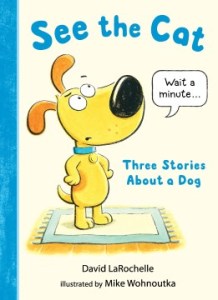
Lynn: I learned to read from the Dick and Jane primers and I remember Dick, Jane, Sally, and Spot to this day! We have come a long way since then, folks! I know that most of you out there came along after Dick and Jane but I know that David Rochelle’s new book, See the Cat (Candlewick, 2020), a delightful spoof of the classic primers will please all generations, most importantly the current crop of beginning readers.
This three-chapter book opens with our hero, Max the dog, responding to the text, “See the Cat.” “I am not a cat,” responds Max, indignantly. Each page juxtaposes a Dick and Jane type statement and an illustration of  Max, reacting to the statements which get progressively sillier. As in any good beginning reader, there is ample repetition of the words and illustrations to assist in understanding. What sets this excellent book apart is the clever humor that works so well for the audience. Mike Wohnoutka takes the joke and extends it wonderfully. Readers will be giggling through the entire book as each page-turn offers another riff on the on-going joke.

Kids will read this adorable book over and over and start on the path to being happy lifelong readers. “Hurray for David, Mike, and Max,” said Lynn.

Cindy: With Covid quarantining and social distancing, it has become harder for Lynn and me to exchange books to review so we’ve had more solo posts than usual (my committee reading and birding obsession may have contributed to those increased solos as well) but we recently risked infection to share this delightful book. I need funny books right now and this beginner reader made me laugh out loud. I can sympathize with Max in the third story as he is denied a nap, but it is a new grandpuppy that is keeping me from my naps.  At any rate, Mike Wohnoutka’s comic illustrations add to the fun text and will delight the adults who are helping the young readers who are finding their way to the magic of reading. Great job, guys. You deserve treats…but I’ve run out while trying to keep my shoes from being chewed.


2020 Just Won’t Let Up…Grim Books

Cindy and Lynn: You’ve got to be kidding? We’re in the middle of a pandemic, economic depression, and an unprecedented post-presidential election transition and you should see the books the publishers are sending us to read! We understand that reading builds empathy and provides survival and coping strategies, but we need cuddly puppies, comfort food, and beach reads since we can’t travel to beaches. Instead, take a look at the depressing topics the authors and publishers are offering up:

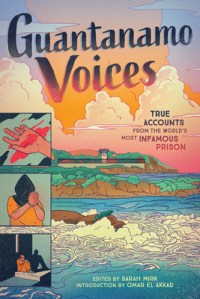
Guantanamo Voices: True Accounts from the World’s Most Infamous Prison (Amulet, 2020)

“You want the truth? You can’t handle the truth!” Yes, it’s a graphic novel, but that just makes it all the more depressing to think about reading since it illustrates in words AND pictures the horrors that happened at this prison. Important stories, to be sure, and about a subject most of us know little about, but hardly the beach read that the picture postcard-inspired cover promises.

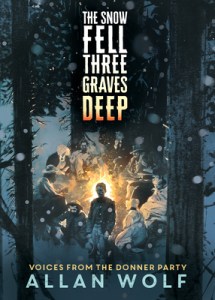
The Snow Fell Three Graves Deep: Voices from the Donner Party by Allan Wolf (Candlewick, 2020)

Narrated by Hunger, the tragic story of the men and women and children who end up stranded in the Sierra Nevada Mountains with nothing to eat but their dead does make our toilet paper shortages of 2020 seem lame, but really? Is this the book you want to read NOW?

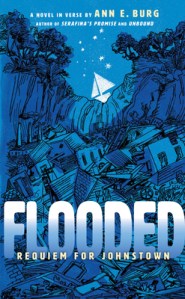
Flooded: Requiem for Johnstown by Ann E. Burg (Scholastic, 2020)

As if the natural disasters the world has been facing all year aren’t enough, let’s revisit one of the most horrific manmade disasters, which at its root was due to class divides and social injustice.

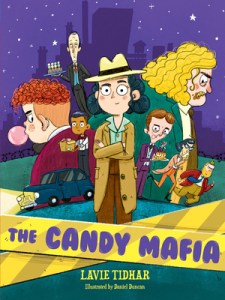
The Candy Mafia by Lavie Tidhar (Peachtree, 2020)

You know things are bad in the reading world when even the promise of sweet candy leaves a bad taste in your mouth. Welcome to the world of black market candy rings…

Good grief! This list looks like the Goodreads account for Count Olaf! What books have you seen that you just can’t pick up right now? Or, please….tell us what you are reading that is bringing you comfort!!!