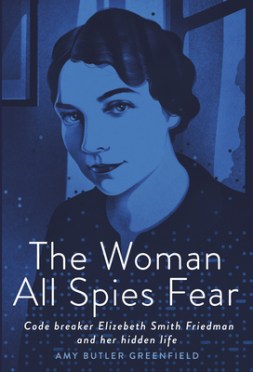
 Cindy: We realize that many of you are already familiar with this 2022 YALSA Excellence in Nonfiction for Young Adults finalist, but we have to talk about The Woman All Spies Fear (Random House Studios, 2021) by Amy Butler Greenfield anyway. Years ago, Lynn and I had a middle school girl who would only, and I mean ONLY, read books that featured math. In that pre-STEM publication world we struggled to keep her in books. Greenfield’s biography of code breaker Elizebeth Smith Friedman would have pleased that student immensely. If you’ve ever struggled to solve a coded message, you’ll appreciate Friedman’s talent.
Elizebeth left Indiana in 1916, after earning a degree in English Literature and with a need to distance herself from a controlling father. Offered a strange job at a tycoon’s estate in Geneva, Illinois, the work at Riverbank would change the course of her life and help her discover her talent for code breaking. Colonel George Fabyan, the bizarre and also controlling millionaire, had many research teams working on his estate, but Elizebeth was put to work helping a team seeking to prove that Francis Bacon was the true author of Shakespeare’s plays and sonnets. The work involved looking for ciphers within the text and also introduced Elizebeth to the man she would marry and work alongside the rest of her life as cryptanalists. Shakespeare’s authorship was never debunked, but the work sparked an interest provided a valuable training ground for understanding ciphers.
As Greenfield sheds light on Elizebeth’s growing skills in code-breaking, she also throws some challenges to her readers as she explains the various types of codes. I found myself pulling out paper and pencil to work some of them myself, and I’m sure teen readers will do the same. Elizebeth and her husband William made a great team as code-breaking involves multiple skills and Elizebeth had a talent for intuition that was invaluable in their work. Working in the first half of the 20th century, she faced bigger challenges than the codes she untangled, that of being a working female in a man’s world. Many of her accomplishments went unrecognized, the credit claimed by the FBI or other agencies as the Friedman’s escaped from Fabyan’s grips and became successful code-breakers working for the government and military the rest of their careers. Her intelligence, tenacity, and dedication to her work are inspiring.
Lynn: Cindy is so right about how inspiring this incredible woman is! Amy Greenfield does a masterful job of presenting the many facets of Elizebeth’s life and abilities, and she had to decipher this information often from the smallest of hints or comments from Elizebeth’s letters and diaries. She and William spent a lifetime dealing with the weight of world-shaking secrets, life or death discoveries, and the binding need for utter secrecy—even from each other. For much of their later working life, they each carried this enormous mental weight alone. William’s mind crumpled at many times but Elizebeth soldiered on, always supportive of him and her family. That their love for each other only strengthened despite this wall of secrecy amazes me.
The treatment of Elizebeth in the workplace, the lack of recognition for her brilliant work and the ultimate outrage of the NSA’s seizure of their personal records is something that will horrify any reader. The fact that Elizebeth persevered, achieved marvels with her work, and remained steadfast, humble, and courageous is truly inspiring. I hope young readers will be as inspired by this woman as they are outraged by the obstacles she overcame.
This is a masterfully crafted work and a well-deserved finalist in the YALSA Award for Excellence in Nonfiction for Young Adults. Greenfield carefully cited her sources, attributions, and conclusions—something of a work of crypto-analysis itself due to the intense secrecy surrounding Friedman’s work and life. It is a compelling story to read as well. A perfect choice for any high school collection and ideal for STEM collections as well.
 Cindy: In 1984 I graduated with my MLS and Gary Paulsen published
  if not as easily as a thick swarm of mosquitos on a hot summer night. We all mourned in October when we heard the news of Gary Paulsen’s death, but his stories will always be with us. And, there’s one more on the way,
 Lynn: The team of Jan Greenberg and Sandra Jordan have brought a wonderful array of artists to the attention of young readers in their many books including Andy Warhol, Louise Bourgeois, Frank Gehry, Martha Graham and Vincent Van Gogh. I’ve found all the team’s books fascinating but their new book has to be my favorite yet. World of Glass: The Art of Dale Chihuly (Abrams, 2020),
 some are historical from his early life but most are of the gorgeous glass artwork in sites, installations, and museums. To see something created by Dale Chihuly is an unforgettable experience and this book will delight those already familiar with his work and will surely create new admirers. I learned a lot and esteem this artist all the more. I will never forget the
  Lynn: Survival in desperate times is often a matter of chance as Uri Shulevitz says in his new book,
  Cindy: What I learned about classical music was mostly learned during my high school days playing flute in our small school’s band and later watching the movie Amadeus. I’m not quite serious, but almost. My middle school orchestra students are probably way ahead of me today. It’s not for lack of wanting to know more, it’s for the lack of knowing where to begin or how to approach such a large body of music of which I know so little. If it’s intimidating to me, it surely must be for a teen who may have even less interest in pursuing that interest without some inspiration. And thus, concert pianist James Rhodes to the rescue for many of us.
 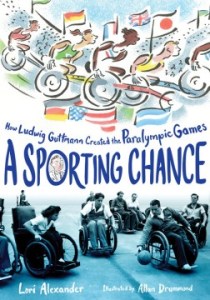 Lynn: I’ve seen a T-Shirt recently that proclaims, “I read. I know things.” I like that but what I want is a T-Shirt that says, “I didn’t know that!” I needed to wear that shirt when I read
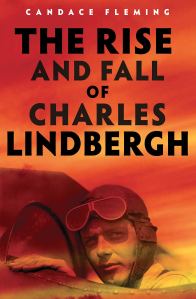 Just as Fleming did with
  bookendsblog.net