Lynn: 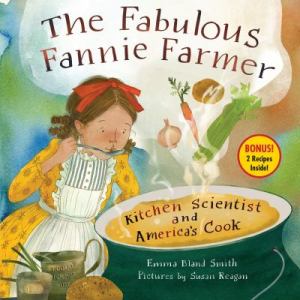 I love how science can be found everywhere! The importance of ratio, reactions, and measurement is as important to great food as the ingredients themselves. But that understanding wasn’t considered important until a young cook named Fannie Farmer started thinking about recipes and culinary instruction in the late 1800s.
Emma Bland Smith brings Fannie’s story to readers in her fascinating new picture book, The Fabulous Fannie Farmer: Kitchen Scientist and American Cook (Astra/Calkins Creek, 2024). There is so much to talk about here, but I’ll try to stay with the best ingredients and let your interest rise. Fannie Farmer grew up in a time when home cooking was considered a woman’s activity and therefore not really worthy of the respect shown to the great male chefs. Girls learned to cook from their mothers with recipes passed down through the generations and cooking was considered a womanly instinct. A lump of this, a pinch of that, as many egg yolks as necessary were all the measurements anyone needed!
Young Fannie’s dreams were of becoming a teacher, but those evaporated when Fannie, at age 16, contracted polio and was bedridden for several years. Cooking was her therapy and Fannie became an excellent cook as she recovered. With encouragement from friends, 31-year-old Fannie decided to enroll in the Boston Cooking School in 1888, and there, her talents as a teacher, cook, and scientist came together. Wanting to help home cooks produce reliable, excellent, and nutritious meals, Fannie began to measure, test, observe, and record her recipes. Students flocked to her classes, and in 1894, Fannie approached publishers with the Boston Cooking School Cookbook, which she had revised and rewritten. The publisher was skeptical but Fannie’s cookbook was an instant success, selling over 300,000 copies in her lifetime and over 7 million to date.
Emma Bland Smith’s clear, age-appropriate writing manages to be fun and fascinating while incorporating historical background and making this a terrific book for starting discussions on the scientific method, women’s roles in history, and the science of cooking. The book’s appeal is heightened by the charming watercolor illustrations by Susan Reagan. As to be expected with a Calkin’s Creek book, the back matter is outstanding, providing additional information on Farmer and her legacy, the science of measurement, polio, the development of the American recipe, resources for young readers, a Timeline, and wonderful historic photographs.
This is a great choice for all elementary libraries and STEM classes while still being an excellent read-aloud and discussion starter. Enjoy!
 bookendsblog.net