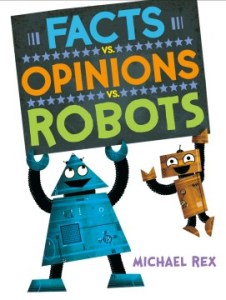
 Lynn: You’d have to live in a cave in the wilderness not to know that far too many Americans have a very sketchy concept of what a fact actually is or how to verify it. The need to understand this important issue is one of national importance these days as it is clear that millions of adults don’t grasp the difference and the impact on our culture is stark. Here, with a great way to start addressing the issue, is Michael Rex with a fabulous picture book, Facts vs. Opinions vs. Robots (Penguin/Nancy Paulsen, 2020). With brightly colored cartoon-style robots, Rex’s appealing book takes on this topic with our youngest readers. The question is posed on the very first page.
“Do you know the difference between a fact and an opinion?
It can be a hard thing to understand. Even these robots get confused.
But maybe if we work together, we can figure it out.”
Taking it step by step, the robots define the two concepts and then provide simple examples to practice. The examples are engaging and child-centered with plenty of humor. The robots are goofy but Rex does a wonderful job of presenting the information in a clear, understandable, and appealing way. Kids are going to WANT to read this book all the way through thanks to the level of humor but more importantly, they are going to grasp and remember this idea. The story also includes the concept of needing to search for more information sometimes and also reminds readers that while we need to respect other people’s opinions, we can’t argue with facts.
If I could, I’d buy this book for every classroom and library in America!
Cindy: What a great way to introduce an important skill in information literacy. Elementary librarians, take note! What if you read this book aloud and then had your students write a declarative sentence and have them present it for the other students to respond with Fact or Opinion? This could work in a virtual class meeting as well. Students could make a 2-sided notecard with the FACT on one side and OPINION on the other and hold them up to their cameras. Lots of ways to use this in an elementary classroom as well.
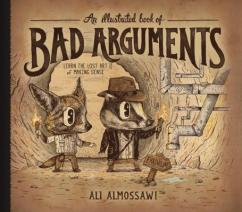 This book for the very young audience brings to mind a book for older students that we reviewed over at Booklist Reader during the last presidential election cycle and it’s worth mentioning again as the facts, opinions, and faulty logic arguments ratchet up. Read our blog post about Bad Arguments: Learning the Lost Art of Making Sense (The Experiment, 2014) by Ali Almossawi if you missed it the first time around. It’s a good time to separate facts from opinions and to do it without faulty logic.
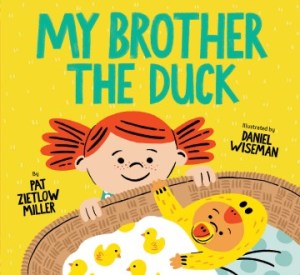 Lynn: Take one “fledgling scientist,” aka young Stella Wells, who is clearly not pleased about the impending addition to the family, and add a father’s joke. “You’re waddling,” he tells Stella’s mom, “We must be having a duck.” Stella is not amused because if a “baby was bad enough, a duck was unacceptable.” Stella decides much more research is required and sets out to gather facts to prove her hypothesis. Pat Zietlow Miller takes on the scientific method in her very funny new picture book,
  Wiseman has as much fun with his ducky illustrations and hidden “eggs” in the brightly colored art as Lynn does with her puns. Make note, the twist ending will have everyone laughing.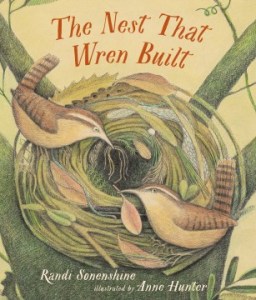
 Excellent back matter includes an illustrated glossary and a page of additional facts about wrens. A perfect choice for a STEM classroom and one that would make a great writing prompt as well.
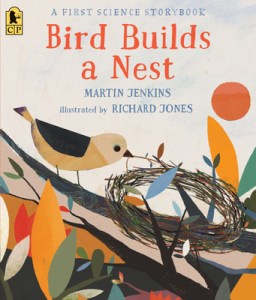
 For the youngest children, try
 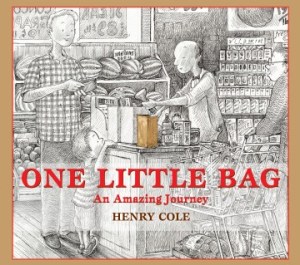 Lynn: I am writing this post as I start the second week of self-isolation and as I do, I am thinking about how differently I am already seeing my world. Some things matter more to me and some seem completely irrelevant. I don’t know how much we will be changed by the events of COVID-19 but I suspect that many of us will feel an even deeper commitment to caring for each other and caring for our world. I loved Henry Cole’s book,
  Cindy:
  Lynn: Frederick Olmstead and Calvert Vaux’s extensive planning, hard work, and attention to every detail resulted in a spectacular garden. But Madelyn Rosenberg imagines a denizen of the park that never showed up in those original plans in a delightful picture book titled,
 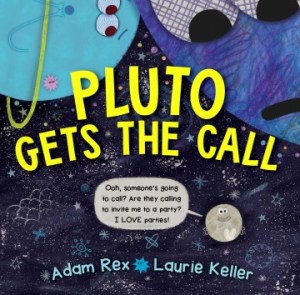 Lynn: Who doesn’t love an underdog or in this case an underplanet? Lots of us have been rooting for Pluto ever since it got reclassified as an ice dwarf a while ago. Adam Rex tops my planetary chart though with his hilarious AND informative new picture book on Pluto,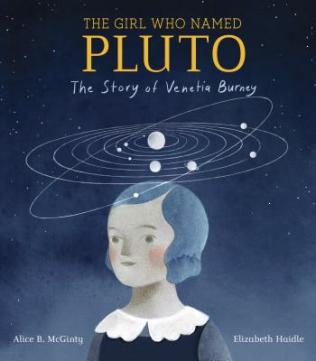
 Lynn:
Lynn: 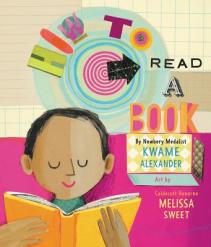 Cindy: You won’t be able to miss the neon-bright cover of
  Lynn: One of the great joys of the children’s publishing world today is the small publishers bringing us books from other countries and cultures. This is such a gift to young readers whose understanding of the world will be enriched and expanded by these wonderful books. One of those publishers is Greystone Kids, a Canadian publisher of books by both Canadian and international authors. We have fallen in love with a new book from them,
 Sunny Rolls the Dice
 Guts
Guts
 bookendsblog.net