Outdoor Fun with Board Books

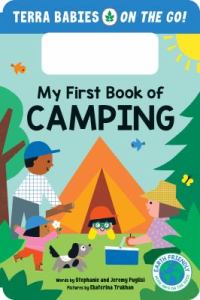
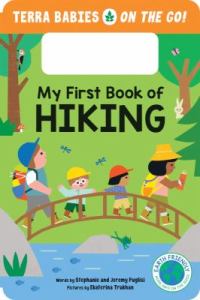
Lynn:  Families who love the outdoors are eager to introduce their little ones to the fun of camping and hiking. Many schools around the nation are integrating outdoor education into their curriculum. It’s not always easy to find books on these activities for pre-schoolers, so I am excited to write about two excellent board books from Duopress, an imprint of Sourcebooks. The series is Terra Babies on the Go, and the two titles I want to feature are My First Book of Hiking and My First Book of Camping.

Both are bright and appealing, with a charming set of diverse children. The text is simple and appropriate but introduces terms for gear, activities, places to go, and simple safety rules. Both mention animals and sights that might be seen. The camping title includes a recipe for S’mores and the Hiking volume has one for a healthy trail mix.

The books are sturdy and rugged enough to be taken along on a trip and are even constructed with a handle for convenient carrying by a child. These are really delightful and will certainly be read over and over.

I want to mention another book from Sourcebooks for older kids. Let’s Go Camping: a Journal & Logbook for Kids (Sourcebooks/Explore, 2025 by Stephanie and Jeremy Puglisi. This paperback journal and activities book is packed with ideas, puzzles, games, and suggestions for hours of fun related to camping and the outdoors. Kids can list animals spotted, review campgrounds, do word puzzles with camping terms, or connect the dots of constellations. There are many places to write or draw what they see and experience. They can do leaf rubbings, seed mosaics, or other fun activities. This journal publishes on June 3 and is perfect to take along for quiet moments, a rainy day in the tent or driving home in the car.

Get these soon! Summer is around the corner!
Sy Montgomery Introduces Kids to Turtles

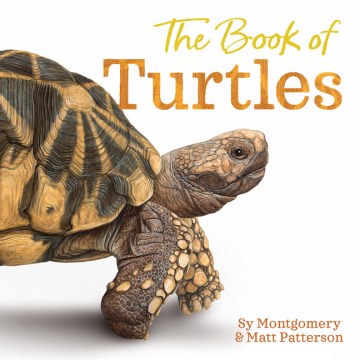
Lynn: book of turtlesThe publisher blurb for Sy Montgomery’s new book describes her as “part Emily Dickinson, part Indiana Jones” and I think that is not wrong. I am a huge fan of Montgomery’s many books and look forward to each new one. Often her books are filled with stunning photographs but this time, she teams up with wildlife painter Matt Patterson to bring one of my favorite creatures to kids with The Book of Turtles (Clarion, 2023).
Montgomery and Patterson take the basic concept of a nonfiction information book to a new level with this wonderful book. Excellent writing provides fascinating facts on turtles in a captivating way. Did you know that by 220 million years ago, turtles looked the way they look today—flourishing alongside dinosaurs? Different types of turtles are introduced along with many did-you-know additional facts. Did you know that Eastern Box Turtles can climb fences or that turtles are as smart as laboratory rats?

The Celebrity Turtle Profiles were my favorite part of the book. Here you meet some famous turtles such as Lonesome George, Myrtle the green sea turtle in the New England Aquarium who loves to photobomb film shoots, and the couple at the Austrian zoo, Poldi and Bibi, who after 115 happy years together, finally couldn’t stand each other. An excellent section on how to help turtles provides practical advice.

Matt Patterson’s beautiful and carefully accurate paintings illustrate the book. Turtles come to life with his skillful brush and the book is so visually enticing that it won’t stay long on the shelves.

All the stars for this must-purchase! Kids will love this one!

Tales of Motherhood – Leopard Variety in Photographs

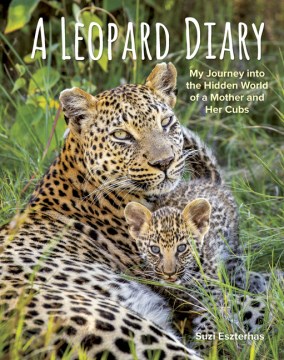
Lynn: leopard diaryMost of us think of gathering information for a book as a pretty safe activity. But not if you are nature photographer and author Suzi Eszterhas! In her recent book for young readers, A Leopard Diary: My Journey into the Hidden World of a Mother and her Cubs, (Owlkids, 2022), Eszterhas shares some really hair-raising adventures! Imagine sitting frozen in an open-sided vehicle with a snarling mother leopard just inches away after her playful cubs run under the vehicle. This was a leopard comfortable around humans but who became ferocious at a potential threat to her babies. Gulp! Or walking into the camp bathroom to discover a tiny leopard cub who had been hidden there by his mom—and who could appear any moment! These are just a few of the fascinating moments in this outstanding nonfiction book by acclaimed photographer Suzi Eszterhas (who is also a personal favorite of mine).
Eszterhas has always loved leopards so when she heard that a female leopard in the Jao Reserve in Botswana’s vast Okavango Delta had given birth to two cubs, she hurried there to photograph the family. Aided by a skilled guide she located the mother and cubs and over the next 15 months took pictures and wrote about the events.

This female dubbed Mom was quite relaxed around humans and allowed them to get close although they always remained vigilant and in the jeep. Leopards move their dens frequently to protect the babies from lions, baboons and other predators so Eszterhas and Kam often had to relocate the family, which sometimes took many hours in the hot sun. But the result is a wonderful chronicle of a leopard family illustrated by rare and breathtaking photographs.

The text is clear and packed with interesting facts and the entire effort was a true adventure and makes an extremely compelling story. The photographs alone make this a worthy read as they are a beautiful look at a rarely-seen event. The entire package is a must purchase and the cover alone will attract readers. Backmatter includes an interview with the guide, Kampongo, a glossary and additional information.

Country Kids – City Kids

Cindy and Lynn: Moving is never easy, and it’s even harder when you are a child who loves nature and you learn you have to move to the city. We have two picture books that might help ease that move or make any big change a little easier.

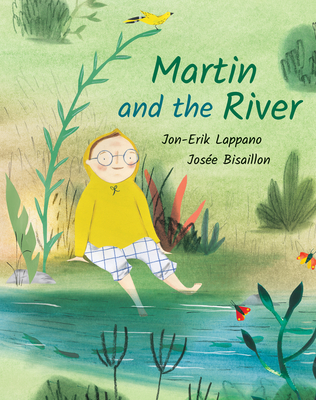
Martin and the River (Groundwood, 2022) by Jon-Erik Lappano.

Martin and the River by Jon-Erik LappanoMartin has a river flowing through the fields behind his house and he spends his days catching frogs and “watching the great blue herons soar like dragons over the water.” When his mother takes a job in the city and Martin learns they will have to move, he is devastated. Promises of museum visits and subway rides do nothing to soothe him. Martin spends time at his river trying to scheme a plan but fails to come up with any good ideas. His parents wisely take him on some visits to the city before the big move. Martin’s imagination comes to his aid and he sees bits of nature and animals in the bustling city, but his heart melts when he sees the park…with a river.
Josée Bisaillon’s mixed media art contains beautiful scenes of the nature that Martin loves and is filled with small details of the plants, flowers, birds, and animals that Martin cherishes. It’s easy to see why he doesn’t want to leave.

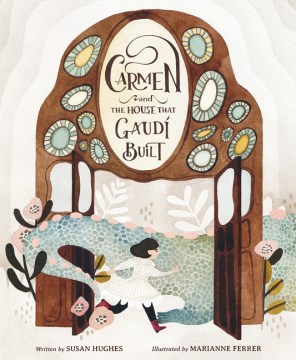
Carmen and the House That Gaudi Built (Owl Kids, 2021) by Susan Hughes.

Carmen and the House that Gaudi BuiltLike Martin in the previous book, Carmen is a country child who loves the woods around her home. She spends hours there exploring with her invisible Salamander friend, Dragon. Carmen is devastated when she learns her father has commissioned a house in the city and that soon the family would move there. When the architect, Señor Gaudi, visits, Carmen refuses to come inside to meet him but Señor Gaudi, standing on the lawn somehow sees her AND Dragon. As the new house progresses, Carmen sees the beauty of nature reflected in the designs. After two years, the house is finished and Carmen must leave her friend behind. But the finished house has an amazing wild beauty. Most astonishing of all is the beautiful stone salamander wrapped around the roof. Carmen has found a home in the city.
Susan Hughes has created a fictional story about a very real house. The Casa Batllo was redesigned and renovated for the Batllo family in 1904. Situated on one of Barcelona’s most fashionable streets, the house featured a wavy exterior and curved interior walls. Tall windows, skylights and interior courts provided light. A mosaic made of pieces of glass decorated the front of the house and all was topped with a spiny ridge along the roof line resembling a salamander. The house was named a UNESCO World Heritage Site and its impact is just as stunning today as it was in 1906.

I have been lucky enough to visit the Casa Batllo and it remains one of my favorite buildings in the world. Hughes includes an Author’s Note that provides the historical facts about the Casa, the Batllo family, and her thoughts on the creation of this picture book. A full-color photograph of the Casa is included. My hat is off to the photographer as the image somehow avoids all the tram power lines, streetlights, and signs that marred my own photos! My hat is also off to Susan Hughes, illustrator Marianne Ferrer, and this book for bringing the remarkable Señor Gaudi to a new generation.

Gone to the Woods: Gary Paulsen

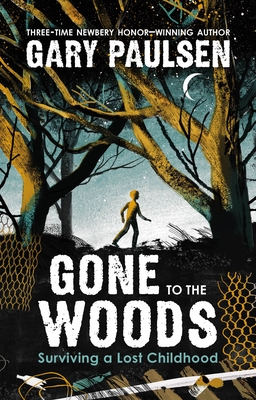
Gone to the Woods by Gary PaulsenCindy: In 1984 I graduated with my MLS and Gary Paulsen published Tracker, a story about a boy deer hunting with his grandfather. Two years later, he added Hatchet to his growing list and picked up the first of his Newbery Honor Awards. For nearly four decades I watched my middle school students forage the shelves for his stories, eager for his descriptions of survival in the wild, life on the farm, or dalliances with an even wilder side of life. Most of those stories contained elements of truth, bits of Paulsen’s life, woven into fiction or told as memoir. His latest book, Gone to the Woods: Surviving a Lost Childhood (Farrar, 2021) provides an even more intimate look into his early years. 
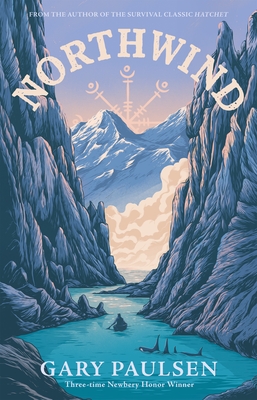
Told in third person, describing himself as “the boy,” Pauslen tells his story in five parts: The Farm, The River, The Ship, Thirteen, and, The Soldier. Here we see and feel the neglect and abuse from his parents, the love and lessons from his grandparents, and his eye-opening experiences in the Philippines that informed his time later as as soldier. In “Thirteen” he shares the story of the librarian who saved him. I’d heard it told at some of his speaking engagements, but the fuller version here can’t help but make you tear up a little, especially if you are a librarian. That she not only gave him books, and a warm place to hang out, and acceptance, but a notebook and pencil with encouragement to write his own stories…I wish every kid had such support. For the kid reading this, who may not have the support they need, the book should provide some hope, and an example that hard, lost childhoods can be survived, Northwind by Gary Paulsenif not as easily as a thick swarm of mosquitos on a hot summer night. We all mourned in October when we heard the news of Gary Paulsen’s death, but his stories will always be with us. And, there’s one more on the way, Northwind (Farrar, Jan. 11, 2022), an ocean adventure with “hints of Nordic mythology.” Thank you, Mr. Paulsen, for all you shared with us.
Ticks in Her Nose – the Story of a Wildlife Photographer for Kids

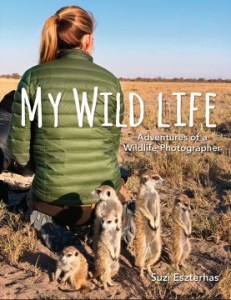
Lynn: Books for really young readers on careers are not easy to do well but a wildlife photographer/author that I especially admire, Suzy Eszterhas, has given us just that in My Wild Life: Adventures of a Wildlife Photographer (Owl Kids, 2020).  This fascinating story comes with a real bonus as the pertinent information includes a bounty of wonderful photographs that clearly expand on the points being made in the text. Eszterhas confides that she wanted to be a wildlife photographer as a child and she spent many hours in her backyard photographing her cats and squirrels, practicing the skills she would need.
Taking readers through many of the fascinating and challenging aspects of her job, Eszterhas provides information about how she preps the shots, finds and allows animals to grow confident around her, some of the techniques she uses to get shots including lying for hours belly down to achieve eye-level pictures and even flying in small airplanes—which makes her throw up in between clicking the shutter. She doesn’t pull any punches about the conditions she often has to live and work in. Kids will love some of the details like having to pee in a bottle while in a camouflaged blind, living in a tent for months without a shower, or waking up with ticks in her nose. She stresses that patience and having to wait for hours is often the key to success. And it is clear that being a woman in this very male-dominated field takes courage and determination.

Each chapter is an accessible and appealing 2 pages, which is ideal for young readers and the clear text is as informative as it is interesting. Several chapters are about the local experts and the scientists she works with and explains about her dedication to giving back to organizations that help wildlife. A concluding chapter is titled “Ask Suzi” and it provides additional information to questions about the profession.

The terrific photographs will draw readers in starting with the cover which is a beguiling shot of a group of meerkats sheltering from the wind up against her back. This book is sure to be a winner with kids who love nature and animals or are budding photographers themselves. All of them will come away with a real grasp of the skills and hard work necessary for this fascinating career and a deeper appreciation for the outstanding work done by photographers like Eszterhas.

Cindy: Eszterhas is an inspiration. Not only is this book as well done as Lynn says, but Suzi is also donating a portion of her royalties to her nonprofit organization Girls Who Click, a group that “empowers teen girls to enter the male-dominated field of nature photography and use their work to further conservation efforts around the world.” The free nature photography workshops are available online due to the current COVID crisis, perfect for distance and virtual learners. I wish I could take one! If, like us, you can’t get enough of Eszterhas’ extraordinary wildlife photography visit her website for more images that will take your breath away.

Birding Adventures for Kids: Bird Identification & Activities

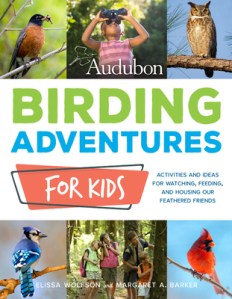
Cindy: At the public library, Lynn found this great new birding guide for children getting started in this rewarding hobby that gets them outside and active. Audubon Birding Adventures for Kids (Quarto, 2020) by Elissa Wolfson and Margaret A. Barker is more than just an identification guide. It’s divided into three sections: Meet the Birds, Outside with Birds, and Inside with Birds, the last two provide ideas and directions for games, activities, and adventures to have in order to learn more about the birds.
Most of the 25 birds selected for the Meet the Birds section are ones that are found throughout the United States at one season or another. A range map is provided for each species, just as is provided in identification books published for adults. A color photo of a single or pair of the species is included along with a “fun fact.” Did you know that Hummingbird eggs are the size of peas? Each species is identified by common name, scientific name, field marks, length (in inches and centimeters), and voice descriptions for songs and calls. There’s also information on feeding (what they eat and how they consume it), conservation issues, tips for helping the species (food or plants to provide), and similar species. There are also a few groan-worthy bird jokes thrown in for fun. “What kind of crows always stick together?….Vel-crows!” HAHAHAHA.

Lynn: Following the section Cindy describes are two more sections that the parent/grandparent in me loved. These are the sections that get kids moving, learning, and entertained. These two chapters provide well-designed activities, one set for outside and one for inside. Each activity clearly lists materials needed, directions, follow up, and discoveries. Some are more involved than others but most require just simple materials. One does require binoculars but I liked this one too as a good basic lesson on how to use binoculars. Glossary and an appendix have related bird information.

I learned a lot myself from the information on common birds despite being a life-long birder. Did you know only the female duck “quacks”? Or that Chickadees hide seeds and go back to them months later? This appealing book will help create more birders and will keep kids nicely occupied with science and bird-related activities. This is an ideal book for kids and caregivers both and may be of special interest to everyone with children doing virtual school in this time of Covid-19.

Ick! A Book About Toxic Toots and Bubbles of Goo for Kids

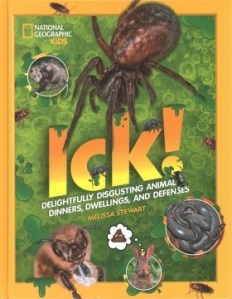
Lynn: National Geographic always does a great job of publishing books that kids love but Melissa Stewart’s new book, Ick!: Delightfully Disgusting Animal Dinners. Dwellings and Defenses (National Geographic, 2020) stands out even from that crowd.
The book is divided into the 3 main chapters listed in the title: dinners, dwellings, and defenses—all icky. All of the delightfully disgusting creatures get their own two-page spread. Each of the creatures featured has the same categories of information provided including a Stat Stack of statistical facts, a general description, Extra Ick with additional or related information, and magnificent large color photographs. Stewart’s writing is terrific! The general descriptions are wonderfully done, snappy, full of groan-worthy puns but also clear, informative, and attention-holding. It is far more than just eww-inducing! There is a lot of great information provided here about why the behavior is employed and the advantages gained by the organism.

Let me be clear. There is plenty of disgusting icky facts that kids will gleefully read and share with everyone around them. How about a lacewing larva that uses its own toxic farts to stun its prey? Or the Caecilian babies who literally eat their mother’s skin? Yup. And of course, there are plenty of poop-related facts like Burrowing Owls who line their underground nests with poop—theirs and anyone else’s they can find. Or read about young Komodo Dragons who roll in their own foul-smelling poop to keep from being eaten by OTHER Komodo Dragons!

I set out on this book, thinking I would read a few pages a day and work my way slowly through but I ended up reading half the book in one sitting and finishing it eagerly the next morning. Stewart’s writing and the fabulous photographs hooked me. It certainly is icky but I learned so much! The excellent back matter includes a Glossary and 2 pages of Selected Sources for additional revolting reading. This is bound to be wildly popular with a lot of kids who will loudly share the grosser elements but they are going to learn a whole lot of solid biology along the way!

The Moose of Ewenki: A Picture Book for All Ages

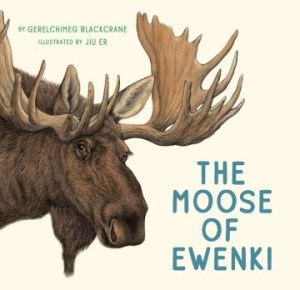
Lynn: One of the great joys of the children’s publishing world today is the small publishers bringing us books from other countries and cultures. This is such a gift to young readers whose understanding of the world will be enriched and expanded by these wonderful books. One of those publishers is Greystone Kids, a Canadian publisher of books by both Canadian and international authors. We have fallen in love with a new book from them, The Moose of Ewenki (Greystone, 2019) by Chinese author, Gerelchimeg Blackcrane and illustrated by Chinese artist Jiu Er.
Set in far northern forests of Mongolia, the story tells of an elder of Ewenki people, a hunter and herder of reindeer, who shoots a moose only to discover sadly that she had a young calf. The little creature follows the old hunter back to his campsite where he feeds and cares for it. Gree Shek names the calf, Xiao Han or Little Moose and raises the baby, including him in his daily life of caring for the reindeer herd, foraging for food and visiting the local village. Little Moose thrives and grows – and grows! In time he grows to adult size but thinks he should still sleep in Gree Shek’s tent, follows him everywhere and doesn’t seem to understand how big he is. After a series of mishaps and dangers, Gree Shek, who is growing older and frailer, realizes that for Little Moose’s own safety he must go into the forest. In some sad scenes that follow, he drives the young moose away and then the old man dies one night in his sleep. The hunters who find him, honor the old hunter by freeing his reindeer herd to join the moose in the forests.

This bittersweet story is full of both humor and tears, an evocative reflection of the life of the Ewenki people. Gree Shek and Little Moose stole my heart and no one who sees Jiu Er’s stunning illustrations will be able to resist this gorgeous book. But, I’ll let Cindy tell you about those!

Cindy: Animal-human bonding stories are popular in children’s literature but this one is a surprise. First, the setting…Inner Mongolia…a region we don’t see often in children’s literature. And then Xiao Han, “Little Moose,” who isn’t so little for long. I couldn’t help but get a flashback to one of my childhood favorites, The Enormous Egg by Oliver Butterworth, but it didn’t linger as this is a very different book, of course. Little Moose peeks out from a bush on the title page but when he steps out from the bush a few pages later his timid gaze will melt the reader’s heart. The illustrations enhance the powerful story beautifully. Full-page spreads are interspersed with smaller vignettes that bring the landscape and its inhabitants to life. Creamy colored paper is perfect for the muted nature palette drawings that convey the humor and the sadness in this gentle story. A Junior Library Guild Section. Don’t miss it.

Owling: Whoooo Needs This Book? You Do!

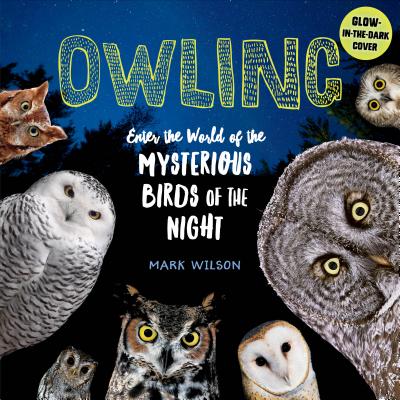
Cindy: “You might not realize it, but you need to see an owl.” That’s the opening line of Owling (Storey, 2019) and you not only need to see an owl, but you need to see this book. Starting with a glow-in-the-dark cover, this large square book holds a wealth of fascinating details and gorgeous photographs of the 19 owls species that breed and nest in the United States and Canada. Can owls really turn their heads 360 degrees? How do an owl’s uneven ears help him pinpoint prey? These and other questions are answered in engaging text. Most welcome is the author Mark Wilson’s challenge to common owl “facts” not documented by research studies and his admission when his long study of owls leaves him without sure answers. Research never ends and we rarely have all the answers. 2-4 page spreads feature a specific owl species with a selection of photos, range maps, feather detail, size, behavior, voice, nesting behavior, menu, or other interesting features. The section on Poop and Pellets is sure to be a hit with the target audience, particularly if they’ve ever dissected an owl pellet to learn about an owl’s diet. The section on how to spot an owl has helpful tips that may produce success for young (and old) birders. Lynn heard about this book and then I received a review copy and have been reluctant to hand it over, but we can’t wait any longer to hoot about its publication. Owling is a perfect identification guide for a young birder, but it is so much more, and it has a place in elementary and middle school libraries and elementary science classrooms. Whooooo needs this book? You do!
Lynn: I really appreciate how this outstanding book is organized, the wonderfully researched information presented, and how much is packed into the book. But I need to mention the sheer audience appeal of the production. Talk about a kid magnet! Put this gorgeous book on display and watch it instantly fly off the shelf. Mark Wilson’s photographs almost steal the show. Every single page has a gallery of jaw-dropping pictures that beg to be studied. The images range from small collections illustrating a particular point to full-page photographs that are works of art. The painted illustrations by Jada Fitch are amazing, too.

I learned so much! The small sections showing what each of the various owls eats, “On the Menu,” was interesting and surprising. As a life-long birder, I really valued the identification information, especially tips on what each variety might be mistaken for and how to avoid that. Also as a birder, I loved the section of how to FIND owls in nature with its additional caution of how to also respect and treat them if you do find them or their roosts. Finally, also in the concluding sections, there is information on some of the current and on-going research projects on owls. The back matter includes a glossary and an extensive list of where to find Owls in Captivity by state so that readers can follow Wilson’s advice and become familiar with the appearance of the various owls.

Finally, I am on a mission to find my slides that were taken in the back yard of our first Holland house that sat in an old deeply forested woods. We had nesting Great Horned Owls there and summer after summer, a pair of adults parked their fledged but still dependent owlets on our deck during the day, I’m guessing while they went to hunt. The owlets were almost as big as the adults and absolutely delightful to watch. The squirrels seemed to know how clumsy the owl babies were and teased them by running just out of their reach on the railing underneath them.

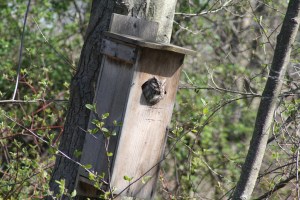
Here is my picture of an Eastern Screech Owl but since I am no Mark Wilson, I urge you to find this book and see some REALLY terrific pictures!