Lynn:  Where were you in October 1962? I know a whole lot of you weren’t even on this planet yet but how much do you know about how close we came to annihilating this place we call home? I was a young teen at the time, going to junior high in Belmont, MA and I remember those days quite well. I think I especially remember them because I realized my father was grimly worried, even scared. We watched the reports on the news and when I asked my dad if there would be a war, all he would do was shrug. I remember too, the sigh of relief when Russia “blinked” but I also remember an overwhelming sense of helplessness at these events that could wipe out the world and there was nothing I could do.
That is a long way of saying that if you read any historical nonfiction book this year, make sure it is Steve Sheinkin’s Fallout: Spies, Superbombs, and the Ultimate Cold War Showdown. (Roaring Brook, 2021). Yes, it was 1962 but there are parallels here that need to be understood by all of us who inhabit this same fragile wanderer in space.
Sheinkin is a master of narrative nonfiction, of careful research, and is a compelling storyteller. He takes an event for which we know the trajectory and manages to keep readers hanging on by a thread as his chronicle unfolds. And in this book, he relates a tale as complex, convoluted, and shrouded in secrecy as anything in history. It is a tale of personal courage, thoughtful reflections, and a willingness to resist the pressures of other dominant opinions. It is equally a tale of luck, bungling, and terrible timing. I paused with awful frequency to shake my head in wonder and horror at the incredible chain of events that we call the Cuban Missile Crisis.
How close did we come to nuclear war? Closer than any of us outside of a very few people knew. There are true heroes in this story as well as reckless fools and power hungry zealots. This is a marvel of nonfiction writing. Succinct, wonderfully researched and cited, and thoughtfully recounted. It is also has the terrible fascination of watching a train wreck. If you were around then or are just now encountering the story, this book will hold you captive and maybe haunt your dreams with what could have been. As Robert McNamara, then Secretary of Defense, said, “At the end we lucked out. It was luck that prevented nuclear war.” See if you agree.
Cindy: Besides being stellar works of nonfiction, Steve Sheinkin’s books are a booktalker’s dream. Here’s the opening paragraph of the prologue, titled: “The Paperboy.”
“The kid hiked up the dark stairwell to the sixth floor, hoping only for a decent tip, maybe fifteen cents. Busting up a Russian spy ring was an unexpected bonus.”
Read that sentence to your students and stand back, hoping you’ve purchased a lot of copies! One of the nickels the paperboy received was a hollow coin that popped open after falling on the stairs and the boy discovered a tiny piece of film inside. Hmmmm….and away we go!
 I couldn’t turn the pages fast enough, and I was holding my breath in places (when I wasn’t gasping) even though I knew the outcome. What I didn’t know was many of the details and stories behind the Cold War build-up, the dangerous rescue efforts after the Berlin Wall went up, and the last hour unlucky mishaps during the Cuban Missile Crisis, any one of which could have could have been more than disastrous, but for some added good luck. Obviously, this is a natural sell to teen readers who were fascinated by Sheinkin’s earlier YA book, Bomb: The Race to Build–and Steal–the World’s Most Dangerous Weapon, but adults will want to read this as well.
 Cindy: Have we got a new series for you to put on standing order!
  Lynn:
Lynn:  Lynn: Let’s set politics aside and admit that our world is in big trouble. Kids know it and are motivated to do something about it. But many also feel overwhelmed by the size of the problems and don’t know how to start. Happily, we have a book to help!
 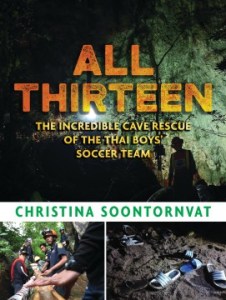 Lynn: Thai-American author Christina Soontornvat was visiting her family in Thailand not far from the Cave of the Sleeping Lady when the news broke about the trapped soccer team. She and most of us throughout the world watched with our hearts in our mouths as the 18-day rescue event dominated the news. Soontornvat, a mechanical engineer and science educator, realized after the rescue that she wanted to know more about this incredible effort and to share the story.
 Cindy: Shortly after the Wild Boars were rescued I was booktalking
 Lynn: Books for really young readers on careers are not easy to do well but a wildlife photographer/author that I especially admire, Suzy Eszterhas, has given us just that in
  Cindy: At the public library, Lynn found this great new birding guide for children getting started in this rewarding hobby that gets them outside and active.
  Cindy: What I learned about classical music was mostly learned during my high school days playing flute in our small school’s band and later watching the movie Amadeus. I’m not quite serious, but almost. My middle school orchestra students are probably way ahead of me today. It’s not for lack of wanting to know more, it’s for the lack of knowing where to begin or how to approach such a large body of music of which I know so little. If it’s intimidating to me, it surely must be for a teen who may have even less interest in pursuing that interest without some inspiration. And thus, concert pianist James Rhodes to the rescue for many of us.
  bookendsblog.net