Celebrating the Book – Picture Books for Bibliophiles of All Ages

Bibliophiles come in all ages. Young or old, we share a common bond, a deep and abiding love of books. Even in this fast-paced digital age, we bibliophiles prosper, enriched and strengthened by this mutual ingrained passion. Don’t believe the current folk wisdom. Kids still love books. We see this in our book club and in our schools. Kids still want to hold books, absorb them, collect them, read them over and over, and protect them. Here are two heartfelt picture books that celebrate books and the readers that love them. The holidays are coming fast and these would make treasured gifts to the bibliophiles, both young AND old, on your list.
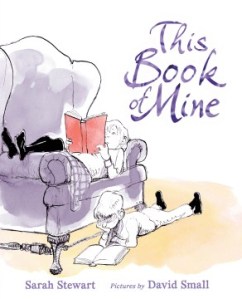
Lynn: This Book of Mine (Farrar, 2019) is by the renown writing-illustrating team Sarah Stewart and David Small. Stewart’s simple rhyming text celebrates the many ways that readers use books: to be a friend, to comfort after a scary dream, to spark imagination or sometimes just to smell that wonderful booky smell. Small’s charming and humorous illustrations fill the pages in warm shades of purple with a bright splash of color highlighting the book on each page. The cast of characters is diverse in age and race but clearly linked in their shared love of books. A New York Public Library lion is featured on the first and last page of the book in a lovely coda. Appropriate for our youngest bibliophiles as well as those of us who have been turning pages for many decades.
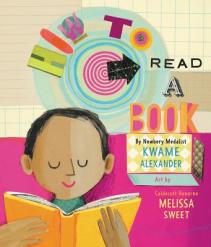
 

Cindy: You won’t be able to miss the neon-bright cover of How to Read a Book (HarperCollins, 2019) by Kwame Alexander and illustrated by Melissa Sweet. This dream team creates something new and fresh with Alexander’s encouraging how-to poem for experiencing a book with all of your senses paired with Sweet’s electrifying collage art. I’m an unabashed fan of Sweet’s artistry, and she stretches yet again with this one. The color palette wakes the reader to the joys of reading. This is no passive act, but one that wakes you if you dig into that clementine and let the juices drip down your chin! A number of creative paper delights await in the turning of these pages. Lynn and I were lucky enough to see some of the original art at a publisher event at the American Library Association and we were in awe. I so want to play in Melissa’s studio!

Don’t miss the author and illustrator notes that provide lovely stories about the creating of this special book.

Kwame’s advice is appropriate for any book, but certainly especially so for both of these visual poetic treats celebrating the wonder of books.

“Don’t rush though:
your eyes need
time to taste.
Your soul needs
room to bloom.”
Picture Books about SCARY Appetites

Stories about scary appetites seem especially fascinating to kids – and if it is all a little gross all the better! Just think for a moment about how many fairy tales you know that have eating terrible things at their center? Remember the witch in Hansel and Gretel, fattening up Hans for the oven, the giant in Jack and the Beanstalk who is going to eat men’s bones or the troll under the bridge who wants the 3 Billy Goats Gruff for breakfast? We’ve recently found two terrific new picture books that take the theme of scary appetites and run with it.

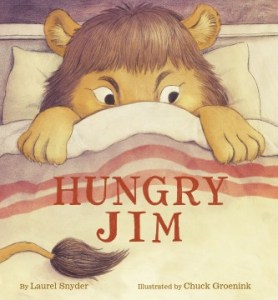
Lynn: Hungry Jim (Chronicle, 2019) by Laurel Snyder is a tale about Jim who wakes up as a lion one morning AND a beastly appetite. When his mother calls him for breakfast, Jim discovers she looks delicious! He didn’t want to eat his mother but… and she WAS delicious! But he was still hungry and the more he ate, the hungrier and wilder he gets until he meets something as big and wild as he is.

This is a hilarious story about the hungry beast we sometimes wake up as and a wonderful tribute to Maurice Sendak who first understood about the wild beast inside all of us. Laurel Snyder’s text is pitch-perfect with an opening sentence that will grab the attention of every kid in the room! Chuck Groenink’s illustrations are equally terrific using lots of 2-page spreads, warm tones, and different perspectives. There is definitely a wild-things feel to the book but it is also very definitely it’s own creation.

Wonderful to use with a group or as a lap book, to use as a discussion starter or writing prompt or simply to enjoy!

Cindy: Families, food, and storytelling combine in this wild tale about Octopus Stew (Holiday House, 2019) by Eric Velasquez. Based on a family story of the time that Eric’s father had to rescue Eric and his grandmother from an overflowing octopus pot, the character Ramsey puts on his superhero cape and finds a way to defeat the ginormous octopus that has his grandmother wrapped in its tentacled arms. The text is infused with Spanish phrases, listed in a glossary in the back. Velasquez’s vibrant action-packed scenes and crazy adventure move the story along quickly, although a foldout spread adds a new dimension to the storytelling. The book jacket blurb presents the option of opening these fold-out pages or skipping them. The choice is yours, but, really, who could resist? The yellow endpapers with white octopus slice rings are a nice touch to the package. (The octopus might not agree!) The back matter also includes an author’s note encouraging the sharing of food and stories and the recipe to try making your own Octopus Stew…grab your copy now and switch up the turkey leftovers with something different!

Cindy and Lynn: As we publish this food-rich post the week of Thanksgiving in the U.S., we want to extend our thanks to our readers who followed us to our new blog home here at Bookendsblog.net. We’re also grateful for those of you who have found us recently. If you find our posts valuable, please share our link with a friend, a teacher, a librarian, or a parent who might enjoy them as well. Thanks!

The Moose of Ewenki: A Picture Book for All Ages

Lynn: One of the great joys of the children’s publishing world today is the small publishers bringing us books from other countries and cultures. This is such a gift to young readers whose understanding of the world will be enriched and expanded by these wonderful books. One of those publishers is Greystone Kids, a Canadian publisher of books by both Canadian and international authors. We have fallen in love with a new book from them, The Moose of Ewenki (Greystone, 2019) by Chinese author, Gerelchimeg Blackcrane and illustrated by Chinese artist Jiu Er.

Set in far northern forests of Mongolia, the story tells of an elder of Ewenki people, a hunter and herder of reindeer, who shoots a moose only to discover sadly that she had a young calf. The little creature follows the old hunter back to his campsite where he feeds and cares for it. Gree Shek names the calf, Xiao Han or Little Moose and raises the baby, including him in his daily life of caring for the reindeer herd, foraging for food and visiting the local village. Little Moose thrives and grows – and grows! In time he grows to adult size but thinks he should still sleep in Gree Shek’s tent, follows him everywhere and doesn’t seem to understand how big he is. After a series of mishaps and dangers, Gree Shek, who is growing older and frailer, realizes that for Little Moose’s own safety he must go into the forest. In some sad scenes that follow, he drives the young moose away and then the old man dies one night in his sleep. The hunters who find him, honor the old hunter by freeing his reindeer herd to join the moose in the forests.

This bittersweet story is full of both humor and tears, an evocative reflection of the life of the Ewenki people. Gree Shek and Little Moose stole my heart and no one who sees Jiu Er’s stunning illustrations will be able to resist this gorgeous book. But, I’ll let Cindy tell you about those!

Cindy: Animal-human bonding stories are popular in children’s literature but this one is a surprise. First, the setting…Inner Mongolia…a region we don’t see often in children’s literature. And then Xiao Han, “Little Moose,” who isn’t so little for long. I couldn’t help but get a flashback to one of my childhood favorites, The Enormous Egg by Oliver Butterworth, but it didn’t linger as this is a very different book, of course. Little Moose peeks out from a bush on the title page but when he steps out from the bush a few pages later his timid gaze will melt the reader’s heart. The illustrations enhance the powerful story beautifully. Full-page spreads are interspersed with smaller vignettes that bring the landscape and its inhabitants to life. Creamy colored paper is perfect for the muted nature palette drawings that convey the humor and the sadness in this gentle story. A Junior Library Guild Section. Don’t miss it.

Graphic Novel Round-Up – Something for Every Reader

Lynn and Cindy: A flock of fabulous graphic novels has swept onto our doorsteps lately and we’ve been happily flying through them. There’s something here for every interest and every age and we’ve been loving them all. Here’s a quick round-up of some of what we’ve been enjoying, starting with graphic novels for high school readers and moving on through to one for our youngest readers.

Laura Dean Keeps Breaking Up with Me, by Mariko Tamaki (First Second, 2019)

This is an absolutely brilliant look at love in a toxic relationship. Charismatic Laura Dean flies in and out of Freddie’s life, bewitching and beguiling her, taking complete advantage of Freddie’s adoration, stomping on her heart whenever she feels like it and leaving Freddie diminished at every turn.

We’ve all watched relationships like this. Maybe we’ve been IN a relationship like this. Tamaki nails the dynamics, the helpless attraction, the hurt that grows bigger and more destructive each time and the hope that THIS time will be different. Masterfully nuanced illustrations heighten the sense of being there and watching a dear friend walk back into the buzzsaw once again. High Schoolers exploring relationships will love and learn from this story.

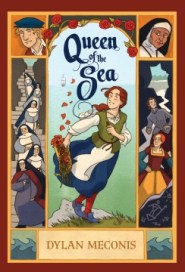
Queen of the Sea, by Dylan Meconis (Walker, 2019)

A stunningly beautiful graphic story loosely based on the history of Elizabeth I and Mary Queen of Scots. While it was fun to notice the parallels, it isn’t necessary to know the history as Meconis creates her own richly immersive story full of period details, evocative characters, and vivid setting. The main protagonist, Margaret, an orphaned child who came to the island surrounded in mystery, is instantly endearing and readers experience the unfolding events along with her.

Meconis’ illustrations are gorgeous but they are also a brilliant part of the storytelling. Each panel has its own part to play in carrying the tale forward, providing important details and developing the characters. This is a visual treat but it is also masterful graphic storytelling. Readers ranging from high school to upper elementary will love the characters, the warmly human touches of humor, the historical feel, the fascinating political intrigue and the feel of an illuminated manuscript. Outstanding book design adds to all these masterfully done elements to make this an imaginative and immersive reading experience.

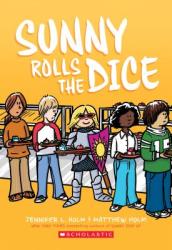
Sunny Rolls the Dice, by Jennifer L. and Matthew Holm (Graphix, 2019)

Middle school is fraught with changing friendships as tweens shift interests, alliances, and struggle to be “cool.” Some mature more quickly than others, some don’t care what others think, and some long for acceptance by a popular group, or are distraught when good friends leave them by the wayside. As a middle school librarian, I’ve watched these friendship struggles for decades. The Holms have captured the essence of this passage in this newest book in the series that started with Sunny Side Up. Sunny’s best friend has discovered boys, fashion, and makeup while Sunny doesn’t understand why they can’t pursue those interests while still playing Dungeons & Dragons with boys they are only trying to slay in the game. 70s memories of the perils of hot rollers and smelly rental roller skates bring the setting alive for those of us who lived through it…and it’s fun historical fiction with a timeless look at friendship for the intended audience.

Guts, by Raina Telgemeier (Graphix, 2019)

Does this book need promotion? Probably not, but given the reception it’s received in my middle school, not because it is Raina’s new book, but due to the subject matter, it’s worth highlighting to be sure you don’t miss it. Telgemeier continues her graphic memoir series with this new entry about what anxiety can do physically and mentally to a child (or an adult). Scholastic published an initial print run of 1 million copies, according to this Forbes! article about the release. Grab your copies quickly, they are already thinking of a second run to meet demand.

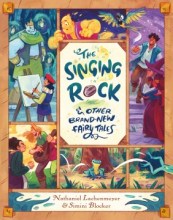
The Singing Rock & Other Brand-New Fairy Tales, by Nathaniel Lachenmeyer (First Second, 2019)

Here’s a graphic novel that is great for the Gr. 2-6 set. Bright, funny and also gorgeously illustrated stories tell four slightly twisted fairy tales that are joyful hoot.

Perfect for the young child who will appreciate the humor and I think middle school kids would love it if they’d be brave enough to look past the young appearance of the book. Besides being wonderful fun, this would make a GREAT writing prompt.


A Book for All Those Square Pegs: Sweety by Andrea Zuill

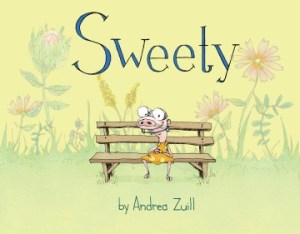
Cindy: Sweety is an awkward retainer-wearing naked mole rat and I have the biggest soft spot in my heart for her. Andrea Zuill, thank you for creating Sweety (Schwartz & Wade, 2019) with the *best* illustrations to bring Sweety to life! When her friends share their dolls’ names, Sweety’s response (delivered with great enthusiasm), is:
This is Warrior Princess Zorna! Friend fo the friendless, destroyer of evil, lover of chocolate-beet cake with cream cheese frosting! Her favorite color is aubergine* and my mom made her for me!

*Grammarly didn’t know this color. You will be more worldly, or you can look it up!

Sweety sometimes wishes she were more like her friends, or even is jealous (For instance, Deb’s hair, and I do mean singular—ONE hair). Other times, she is content to be herself enjoying her hobby of fungi identification. The illustrations make me giggle and laugh…but always with Sweety, not at Sweety.

It’s Aunt Ruth who helps Sweety to understand that being a “square peg” is not a bad thing. She advises her niece to stay true to herself and promises that one day she’ll find her people. Zuill dedicates the book to “all those who have accepted their inner oddball.” We all know a Sweety or two…and perhaps some of us have our own inner oddball. Here’s to Square Pegs everywhere!

Lynn: I fell hard for Sweety too. The illustrations just crack me up! Don’t miss Sweety’s family album or vignettes of Sweety trying a different hobby. Even a “normal” hobby like knitting gets its own Sweety style.

But as much as I love the illustrations here, I love Andrea Zuill’s message to kids even more. We’ve said the same thing to the Sweety kids seeking refuge in the library over the years! Be true to yourself and hang in there. You will find your people. Happily in this charming book, Sweety doesn’t have to wait too long before she finds a kindred fungi-loving friend. Queue the secret handshake and make sure to share Sweety and her message to kids everywhere!

New Fantasy Series Starts for Middle School Readers

Lynn: According to our middle school book club readers, there are NEVER too many fantasy series to keep them busy! Yup – they are a bottomless pit of fantasy eagerness. I’m sure you have readers like ours so I’m happy to suggest some brand new series that will delight our readers and yours. Of course this also means they will be bugging us all for the next book in the series the MINUTE they finish the first one!

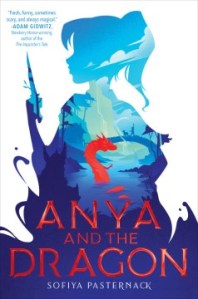
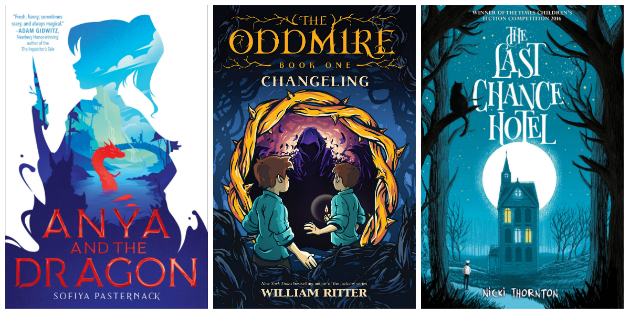
Anya and the Dragon (Houghton/Versify, 2019) by Sofiya Pasternack

What would it hurt to help the Tsar’s people kill the scary river dragon? Anya thinks it would be worth it to save her family’s home and farm from being taken over for unpaid taxes. Her soldier father hasn’t been heard from and Anya’s Jewish family is often harassed by the villagers. But then the dragon saves Anya’s life and he turns out to be young and nice! What should she do? Pasternak fills her debut fantasy with creatures from Slavic and Jewish folklore and sets this exciting tale in an alternate Kievan Rus.

Touches of humor balance the more serious subjects of antisemitism and oppression. Anya is a strong and determined heroine and Pasternak’s dragon is fresh, inventive and easy to care about. A well-drawn cast of characters and the friendships with newcomer Ivan and the dragon are central to this tale of a lonely girl taught to avoid notice. There’s plenty of danger and adventure here and readers will be eager for the next installment.


The Changeling (Algonquin, 2019) by William Ritter

A goblin creeps into a nursery with a changeling who is desperately important to the magical world of the Wild Wood. But something goes wrong and he ends up leaving both babies in the nursery. Everyone knows one of the babies is a changeling but it is impossible to tell them apart and Annie Burton raises the twins, loving them both with her whole heart. 13 years later a mysterious letter arrives that leads the twins into the Wild Wood. There they encounter a fantastical array of magical beings including an annoying shape-shifting little girl, a hinkypunk and the Thing.

SO much fun with just the right amount of scariness and ultimate reassurance about the boundless capacity of love and family. I cannot wait to see where this leads next.


The Last Chance Hotel (Scholastic, 2019) by Nicki Thornton

Seth dreams of being a great chef like his father who left long ago. But for now he is a kitchen boy at the remote Last Chance Hotel, owned by the cruel Bunn family who take advantage of the lonely boy. Now an important gathering of magicians is taking place at the hotel and the Bunn’s are desperate to please the important guests. Seth creates a fabulous dessert especially for the most illustrious guest, Dr. Tallomius. The magicians meet in secret behind locked doors and Seth hopes his dessert will win him a ticket out of the Last Chance. But when the door are flung open, Dr. Thallomius lies dead on the floor and Seth is the chief suspect.

A little Agatha Christie, a little Harry Potter, but mostly this fun magical mystery is entirely its own original and entertaining story. Lots of engaging characters including a talking cat and a whole school of red herrings!

“Following the Bend in the Road” – Michael Morpurgo and WWII in the Camargue

Lynn: One of the things I love most about the world of books—and children’s books in particular—is the way authors keep crafting new stories from the past that connect deeply to the events of the present. There is no better way for readers to learn about history and its driving forces and to realize that those same forces impact us still. Michael Morpurgo’s new book, The Day the World Stopped Turning, (Feiwel, 2019) is a shining example of that. There have been thousands of books written about WWII (and we have read a LOT of them) but Morpurgo tells a story that is fresh and unique and one that shines a beam on today’s issues in a way that will resonate with young readers.
Morpurgo uses an unusual structure for a book for middle schoolers. The framing story is that of Vincent Carter, an adult over 50, looking back briefly at his youth and then at his decision as an 18-year-old to leave home and travel to the south of France, following the path of the artist who inspires him, Vincent Van Gogh. He is further motivated by a childhood story about the wisdom of following the bend in the road to wherever it takes him. While walking in the isolated marshy area of the Camargue, Vincent falls seriously ill and collapses. He is rescued by an autistic man, Lorenzo, and taken back to a farm by the beach where Lorenzo and his companion Kezia nurse Vincent back to health. It is here that that heart of the story lies. As Vincent gradually regains his health, he becomes curious about his rescuers and their mysterious history. The narration then shifts to Kezia as she slowly relates their story that begins in 1932, of Lorenzo and his farmer parents and of Kezia only child of Roma parents who moved from town to town with their beautiful carousel. As Kezia grew older, her parents decided to stay in the town near the farm so she could go to school. The war is on, France has been defeated and the Vichy government rules the Camargue but for the most part, the war has left the area relatively untouched. All that ends one day when the Germans roll into town to set up fortifications on the beach and to stay. Lorenzo’s parents know that Roma people are being rounded up and they offer to hide Zezia and her family on the farm. This decision will forever change the lives of the two children, their families, and the town. And the story, as Kezia tells it, will forever change Vincent’s life as well.

This is a quiet tale and although there are great tension and suspense, the story allows time for readers to absorb and to reflect. It is a story about the issues of racism and hatred, of war and fear. But it is also an uplifting story of the greater power of friendship, kindness and love, courage, and the enduring nature of doing what is right. The setting will be unfamiliar to most American students but the lyrical writing brings this remote and beautiful place to life. The narratives are an interesting blend of adult and child perspectives with the framing voice adult and the WWII sections of the book in young Kezia’s voice. This device brings added emphasis to the central story and puts readers firmly in the shoes of the children experiencing the events of the occupation.  The parallels to issues in the headlines today are stark and kids will readily make the comparisons and come to their own conclusions.

This book is not for every kid but it offers rich rewards for a mature and curious reader ready to try something different.

“Children Deserve Important Books!” Thank You, Margaret Wise Brown.

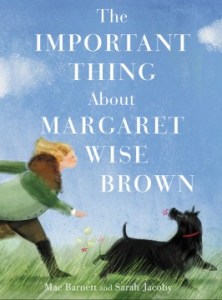
Lynn: As a young librarian I was taught to honor Margaret Wise Brown and as a parent I loved to read her books to my boys. But with all that, I knew very little about the life of this iconic author. Mac Barnett steps up to help me with that glaring error in his new stellar picture book biography, The Important Thing about Margaret Wise Brown (Harper/Balzer+Bray, 2019)
Right from the start, Margaret was a different soul and Barnett does an outstanding job of bringing that difference forward and letting readers know that it was more than okay. I LOVE Barnett’s writing in this book. He speaks directly to the reader, is conversational, blunt and refreshingly honest with kids, acknowledging some of Brown’s strange actions. Kids probably won’t know of many other authors who skinned a dead pet rabbit and wore its pelt around her waist, swam naked, or blew her entire first book earnings on an entire flower cart and threw a big party! And, Barnett goes on to say, Brown also wrote strange books, at least strange for her time although not so dissimilar, kids will note, to the very book they are reading.

What comes through wonderfully here is that it is OK to be strange and Margaret Wise Brown was strange in some truly important ways. Brown believed that children deserve important books and as Barnett again points out, life is strange and books that reflect that may seem strange but they also “feel true.” Margaret Wise Brown was a champion for children and books and after reading this amazing book, I think Mac Barnett is too.

Cindy: Maybe the reason we knew so little about Margaret Wise Brown is that she thought the stories were more important than the author! Here is the quote that Barnett opens with:

“It did not seem important that any one wrote these stories. They were true. And it still doesn’t seem important! All this emphasis today on who writes what seems silly to me as far as children are concerned.”

No matter, we know a little bit more now about the author of Goodnight Moon, The Runaway Bunny, The Important Book, The Little Fur Family, and so many more. While Barnett spins the tale, we get to immerse ourselves in Sarah Jacoby’s watercolor and Nupastel paintings. There are bunnies, and dogs, and many flowers and trees, and bunny children reading books or being read to by librarians like Anne Carroll Moore. The scenes are at once familiar and fresh.

And then, Mac Barnett slices into our hearts with his truthful pen, or computer, and says:

“Lives don’t work the way most books do.
They can end suddenly,
as fast as you kick your leg in the air.”

And it goes on and is beautiful and is a tribute that Margaret would have liked, I think. But you’ll have to buy the book and read the rest yourself because I am crying just a little and the words are blurring.

Gondra’s Treasure – Dragon Lore History and Blended Families in a Picture Book

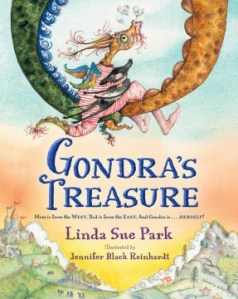
Lynn:  Readers might be surprised if we described a new picture book for the PreK-Gr.2 set as an introduction to dragon lore, its history and cultural differences, a story about biracial families and a sweet bedtime tale all in one. But if we then revealed that the author is the talented Linda Sue Park, all would be explained. Park’s new picture book, Gondra’s Treasure (Clarion, 2019), is all of those unusual elements and more and the result is completely charming.
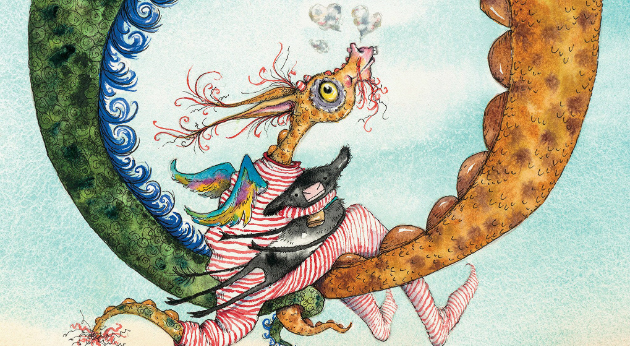
Gondra, a small dragon, confides that her mom’s family is from the West and her Dad’s is from the East. As Gondra goes on to describe her family, readers get an introductory lesson in dragon folklore and the cultural differences in the traditional stories. Gondra’s mother breathes fire and her father breathes mist. Her mother’s ancestors lived in caves with treasure and her father’s had a single magical pearl that could control the weather. Gondra herself is a charming mix of both and this blend is presented along with a loving banter between the parents that is both humorous and reassuring. In what is clearly bedtime routine, Gondra brushes her teeth, dons striped pajamas (with her tail sticking out)  and hauls her stuffed toy and a stack of books off to bed, asking on the way, “What happened to the magic pearl and all the treasure?”

“Oh, that’s right. We don’t need them

anymore – because I’m your treasure.”

While the simple dragon lore is front and center here, the subtle message of loving acceptance and biracial families is the sweetly told heart of this dragon tale.

Cindy: Linda Sue Park’s story is warm and tender and encouraging to children living in many types of blended families. The humor in the tale is brought to life brilliantly in Jennifer Black Reinhardt’s whimsical illustrations. Created in ink, watercolor and collage paper, they are bright and expressive and Gondra made me snort in almost every scene. Unfortunately, I produced neither flames nor mist. Sigh.

Gondra’s attempts to fly and the caution to only breathe fire with an adult present will be familiar to the intended audience who are learning new things or having to wait to learn them. Gondra’s imagination shines as she takes to a swing to soar in the air while she waits for her magic to unfold.

An author’s note explains the lore behind dragons from different regions and some theories related to dinosaur fossil beds as to how people on different continents imagined dragon stories. Or perhaps, dragons are real? Gondra makes me wish it were so.


ALA Exhibits: Books, Books, Books

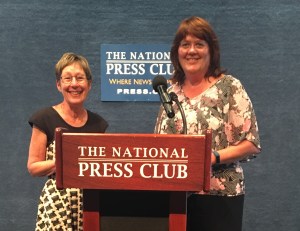
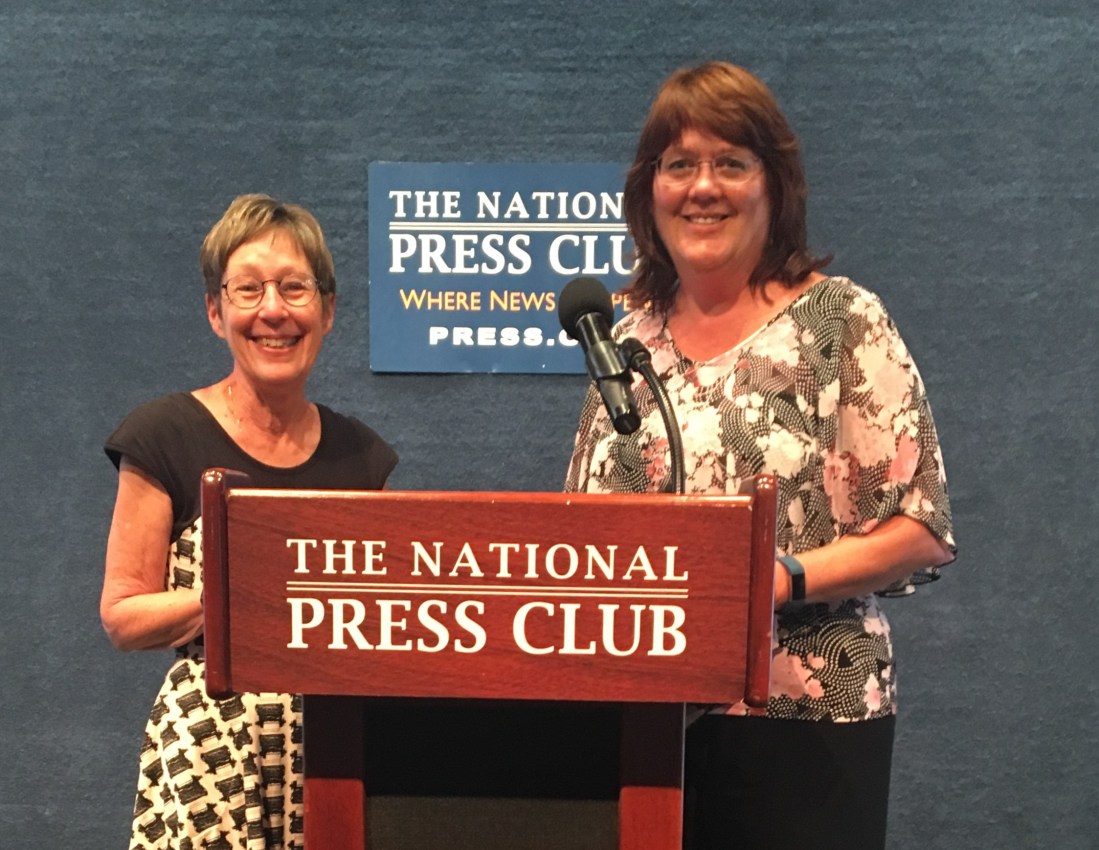
Cindy and Lynn: Bookends Blog here, reporting from the National Press Club in Washington, D.C.

Yeah, we know the exhibit hall included technology and furniture vendors, library suppliers, and a food court, but our favorite aisles are the ones with booth after booth of youth books and our familiar school and library marketing reps. While we tried to follow our own advice about not being greedy in the aisles, we are delighted that these books made it into our suitcase:


Dead Voices, by Katherine Arden (Penguin/Putnam, Aug. 2019)

We raved about Small Spaces last year, and it has become a middle school favorite. Its sequel, Dead Voices, was one of the books we most wanted to get and it was the arc that we read on the flight home. If you want middle grade creepy, this is your series. Dead Voices finds Ollie, Coco, and Brian who survived the scarecrows and spooky cornfields of the first book now snowed-in at a haunted ski lodge that did remind us a little of the setting of Stephen King’s The Shining. We gotta believe he would love this book, too.


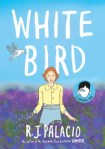
White Bird, by R. J. Palacio (Random, Oct. 2019)

Palacio, the author of the wildly popular Wonder, has written and illustrated her first graphic novel, White Bird. We were so excited to receive a gorgeous color galley and cannot wait to read it! This story is about a young Jewish girl who is hidden from the Nazis in occupied France during WWII.


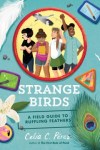
Strange Birds: A Field Guide to Ruffling Feathers, by Celia C. Perez (Penguin/Kokila, Sep. 2019)
One of our favorites of 2018 was Perez’s debut, The First Rule of Punk (Penguin, 2018). We stood in a very long line to get our hands on her new book and it sounds fabulous. The cover blurb says, “When three very different girls find a mysterious invitation to a lavish mansion, the promise of adventure is too intriguing to pass up.”  See, you’d stand in line too!


Free Lunch by Rex OgleFree Lunch, by Rex Ogle (Norton, Sept. 2019)

Rex Ogle was looking forward to starting sixth grade. Things are tough at home, though, with his mom and her boyfriend out of work and so she signs Rex up for free lunch. Then Rex discovers he has to announce that fact out loud every day to the lunch lady. Our school district has almost 60% of our students on a free lunch program and we think this is one that is truly important for them and everyone else in the district as well.


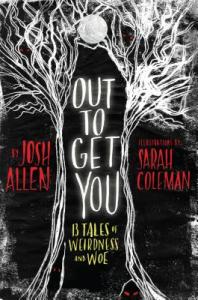
Out to Get You: 13 Tales of Weirdness and Woe, by Josh Allen (Holiday, Sept. 2019)

A debut author collection, blurbed by Gary Schmidt: Wonderful and weird, compelling and unsettling…These stories are scary because they are so very true.” We’re in!


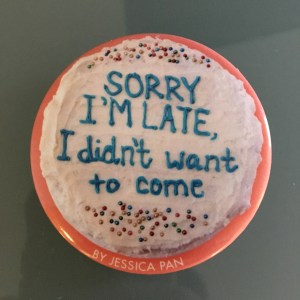
While there was no lack of swag at the booths, our favorite item this year was a button promoting Jessica Pan’s new book, Sorry I’m Late, I Didn’t Want to Come (Andrews McMeel, 2019). We can think of lots of places to sport this…staff meetings, anyone?


allthe rest of our student population.