FRIDAY! Online & Free: KPL Youth Literature Seminar

Cindy & Lynn: What are you doing Friday, November 13th? We’ll be presenting our Best Books session at the 2020 Youth Literature Seminar for Kalamazoo Public Library. Headling the day will be authors Candace Fleming, Varian Johnson, and Paula Yoo.

Here is the description from the seminar’s website:

The Time is Now

The traumatic events that have occurred during most of 2020 have drawn many comparisons to similar events in U.S. history. A pandemic, racism, political and civil unrest, and a floundering economy have not only caused many people to experience severe emotional and mental distress but have also torn open old scars for those who have survived similar events.

This year’s Youth Literature Seminar will focus not only on how our present echoes our past, but also how historical trauma affects how we respond to current tragedies. Join us as we examine our past, its impact on our present and our future, and how books can help guide us through a process of healing, growth, and unity.

We’re delighted to be a part of this fabulous seminar again and hope you will consider tuning in for all or part of the day. We’ll be presenting books for middle and high school while Ed Spicer presents for the preschool and elementary grades. In addition to the featured speaker authors and our book talks there are other breakout sessions to examine the theme more deeply. When should you register? The Time is NOW! A full schedule and the link to online registration is available at the 2020 Youth Literature Seminar website. See you there!


Absolutely Everything About How We Got to the Moon

Lynn: This is a soaring triumph—stellar in every way!

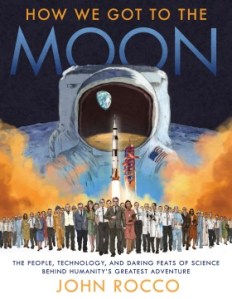
John Rocco set out in How We Got to the Moon: The People, Technology, and Daring Feats of Science Behind Humanity’s Greatest Adventure (Crown, 2020) to explain how every part of the Apollo/Saturn machine worked and how it was built. He especially wanted to show young readers the science and problem solving that was involved along the way. And he wanted to introduce some of the thousands of unsung people who contributed to this monumental achievement. He does all that in this fascinating, detailed, and visually magnificent chronicle.

He begins with the origins of the Space Race in 1957 and a brief history of rocketry and then plunges into the nitty-gritty of designing, building, testing, and flying to the moon with all the steps, problems, and triumphs along the way. As someone who has read many histories of this period AND lived through it, the early history was bit slow but I understand the necessity for young readers. The book becomes deeply interesting quickly in Chapter 2 with the discussion of the process of designing a rocket.

While this is a solid historical account of the Apollo effort, the focus is on the science, technology, and engineering achievements. Rocco’s prose is clear and understandable as he carefully distilled oceans of information for young readers. He does an excellent job of providing a thorough explanation without overwhelming the text. The tone is just right: informative, concise, and filled with wonderful tidbits of related topics to heighten interest even for those only generally interested in the technical details. Space food, the disgusting but imperative issue of going to the bathroom in space, the history of the “human computers,” and, something I always wondered about, what are all those people in the command center doing at all those monitors.

A wonderful feature of the book is the many sections that show some of the scientific problems faced along the way and the solution. Often these also include a simple experiment that kids can do that demonstrates the science behind the solution.

A highlight for me is the many short biographical inserts that feature some of the people involved in the effort who contributed important ideas, developments, or work along the way. So many of these people were critical to the success of the mission but received very little public attention. Rocco includes people like Ann Montgomery, an engineer, and the only woman allowed on the launchpad, Charles Draper who developed the Guidance system, or Eleanor Foraker, the Seamstress Manager for the Apollo Spacesuits.

Rocco explains in an Author’s Note in the back matter that although there are a plethora of photographs, blueprints, and drawings available, he chose to create all the illustrations himself. He did that in order to make the concepts more accessible and understandable for readers without being overwhelmed by extraneous details. He also chose to use color as most of the original photographs and visual materials are black and white. The result is visually stunning as well as being deeply absorbing.

I read this in galley with only some of the planned back matter included. The Note on the Research was extremely interesting and even in galley form the visual impact of the book is outstanding. I am eager to see it in the finished copy. This is a must purchase for every library collection and a perfect choice as a gift book for every science-loving student.

Sometimes We Just Need to Laugh – Funny Picture Books

Lynn and Cindy: We don’t really have to say anything about just how tense and depressing things are right now! We have often sought relief and diversion in funny books and we think kids will welcome that escape too. Here are three new picture books that are just what the book doctor ordered! Share and enjoy!

Glory on Ice: A Vampire Hockey Story, by Maureen Fergus (Knopf, 2020)

You read that right. This hockey story features a vampire on blades! A bored, lonely Vlad heads to the local Community Center to find a new hobby. After rejecting dancing, scrapbooking, and water aerobics, he almost gives up but then overhears some young hockey players talking about pounding, crushing, and destroying the other teams Vlad knows he’s found his calling! After buying the “best hockey equipment that treasure plundered from ancient gravesites could buy,” and careful preparation and study of the sport, this vampire learns that ice skating isn’t easy! Mark Fearing’s hilarious illustrations of Vlad’s progress to master the ice and become a gracious loser as part of a team will have young sports fans chuckling along. (We raved here about The Great Thanksgiving Escape written and illustrated by Fearing a few years ago. It’s another fabulous funny book!)

The Staring Contest, by Nicolas Solis (Peter Pauper, 2020)

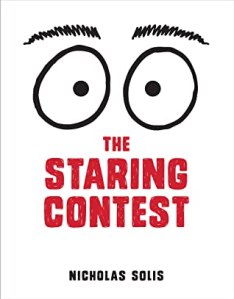
This hilarious book made us slap our foreheads and ask, “Why didn’t WE think of this?” Talk about the PERFECT funny kid book! The challenger, drawn only with big eyes and impressive eyebrows challenges readers to a staring contest. Each page turn is a new trick to get the reader to blink. The eyes roll up and down, side to side, and even cross. It asks “What is that behind you?” and suggests you might have to go to the bathroom. Kids will be giggling helplessly by this point as the tricks backfire. Everyone is a winner in this delightful picture book. Be prepared for multiple readings! Ready, set, GO!

The Attack of the Underwear Dragon by Scott Rothman. (Random, 2020)

Of course, just the idea of underwear is funny to kids and dragons in underwear is guaranteed to be sidesplitting. This story is far more than just oddly-clad lizards, as funny as that is. Rothman takes on a knightly tale that begins when young Cole writes a letter to his favorite knight, Sir Percival asking to become his assistant. Illustrator Pete Oswald’s comic vignettes of Cole’s training are packed with visual jokes that will keep the giggles going. When the Underwear Dragon attacks, defeating ALL the knights, only Cole is left to protect the kingdom. But never fear—all that training pays off and the dragon is “barely” defeated.  Don’t miss the wonderful before and after 2-page spreads!


Eighty-dollar Champion

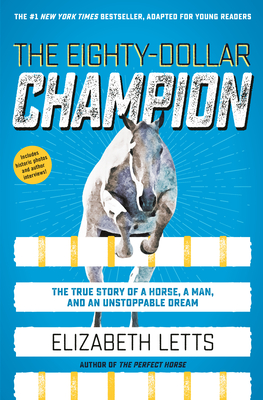
Lynn: There is nothing I like better than an uplifting underdog story and this underhorse story was a pleasure to read–especially as it is a TRUE story! In this time of soaring egos, disdain for others, and scorn for real integrity, this is a lovely tale of the quiet, humble, and hard-working immigrant whose act of kindness rewarded him and his family–AND the horse he rescued. The Eighty-Dollar Champion: The True Story of a Horse, a Man, and an Unstoppable Dream (Random/Delacorte, 2020) is a story that will lift readers’ hearts.

Harry De Leyer and his wife Johanna came to the U.S. from Holland following WWII with almost nothing in their pockets. Harry’s hard work and ability brought him to a job as a riding teacher at an exclusive girls school on Long Island. Needing a gentle lesson horse, Harry set out one winter day to attend a horse sale but arrived too late, just as the “kill buyer” was loading the rejects. One of the horses, a big undernourished grey, caught Harry’s eye and on instinct, he paid all he had, $80.00 for the horse. It was 1956 and Harry had no idea the bargain he had just made.

Snowman, under Harry’s care, prospered and became just the lesson horse he needed–gentle, patient, and loving. The girls at the school loved him as did Harry and his whole family. But no one suspected the amazing ability Snowman’s gentle nature hid. That spring, reluctantly, Harry sold Snowman to a neighbor needing a gentle horse for his young son. Snowman had other ideas. Again and again, he jumped increasingly high and challenging fences to return home to Harry. Snowman knew where he belonged and it was with the De Leyers! It was then that Harry began to discover just how skilled a jumper Snowman was and to train and enter him in horse jumping shows around the state.

Snowman had been a plow horse and even in his coddled days with Harry, he never looked like the highly bred, highly strung horses at the top of the equestrian meets. In the beginning, most people laughed at Harry and Snowman as they began competition. Steady and unflappable, Snowman began to win every competition, cheerfully jumping easily over every obstacle before him. Eventually, he went on to win two Triple Crowns in a row–something that had never been done before.

Harry and Snowman became celebrities and throughout it all remained humble and little changed by fame. Snowman continued to be a lesson horse and Harry to resist all offers to buy him.

This is a very successful abridgment of Letts’ adult book and it was a perfect joy to read. You don’t have to be a horseman or to have had experience with the sport of jumping. Letts gives us a wonderful peek at that world, with just enough of the experience and tension of the various competitions to raise suspense and heighten the pace. But she also makes readers feel as if they know Harry and Snowman and they become vivid and heartfelt characters we deeply care for. And in this dark time, it is a welcome reminder that humility and hard work have rewards, that kindness makes a difference, and that the underestimated can achieve it all. I teared up several times, especially with the book’s conclusion.

“Never give up, even when the obstacles seem sky-high. There is something extraordinary in all of us.”

Back matter includes an interview with Harry De Leyer and a conversation with the author as well as extensive source notes. Give this to kids wanting an uplifting story, engaging nonfiction, or a very unusual horse story.

Scary Stories for Middle Grade

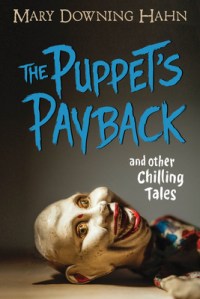
Cindy: I just retired from almost four decades as a middle school librarian and I’ve been reading Mary Downing Hahn books for almost as long—her first book was published in 1979, the year I graduated from high school—and now that I’ve made us both feel old, let’s move on. My students have remained big fans throughout my career. Wait Till Helen Comes has always been a favorite booktalk of mine, and even before the fabulous new cover art it’s gotten in recent years, the book had brisk circulation. Hahn’s new book, The Puppet’s Payback and Other Chilling Tales (Clarion, 2020) is her first collection of short stories and with its arrival, I realized that we’d never blogged one of her books. I was equally surprised to read in her afterword that she was afraid of everything as a child never read scary stories and wouldn’t have gone near WTHC if she’d seen it as a ten-year-old. Certainly, she’s channeled that fear into an ability to bring just-right frights to her young readers. The title story in this collection is a “Monkey’s Paw” tale of a sort for a younger audience. Be careful what you ask for…you may not be able to get rid of it. In this case, though, a toxic teacher eventually gets her due. In some of the ten stories, it is our young protagonists, instead, that are forever cursed by their interactions with the supernatural in these tales. For young writers, in the Afterward, Hahn includes a story she originally wrote in high school. The story eventually was reworked into “Trouble Afoot” for Bruce Coville’s Book of Monsters, and it is reprinted in this book. Her comments about her teacher’s B- grade and then her own later assessment that it should have gotten a C+ made me laugh. “Were adjectives on sale cheap that year?” It will be fun for readers to compare the two stories and maybe they will be inspired to work on their own B- story. Thank you, Mary Downing Hahn, for decades of scary stories; I’m sorry it’s taken me so long to say so. My students and I are grateful.

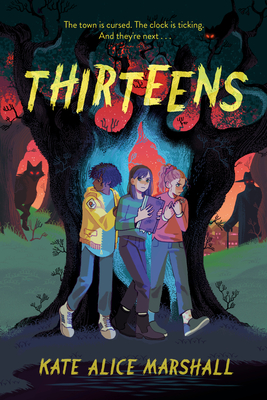
Lynn: As Cindy says, our middle school students seemed to have an unquenchable thirst for scary (but not too scary) books and Mary Downing Hahn was always our go-to author. But did I mention our readers were always wanting MORE books. So I am happy to say that we have some new offerings to help fill the scary book demand. Thirteens (Penguin/Viking, 2020) by Kate Alice Marshall is a great choice for the kids looking for a shivery read.

Eleanor has just moved to Eden Eld to live with her Aunt Jenny and Uncle Ben. Just about to turn 13, Eleanor has just survived a house fire that seems to have been set by her own mother who then disappeared. Eleanor wants desperately to be normal, to settle in here, and try to forget her past, which includes sightings of strange monsters. Lovely Eden Eld seems like a picture postcard town but Eleanor’s mother had warned her to NEVER go there and right from the start Eleanor senses that something is very wrong.

Eleanor is immediately befriended by two schoolmates, Pip, daughter of her new school’s headmistress, and Otto, who has a love of research, marshaling facts, and logical analysis. But it quickly becomes clear that Eleanor’s new friends can also see the monsters and that something is deeply wrong in Eden Eld.

This is a deliciously scary start to a series. It is packed with all the elements readers will love: Odd sightings, a huge mansion bulging with cleverly planted clues, a menacing stranger, palindromes, and a crisis coming to a head just at Halloween! Be prepared for a gigantic cliff-hanger which will have readers begging for the next installment.

Stories That Need to Be Told – Picture Books Take Up the Challenge

Lynn and Cindy: One of the things we love about picture books is that authors and illustrators often take up the challenge of bringing a little known story to young readers. It is so important to keep our history and our stories alive! As reviewers, we also love that we get the benefit of these stories too. Here are two new picture books that do this important work—and do it wonderfully.

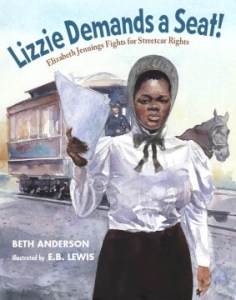
Lynn: Decades before Rosa Park refused to sit in the back of a bus, another brave determined woman demanded her rights on a streetcar in New York. Beth Anderson tells her inspiring story in Lizzie Demands a Seat: Elizabeth Jennings Fights for Streetcar Rights (Boyds Mills/Calkins Creek, 2020). It was 1854 in New York City and Elizabeth Jenkins, a teacher and organist from a wealthy family, was on her way to church. When the horse-drawn streetcar arrived it had empty seats and Lizzie and her friend hurried to board. But the conductor would not allow them on, telling them to wait for the car for “her people.” Lizzie had no intention of waiting. There was no law keeping anyone of color from riding the streetcars although there was a custom of not riding if a white passenger objected. When no one on board objected, Lizzie persisted and the conductor physically threw them from the car. Lizzie, whose family were leaders in their community and well connected, took the Third Avenue Streetcar company to court where, with her attorney Chester A. Arthur, she won her case, paving the way for people of color to fight for their rights to ride then and in the future.

The text is wonderful, lively, and compelling and I’m truly sorry it has taken me so long to learn about Elizabeth Jennings. The author notes that the “dialogue closely follows her account as it appeared in the newspapers of the time,” and this gives the story a very immediate and personal feel that will appeal to kids. The back matter is outstanding too with fascinating additional historical material on Elizabeth Jennings and her case in an Author’s Note, information on the research. a bibliography, a list of further readings, and a Note from the Illustrator.

And speaking of illustrators! I am a big admirer of E.B. Lewis’s illustrations and here they add wonderfully to the overall impact of the story. Lewis, who usually uses a muted palette, chose intense colors and the result is a wonderful sense of the drama of the event. In an artist’s note, Lewis says, “I wanted to go all out in the way of color—to stretch my own internal prism.” He even had to purchase colors he had never used before. I’m so glad he did as the result is beautiful and effective!

Once again a picture book has introduced me to a memorable and important historical person that I had never heard of before. I’m beginning to think that we should give up textbooks and flood our classrooms with shelves of outstanding nonfiction picture books!

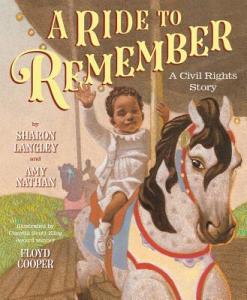
Cindy: Another African American girl who took an important seat is featured in A Ride to Remember (Abrams, 2020) by Sharon Langley and Amy Nathan. Occasional peaceful protests at the Gwynn Oak Amusement Park in Baltimore, Maryland were held for a decade asking for the right for people of color to visit the park. Nothing changed. But after new segregation laws were passed in Baltimore in 1962, a big protest was planned at the park for Independence Day, July 4, 1963. Arrests were made but the protest continued a few days later. When pressure mounted as the publicity surrounding the protests spread, change finally occurred and the park officials corrected their policy. On August 28, 1963, the park was opened to everyone. Sharon Langley’s parents bought tickets and they were the first family of color to walk through the gates. Sharon was photographed riding a horse on the carousel, a photo that ended up in the newspapers the next day. The carousel is now turning its circles on the National Mall in Washington, D.C. and Sharon Langley’s name is on a horse’s saddle and horseshoe.

Co-author Amy Nathan wrote a book for teens and adults Round and Round Together: Taking a Merry-Go-Round Ride into the Civil Rights Movement that also includes the other historic event of 8-28-63, Martin Luther King, Jr.’s “I Have a Dream” speech at the March on Washington. Award-winning illustrator Floyd Cooper’ artwork helps tell this important story in moving paintings.

The Talk: Conversations About Race, Love & Truth

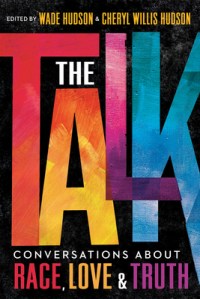
Cindy: Can we talk? A few years ago when one of my white 8th-grade students read The Hate U Give (2017) by Angie Thomas, she talked with me about it afterward. She expressed her shock at learning about “The Talk,” the one that black parents need to have with their children as they become drivers to help keep them safe during traffic stops. She said to me, “My parents never had that talk with me.” It was an important awakening for her. The Talk: Conversations About Race, Love & Truth (Crown, 2020) edited by Wade Hudson and Cheryl Willis Hudson will cause similar awakenings for some children and teens, and for others, the experiences and stories related here will be all too familiar. This illustrated collection of stories, poems, and essays illuminates the need for many different “talks” as parents help their children navigate prejudice due to race, religion, gender, sexuality, and other ways that people find to categorize people as “other,” “less than,” and “dangerous.”

Renee Watson launches the collection with a powerful talk for black girls in “Remember This,” as she reminds them of the many black heroines who led the way, of the power of your voice, and the encouragement to be your best self even when others around you cannot be theirs. Grace Lin takes on Asian stereotyping and female diminishment in “Not a China Doll, an illustrated letter to her daughter at ten (five years in the future). “Why Are There Racist People,” was generated by a school visit question asked of Mexican author and illustrator Duncan Tonatiuh, one that he struggled to answer. This talk is the result of his research, reading, and thought. Tonatiuh illustrates his own entry, others are done by other talented artists. I read this in an advanced reader copy and I’m eager to see the finished copy including the unavailable backmatter. Talking to our children and to each other is a powerful way to build relationships. Let’s talk.

Lynn: This year especially has seen the publication of several outstanding books for teens on the subject of racism and authored by the voices of writers who have first- hand experience. All of them have informed and challenged me. Perhaps it is the teacher in me but this slim book tops the list for me. Its format of short contributions is perfect for reading aloud in a classroom where instructional time is often highly regimented. Each piece is powerful, moving, and absolutely ideal for use as discussion starters or writing prompts. The wonderful variety means that there is something here for every reader and every reader will find a favorite.

My own favorites start with Derrick Barnes’ story about a kitchen-table conversation with his young son while helping him with math homework. It is an experience most of us, young and old, have had and the commonality of it contrasts starkly with the racism the little boy has just experienced. For young readers of color it will be instantly recognizable and for white readers it will be, as it was for me, jarring. For all readers it will be incredibly moving and deeply memorable.

There are so many powerful pieces here and I also especially appreciated Tracy Baptiste’s driving lesson advice to her son, Nikki Grimes’ poem about choosing “not to pick up the hurtful words thrown like stones,” and Adam Gidwitz’s essay that brought a wholly different look at racism. The black and white illustrations are as varied and as effective as the text contributions and add greatly to the overall impact of the book.

This slim but important book should be in every classroom and library collection in the country. It is truly a gem and opens the door to conversations among all of us about racism, discrimination and the social condition of our country.

Once Upon a Now: The Longest Night of Charlie Noon

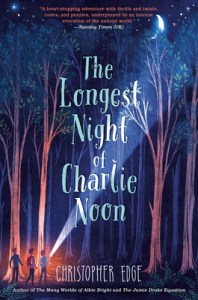
Cindy: I’ll say right off the top that I’m not convinced this book is entirely successful but I admire Christopher Edge for creating a story that is unique and thought-provoking. The Longest Night of Charlie Noon (Delacorte, 2020) starts with an intriguing opening:

Once upon a time doesn’t exist.
This story starts once upon a now.

Friends Charlie and Dizzy and bully Johnny become lost in the woods while trying to decode messages left there, perhaps by a child-eating monster. More dangerous, perhaps, is the woods itself and the night that falls more quickly than usual, the storms that threaten, and the stars that are not in their familiar constellations. As the night wears on and the weather changes impossibly, the children are not only lost in the woods but maybe, lost in time. Forget the monster, it may be the woods that gets them.

Edge plays with Einstein’s special theory of relativity and presents a story that is at once a page-turner creepy adventure and a thoughtful look at friendship, the fluidity of time, and who we choose to be. The book has two starred reviews already, so perhaps it is entirely successful; regardless, it’s a book for those kids who need challenging books without mature content. There’s plenty to think about here.

Lynn: Christopher Edge is doing a lot of things in this slim book. He’s got mystery, suspense and a bit of horror, a story of friendship and bullying, and kids finding their strengths. And he also has time travel. As a lifelong reader of science fiction, I am accustomed to being confused when I tackle time travel. I expect to be confused! Young readers have differing reactions to feeling off-footed by a plot. Some dislike it and others embrace it. Here, Edge helps readers to keep going when time travel adds its slippery effect by giving kids a lot of incentive to keep going. Charlie is in a dire situation and wondering what will happen next is a terrific impetus to keep turning the pages. And then there are the puzzling codes and, oh yes, the possibility of a kid-eating monster! It is cleverly designed to propel kids through what may be for some an off-putting sense of not really knowing what is going on. When they come out of the woods in the morning with the three protagonists, readers will find a lot of rewards. They’ll get a satisfying conclusion to the story, a summary of what happens to the characters when they grow up, and answers to at least some of their questions. Kids are going to want to immediately share and discuss the story, another great feature. Edge provides extensive and interesting back matter in “The Science in the Longest Night of Charlie Noon.” Here he explains the codes, code-breaking, and complicated concepts such as Einstein’s Theory of Relativity and the speed of light.

Perhaps the biggest reward of all here for young readers is in understanding that being confused for a while in a book can be a really great thing!


Ticks in Her Nose – the Story of a Wildlife Photographer for Kids

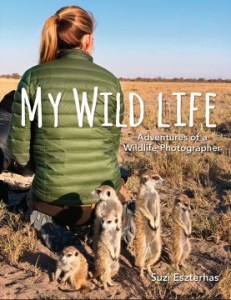
Lynn: Books for really young readers on careers are not easy to do well but a wildlife photographer/author that I especially admire, Suzy Eszterhas, has given us just that in My Wild Life: Adventures of a Wildlife Photographer (Owl Kids, 2020).  This fascinating story comes with a real bonus as the pertinent information includes a bounty of wonderful photographs that clearly expand on the points being made in the text. Eszterhas confides that she wanted to be a wildlife photographer as a child and she spent many hours in her backyard photographing her cats and squirrels, practicing the skills she would need.

Taking readers through many of the fascinating and challenging aspects of her job, Eszterhas provides information about how she preps the shots, finds and allows animals to grow confident around her, some of the techniques she uses to get shots including lying for hours belly down to achieve eye-level pictures and even flying in small airplanes—which makes her throw up in between clicking the shutter. She doesn’t pull any punches about the conditions she often has to live and work in. Kids will love some of the details like having to pee in a bottle while in a camouflaged blind, living in a tent for months without a shower, or waking up with ticks in her nose. She stresses that patience and having to wait for hours is often the key to success. And it is clear that being a woman in this very male-dominated field takes courage and determination.

Each chapter is an accessible and appealing 2 pages, which is ideal for young readers and the clear text is as informative as it is interesting. Several chapters are about the local experts and the scientists she works with and explains about her dedication to giving back to organizations that help wildlife. A concluding chapter is titled “Ask Suzi” and it provides additional information to questions about the profession.

The terrific photographs will draw readers in starting with the cover which is a beguiling shot of a group of meerkats sheltering from the wind up against her back. This book is sure to be a winner with kids who love nature and animals or are budding photographers themselves. All of them will come away with a real grasp of the skills and hard work necessary for this fascinating career and a deeper appreciation for the outstanding work done by photographers like Eszterhas.

Cindy: Eszterhas is an inspiration. Not only is this book as well done as Lynn says, but Suzi is also donating a portion of her royalties to her nonprofit organization Girls Who Click, a group that “empowers teen girls to enter the male-dominated field of nature photography and use their work to further conservation efforts around the world.” The free nature photography workshops are available online due to the current COVID crisis, perfect for distance and virtual learners. I wish I could take one! If, like us, you can’t get enough of Eszterhas’ extraordinary wildlife photography visit her website for more images that will take your breath away.

Cast Your Vote for Picture Books about Elections

Lynn and Cindy: Unless your pandemic shutdown has included no access to electronic media, you will have noticed that the U.S is fast approaching an important election. Adults everywhere are talking about politics, candidates, and elections and for children, it can all seem mystifying. Happily, authors and publishers have stepped up and there are a lot of picture books currently being published on the subject. Here’s a round-up of a few that we think will help kids make sense of this important topic.
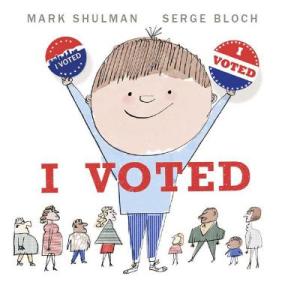
I Voted: Making a Choice Makes a Difference (Holiday House/Neal Porter, 2020) by Mark Shulman.

This book focuses on the idea of making a choice. It starts with the most basic of choices by asking what the reader likes best: ice cream or onions and apples or oranges? The concept slowly broadens by asking the reader to imagine a choice being made by more people such as choosing a class pet. In the simplest of terms that kids can easily understand, the book discusses facts about voting such as sometimes not getting what you want, ways to help people vote for what you want, and how a vote can be held. Broadening more, the topic shifts to grown-ups voting for leaders of their cities, towns, or states, why that is important and how to decide who to vote for. Kid-friendly and very accessible, this is a terrific vehicle for introducing the concept. Back matter includes Five Easy Steps for Voting and information on How Our Government Works. Serge Bloch’s cartoon illustrations make the book very appealing.
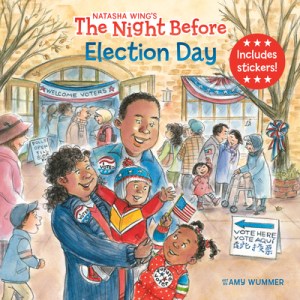
Natasha Wing’s The Night Before Election Day (Grosset & Dunlap, 2020) by Natasha Wing

This cheerful book is part of an extensive series told in the tradition of Clement Moore’s Night Before Christmas poem. Each book in the series tells the story of the night before a special event or festival. Here the event is Election Day and the children in the family are reminding their parents that school will be closed the next day so people can vote. Their classes have been decorating, everyone has been getting ready for months, and now the election is here. The basics of what is an election and the voting day process are covered here. Clearly stated yet retaining a child’s perspective, one of the chief joys of the book is the well-conveyed sense of excitement and importance of an election. This will be great to use in the classroom or at home in the fall as election time draws near. Extra nice to have a family of color at the center of the story. We love the idea of helping kids to understand how important AND exciting elections should be.
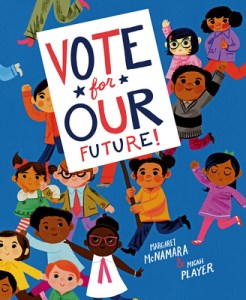
Vote for Our Future! (Schwartz & Wade, 2020) by Margaret McNamara

A diverse cast of children (and teaching staff) have the day off school in order for their elementary school to transform into a polling station. The children aren’t old enough to vote, but they figure out ways to perform other civic duties in this Get Out the Vote story. Their actions leading up to election day explain voting practices like registration, making a plan for election day, voting early or by mail, and the importance of voting. A gatefold shows a large crowd of people heading to the school to cast their votes in an effort to affect change. In addition to Micah Player’s colorful and lively illustrations throughout, the endpapers include images of political buttons encouraging voting. The end matter includes a list of Acts of Congress that improved life in the United States starting with the 1792 Postal Service Act signed into law by George Washington, and acts to protect national parks, Indian citizens, control air pollution, and protect civil rights, provide protection for Americans with disabilities, and access to affordable health care.
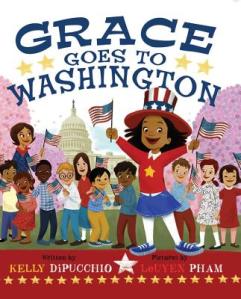
Grace Goes to Washington (Disney/Hyperion, 2019) by Kelly DiPucchio

The first book in this series, Grace for President (Little, Brown, 2008), explained the Electoral College as Grace tried to become the first female US president in her class’ mock election. This second book takes on the three branches of government as Grace’s student council struggles with deciding how to spend their fundraiser profits to best benefit their school. Everyone has a special interest (sports equipment, library books, or musical instruments). We all know how many adults in charge deal with these issues, but perhaps the kids can teach us something? Illustrated by the talented LeUyen Pham and including a field trip to Washington, D.C., an author’s note explaining the branches further, and a list of ideas for becoming an involved citizen, this book has a lot to offer an elementary classroom.

The Next President (Chronicle, 2020) by Kate Messner

And, while we wait to learn who our next president will be, take a stroll through presidential history with Kate Messner and Adam Rex. At any one time, we have approximately ten people alive who will become one of our next presidents, some who are still children and have no idea it will be them one day. Starting with George Washington, there were nine future presidents in the wing. In 1961 there were ten also, four of them just children (Bill Clinton, George W. Bush, newly born Barack Obama, and teenager Donald Trump). The following page has stirred some controversy, but careful readers will understand that Kennedy and Obama, and on another wall in the illustration, Hillary Clinton, are representing this text:

“The truth is America’s earliest presidents weren’t all that different from one another. Most were wealthy, white, Protestant men who might have been surprised if they’d been around to see a Catholic or an African American man elected president…or a woman nominated by a major party for the highest office in the land.”

An empty frame labeled “46” awaits the “next” president either this November or another four years from now. Adam Rex’s illustrations are magnificent and complement the interesting details and timelines that Messner researched and threaded together about what each president was doing earlier in their life before becoming America’s Commander in Chief. It’s an inspiring collection for children who wonder what their futures might hold.