PHEW – A Picture Book About a Stinky Subject

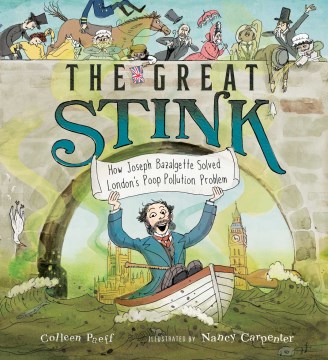
Lynngreat stink: Say the word “poop” and you get every kid’s attention. But of course, the management and disposal of poop is a critically important health issue for people everywhere.  So how do you help kids learn about the serious facts behind this stinky subject—all the while acknowledging that the giggles are inevitable? Colleen Paeff has the answer with her wonderful picture book, The Great Stink: How Joseph Bazalgette Solved London’s Poop Pollution Problem (S&S/Margaret McElderry, 2021). Paeff’s fascinating story of the brilliantly innovative engineer Joseph Bazalgette who truly saved London from its offal self is guaranteed to captivate and inform young readers—all without anyone having to hold their noses!

Told with a smile and engaging language, the history will make kids laugh but at the same time clearly delivers important facts about health and history. For most American kids, plumbing is a given and the protection the system provides us mostly out of mind with each flush. The reality for both history and many countries even today, is of course, another story.

Paeff focuses her story on London, beginning in 1500 with an introduction as to what passed for sanitation then. People in those days put human waste into deep cesspools in their basements and hired “nightsoil men” to come dig out and carry away the poop when it got too deep. Yuck!!! In 1819, when Bazalgette is born, flush toilets were just beginning to catch on but all the sewage goes directly into the Thames. A series of cholera outbreaks kills many Londoners who blame the disease on the bad air or misasmas while continuing to drink the polluted water. By 1850, Joseph Bazalgette, now an engineer, disagrees and he thinks he knows how to help.

But the city fathers didn’t agree and it took a lot of years, Bazalgette’s persistence, and a summer heat wave that produced an event called The Great Stink in 1858 to get his plan approved! But soon, thanks to Joseph Bazalgette, the London sewer system is flush with success!

Cindy: I don’t think I can keep up with Lynn’s stream of sewage metaphors but I do agree with her assessment of this important book. It’s hard to make such a putrid topic a joy to read, but Paeff has done it and Nancy Carpenter’s illustrations are the perfect touch to keep young readers flipping through the filth. The watercolor and ink artwork depict detailed scenes starting with the title page showing the royal “throne” occupied by the queen reading a newspaper! Plumbing pipes snake across later pages while earlier pages show Londoners using umbrellas to protect more from chamber pots being emptied than rain falling. Gross! But history isn’t always pretty, eh?

Knighted Sir Joseph Bazalgette’s story comes to an end in this book in 1874, but added backmatter includes an update on “Poop Polution Today” with tips for readers that include building a rain garden, planting trees, and touring a wastewater treatment plant, small acts to help prevent water pollution. There’s also a “Detailed Timeline,” a list of “Further Reading, and a “Selected Bibliography” for children and adults who want to learn more. My husband works in the wastewater industry, and we live on the water downriver from a large city that still struggles with sewage overflow into the river after big storms. Bazalgette was a hero, but it will take many more heroes to keep our waters safe. It’s never too early to be informed, and reading The Great Stink is a great start. 
Hurricane – Weathering a Storm with a Picture Book

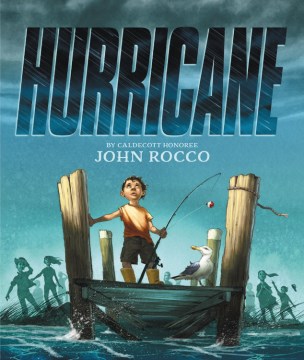
Lynn:Hurricane As he has done in other books, Rocco tells a story of a large event affecting a child and a community. Like Blackout (Disney/Hyperion, 2011) and Blizzard (Disney/Hyperion, 2014) these events are largely unexpected and out of a child’s ability to control them. And, like the previous books, the events result in a community coming together. This latest picture book, Hurricane (Little, Brown, 2021) begins calmly like the weather before a storm. Told in first person, a young boy confides to the reader that his favorite place is the neighborhood dock. “It’s old and splintery, ” he says, and the double-page spread that follows shows a delightful depiction of the many joys the old dock provides.
But when he walks home through the peaceful night, the boy notices that something feels different. Everyone is acting strangely, including his father. A hurricane is coming and the neighborhood is boarding up windows and getting ready. The scary storm roars through in the night and in the morning the little boy grabs his gear and rushes outside to discover that his neighborhood looks like “a giant angry monster stomped through it.” Worst of all in the boy’s view is that his beloved dock has been destroyed. Looking for help to fix it, the boy asks his father and the neighbors but they are all too busy with their own repairs so the little boy pitches in to help them first. As the neighborhood returns to normal, he decides to fix the dock himself  but the results are disastrous. Happily the neighborhood rallies around and in a lovely series of scenes, they not only repair the dock, but improve it, making it a neighborhood gathering place.

I am always charmed by the hopeful encouraging perspective that Rocco brings to his stories of big issues. He sees a bright side to events when those involved unite to make that happen. It is a story arc that never fails to inspire and delight. I love Rocco’s slightly nostalgic illustrations too but I’ll leave those to Cindy. This is another winner from Rocco and guaranteed to enchant his many fans.

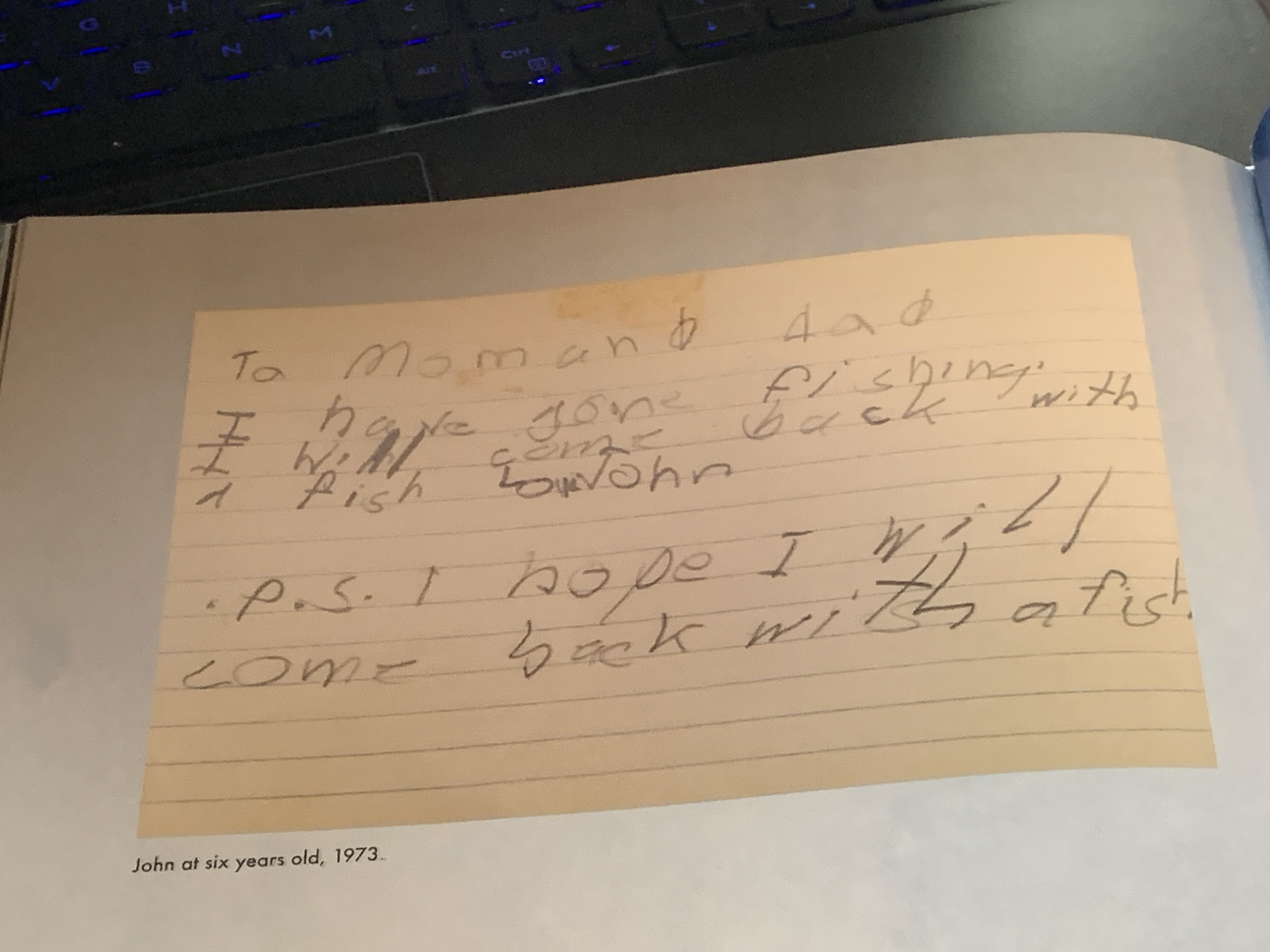
Cindy: To learn about the illustrations in this moving book, I’d recommend going straight to the source, John Rocco. Victoria Stapleton interviewed Rocco for the release of Hurricane, and his answers and accompanying slide show is fascinating. Watch the interview here, and learn about Rocco’s use of shapes and color to help tell a story of destruction and rebuilding. A story of hope. Not shown in the video are the fabulous end papers. The opening papers show the science and movement behind how a hurricane forms. The final end papers illustrate the parts of a dock and the installation of pilings. Another treat is John’s 1973 note left for his parents in his six-year-old handwriting. Hope applies to young fishermen as well. Don’t miss this one!

John Rocco fishing note

This Very Tree – a story of hope and resilience following 9/11

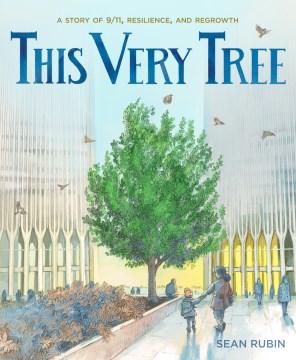
Lynn: This Very TreeLike so many adults, the memory of that day in September 2001 is harshly strong. And like many of us, I find it difficult to talk about the enormity of the experience to children. I’ve approached the growing number of picture books on the subject with mixed feelings. Sean Rubin’s new picture book. This Very Tree: A Story of 9/11, Resilience and Regrowth (Henry Holt, 2021) doesn’t try to explain the event. Instead he takes the event as a given and focuses instead on the strength, determination and resilience of the people of New York City and America to restore their city.

He does so by using the voice and perspective of the very real Callery Pear tree that stood by itself in the World Trade Center Plaza. Planted in the 1970’s the tree heralded spring each year with early blossoms and provided welcoming shade. Rubin addresses the issue of the attack with these simple sentences, “It was an ordinary morning. Until it wasn’t.” The peaceful green scene is replaced by a series of dark and angular panels that gradually lighten with a view up to light and firefighter faces looking down. No explanations are used here but the sense of something dark and catastrophic is clear.

The tree itself was seriously injured, with broken limbs, roots snapped, and branches burned. The tree relates how it was transplanted and gradually began to regrow. The New York Dept. of Parks tended the tree carefully for 9 years before it was finally returned to the Memorial Plaza where it now thrives among over 300 other trees. Called the Survivor Tree, the pages chronicling the healing and regrowth of the tree itself and the city are full of green life and a hopeful spirit. And I dare you to read them without tearing up! Yes, this is a story of 9/11 but it is also a story of resilience and hope and coming together and perhaps this is what we all need right now.

Cindy: Trauma and recovery are serious subjects for picture books, but so many children have experienced big and little traumas that even if they are too young to understand the world-changing event that was the terrorist attacks of 9/11, there is a healing story here that may help them. There is plenty for adults here, too, including the opening poem by E.B. White from Here is New York, that ends with the titular line, “This very tree.” Rubin’s art illustrates not only the storyline but the emotional path from trauma to recovery and hope. Along the way are lots of details of city life, construction equipment, and pockets of nature for young readers to explore. 

An author’s note explains how Rubin came to tackle this difficult story with its survivor tree, and a double page spread gives a brief history of  the World Trade Center, 9/11, and the Survivor Tree for older readers. Many tiny details (such as using the same typefaces as those used on the cornerstone of the One World Trade Center) make this a lovely tribute to New York City, its people, and to hope.

Not Your Ordinary Summer Vacation!

Sunrise SummerLynn: A bright cheerful cover of a new book on display at the public library recently caught my attention. Even with summer fading fast, the cover of Sunrise Summer (Imprint, 2021) by Matthew Swanson made me smile and I grabbed it thinking I was in for one last trip to the beach via picture book. Well, I was but this is not like any summer beach vacation picture book I have ever read! What surprise this book was to me and it is one I’m eager for kids and adults to be amazed by too.
The opening pages reinforced my first estimation of the content. A young girl tells us that summer, her favorite time of year, is here and her family is packing for their vacation. Here is where I began to wonder as this family was packing onions, potatoes, batteries, and spark plugs! This young family is headed to Alaska, specifically a place called Coffee Point in Egegik far far to the north. They own a property there where they go to commercially fish sockeye salmon each summer and this year our young narrator gets to join the fishing crew. She describes the process and that first summer of hard work and excitement, setting the nets and pulling in the salmon. Told with a joyful buoyancy, the story is immensely interesting and full of sensory descriptions that will fascinate kids. The sense of the hard work comes through clearly but so does the excitement, and sheer joy of this very unusual summer experience.

Cindy: I’m going to appreciate my salmon dinners much more after having read this story that clearly shows all the hard work that goes into catching those fish. The mixed media art is colorful and vibrant, but dark when the fishing happens in the wee hours of the morning or during storms. This is not a summer vacation for anyone but the hardy! The artist, Robbi Behr, has been summering in Alaska since she was 2 years old when her family decided to buy property at Coffee Point and have summer “adventures.” She now carries on the tradition with her husband, who wrote the text, and their four children. The final two spreads of the book include family photos, and illustrations, diagrams, and text to further explain the Alaskan salmon fishing industry and the indiginous history and current traditions. What a great catch, Lynn.

A Picture Book about Hineographs – Changing Child Labor

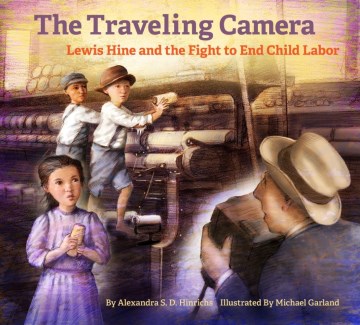
Traveling cameraLynn: My introduction to Lewis Hine came through Russell Freedman and his memorable book, Kids at Work: Lewis Hine and the Crusade Against Child Labor (Clarion, 1994). It was a book we used constantly in our middle school collection and the photographs in it have always stayed in my mind. I have seen very few if any books for students since Freedman’s book and the issue of child labor is still a problem in the world today. So I was truly excited to learn about a new book about Hine, this time a picture book, The Traveling Camera: Lewis Hine and the Fight to End Child Labor (Getty, 2021) by Alexandra S. D. Hinrichs.
Basing her text on Hine’s letters, reports, and photo captions, Hinrichs introduces young readers to Lewis Hine and his pivotal work, photographing child workers all across America in the early 1900’s. Hired by the National Child Labor Committee in 1908 to take pictures to bring awareness of the horrendous conditions children worked in. His jarring photographs helped to bring about legislation to protect children in this country. Having worked himself as a child, Hine became a teacher, then a photographer, eventually working for the Red Cross. His work was critically important in changing public opinion but sadly it was gradually forgotten until long after his death.

Hinrichs does an excellent job of bringing Hine and his work to life for kids today. As an amateur photographer myself, I especially appreciate the background she provides on the awkward and heavy equipment Hine had to use. For kids used to point and click cameras, the process will be eye-opening as is the information about Hine having to disguise himself in order to get into work places to get his pictures. Well written, and beautifully illustrated by Michel Garland, this is a terrific book to add to all collections.

Cindy: On the opening page of the book is a quote by Hine under his own portrait photograph defining his goals with photography. He met them both:

There are two things I wanted to do.
I wanted to show the things that had to be corrected;
I wanted to show the things that had to be appreciated.

Illustrator Michael Garland does a beautiful job with his combination of digital and traditional pastel and sepia-toned paintings, many of which are “snapshots” of the scenes behind Hine’s photographs. A sliver of each page spread holds the free verse poetry that tells “a big story/in a small space” as did the photographs of these children at work. The rest of the page is given to the visual story, in a design that is very appropriate for the subject.

For readers who haven’t seen Hine’s work, the story ends with a spread of some of his photographs. Others are sprinkled throughout the backmatter. There’s a Note to the Reader with information about child labor and other topics related to the book. A Time line of Hine’s life and child labor in the US is included as well as a good list of selected sources and quotation sources.

Older students interested in the subject should also get their hands on Susan Campbell Bartoletti’s child labor books, Growing Up in Coal Country (Houghton Mifflin, 1996) and Kids on Strike! (Houghton Mifflin, 1999). This is a world-wide problem that isn’t going away. I’m grateful for the photographs and the books that help “show the things that (have) to be corrected.”

Overcoming Fears – New Chapter Books for the First Grade Set

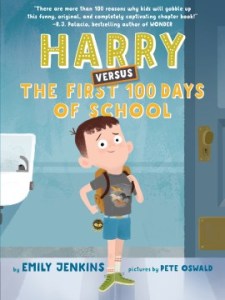
Lynn: I am firmly convinced that writing well for children is extremely difficult and writing well for the K-Gr. 2 set is one of the most difficult challenges of all! My all-too-necessary-in-Michigan stocking hat is off to people that manage to be authentic, engaging, and developmentally appropriate while telling a wonderful story! One of the best is Emily Jenkins, author of one of my favorite chapter book series, The Toys Trilogy. I am delighted to report that Jenkins has a new chapter book that will be published in June, Harry Versus the First Hundred Days of School (Random/Schwartz & Wade, June 2021. I fell in love with 5-year-old Harry Bergen-Murphy on the first page.
Harry doesn’t think he is ready for first grade. He has worries. Will he get lost in the big building? Will his teacher yell? What about mean kids and scary classroom guinea pigs? Not even the new Fluff Monster keychain on his backpack makes Harry feel ready. This absolutely endearing tale chronicles Harry’s experiences with school, the ubiquitous Hundred Days lessons, and how he becomes an expert at, not one, but three things! Jenkins masterfully puts readers right inside Harry’s head as he takes on the challenges of first grade. Funny, sweet, and absolutely dead-on authentic, this book addresses the complicated whirl of a child’s fears, misunderstandings, and confusions as well as the growth, revelations, breakthroughs, and triumphs of that important early school experience.

Harry is a complete delight. Loaded with Jenkins’ signature wry humor, the book is as insightful in the ways a young child thinks as it is funny. This will be a perfect read-aloud for classrooms, for parents helping prepare a child for that first day of school, or as a solo read for kids tackling chapter books on their own. Kids will delight in finding their First Grade experiences reflected here. Adults will find a heartwarming story of a little boy discovering his strengths, aided by caring teachers and supportive adults. Jenkins includes a terrific Author’s Note that includes comments on the lessons and a list of the many stellar books referenced in the story. I’d also just like to say the “Fluff Monsters” that Harry loves and invented for the story are the next fad waiting to sweep First Grades everywhere! Emily—you need to copyright this now!

I read this in galley which included just a few of the promised illustrations by Pete Oswald and I’m eager to see the finished copy. I can’t think of a better book to use as a first-grade classroom read-aloud or one for a parent to read with a first-grader to be. Absolutely stellar in every way.
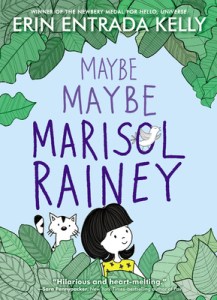
Cindy: I have a story about a girl who has tackled and survived first grade, but has many more fears to conquer. Maybe Maybe Marisol Rainey (Greenwillow, May 2021) by the talented Erin Entrada Kelly introduces us to 8-year-old Marisol who is afraid of everything. Small, quiet, and timid Marisol Rainey is a main character that many children will relate to, although they may need to be introduced to silent movies and their stars like Charlie Chaplin and Mary Pickford. Marisol is a fan of those funny movies and how the actors can say so much without saying anything.
Marisol names everything, her stuffed animals, the refrigerator (Buster for Buster Keaton), and the huge scary tree in the back yard, which she named Peppina. She names all of the important things in her life as she says she wouldn’t want to be called “human” or “girl” so why shouldn’t refrigerators and trees have names?
Marisol has a supportive family and a patient best friend, Jada, who all understand Marisol’s fears and let her tackle them when she is ready. She also has mad Claw-Machine skills that have helped to grow her stuffed animal collection, but even then, she uses them to rescue the one-eyed misfit animal in the far corner of the machine. Marisol is kind. She is the kind of friend all first to third graders should get to know.

I Talk Like a River – A Perfect Pairing of Text and Illustration

Cindy:  It mystifies me that people can still be mean to others for their looks, their disabilities, and other things out of their control. Little is more isolating or heartbreaking than the loneliness of being singled out or mocked or bullied for something that is just a part of who you are. No matter how many “Kindness Matters” or “Be Kind” movements there are, we still have work to do to spread compassion. I Talk Like a River (Holiday/Neal Porter Books, 2020) by Jordan Scott and illustrated beautifully by Sydney Smith, shines a light on one such effort. The young boy in this book stutters. With poetic metaphor, Scott writes of words that take root and stick and turn to dust in his mouth. Speaking aloud in front of a class often makes for a “bad speech day.” His father can tell and offers to “go somewhere quiet.” They head to the river, a favorite place, where his father one day points out the movement in the river, the bubbling, churning, whirling, crashing. But after the rapids are calm places where the river flows smoothly and he tells his son, “You Talk Like a River.” That line comes from Scott’s own father, who helped him with his own stuttering. This will make a beautiful read aloud in a classroom and would pair well with Jacqueline Woodson’s Each Kindness.
Lynn: We were lucky enough to see this book in galley at a Midwinter preview a year ago and it has been on my to-read list ever since. The finished copy is even more outstanding than I remembered. Sometimes the text of a picture book and the illustrations aren’t always equal in quality but that is not the case here. Rarely have I seen a case of the two coming together so perfectly. The text is deeply moving with writing that is ideal for a young audience and metaphors that every child can grasp.

“The P in pine tree grows roots in my mouth and tangles my tongue.

The C is a crow that sticks in the back of my throat.”

The illustrations are perfectly partnered with the text. Some are luminously beautiful, especially the scenes of the river. Some are ominous and threatening such as when the class has turned to stare when the boy is called on to answer in the classroom. Using watercolor, ink, and gouache, illustrator Sydney Smith’s art doesn’t just extend the text, it amplifies each emotion and experience. There is a gatefold center spread that opens to a shimmering image of the boy standing in the river backlit by the sun that is stunning! There are no words here but the images refract the overall healing sense of the place, the experience, and the father’s love and support.

Readers will come away from this book with a clear sense of the struggles the child experiences with his stutter and that is valuable. Perhaps more valuable is the underlying knowledge that the child is loved, supported, and understood and the strength that provides.

Update: We had this post in the queue and missed getting it published before the book was honored at ALA Midwinter with a 2021 Schneider Family Book Award for Younger Children. Congratulations!


Stories That Need to Be Told – Picture Books Take Up the Challenge

Lynn and Cindy: One of the things we love about picture books is that authors and illustrators often take up the challenge of bringing a little known story to young readers. It is so important to keep our history and our stories alive! As reviewers, we also love that we get the benefit of these stories too. Here are two new picture books that do this important work—and do it wonderfully.

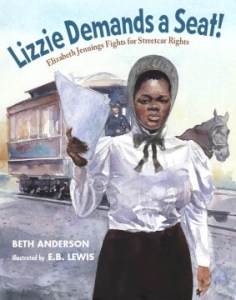
Lynn: Decades before Rosa Park refused to sit in the back of a bus, another brave determined woman demanded her rights on a streetcar in New York. Beth Anderson tells her inspiring story in Lizzie Demands a Seat: Elizabeth Jennings Fights for Streetcar Rights (Boyds Mills/Calkins Creek, 2020). It was 1854 in New York City and Elizabeth Jenkins, a teacher and organist from a wealthy family, was on her way to church. When the horse-drawn streetcar arrived it had empty seats and Lizzie and her friend hurried to board. But the conductor would not allow them on, telling them to wait for the car for “her people.” Lizzie had no intention of waiting. There was no law keeping anyone of color from riding the streetcars although there was a custom of not riding if a white passenger objected. When no one on board objected, Lizzie persisted and the conductor physically threw them from the car. Lizzie, whose family were leaders in their community and well connected, took the Third Avenue Streetcar company to court where, with her attorney Chester A. Arthur, she won her case, paving the way for people of color to fight for their rights to ride then and in the future.
The text is wonderful, lively, and compelling and I’m truly sorry it has taken me so long to learn about Elizabeth Jennings. The author notes that the “dialogue closely follows her account as it appeared in the newspapers of the time,” and this gives the story a very immediate and personal feel that will appeal to kids. The back matter is outstanding too with fascinating additional historical material on Elizabeth Jennings and her case in an Author’s Note, information on the research. a bibliography, a list of further readings, and a Note from the Illustrator.

And speaking of illustrators! I am a big admirer of E.B. Lewis’s illustrations and here they add wonderfully to the overall impact of the story. Lewis, who usually uses a muted palette, chose intense colors and the result is a wonderful sense of the drama of the event. In an artist’s note, Lewis says, “I wanted to go all out in the way of color—to stretch my own internal prism.” He even had to purchase colors he had never used before. I’m so glad he did as the result is beautiful and effective!

Once again a picture book has introduced me to a memorable and important historical person that I had never heard of before. I’m beginning to think that we should give up textbooks and flood our classrooms with shelves of outstanding nonfiction picture books!

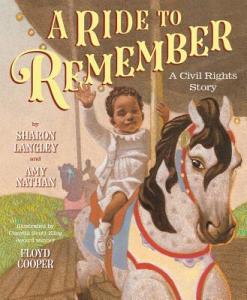
Cindy: Another African American girl who took an important seat is featured in A Ride to Remember (Abrams, 2020) by Sharon Langley and Amy Nathan. Occasional peaceful protests at the Gwynn Oak Amusement Park in Baltimore, Maryland were held for a decade asking for the right for people of color to visit the park. Nothing changed. But after new segregation laws were passed in Baltimore in 1962, a big protest was planned at the park for Independence Day, July 4, 1963. Arrests were made but the protest continued a few days later. When pressure mounted as the publicity surrounding the protests spread, change finally occurred and the park officials corrected their policy. On August 28, 1963, the park was opened to everyone. Sharon Langley’s parents bought tickets and they were the first family of color to walk through the gates. Sharon was photographed riding a horse on the carousel, a photo that ended up in the newspapers the next day. The carousel is now turning its circles on the National Mall in Washington, D.C. and Sharon Langley’s name is on a horse’s saddle and horseshoe.
Co-author Amy Nathan wrote a book for teens and adults Round and Round Together: Taking a Merry-Go-Round Ride into the Civil Rights Movement that also includes the other historic event of 8-28-63, Martin Luther King, Jr.’s “I Have a Dream” speech at the March on Washington. Award-winning illustrator Floyd Cooper’ artwork helps tell this important story in moving paintings.

Ticks in Her Nose – the Story of a Wildlife Photographer for Kids

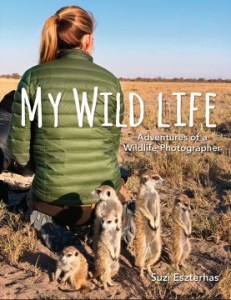
Lynn: Books for really young readers on careers are not easy to do well but a wildlife photographer/author that I especially admire, Suzy Eszterhas, has given us just that in My Wild Life: Adventures of a Wildlife Photographer (Owl Kids, 2020).  This fascinating story comes with a real bonus as the pertinent information includes a bounty of wonderful photographs that clearly expand on the points being made in the text. Eszterhas confides that she wanted to be a wildlife photographer as a child and she spent many hours in her backyard photographing her cats and squirrels, practicing the skills she would need.
Taking readers through many of the fascinating and challenging aspects of her job, Eszterhas provides information about how she preps the shots, finds and allows animals to grow confident around her, some of the techniques she uses to get shots including lying for hours belly down to achieve eye-level pictures and even flying in small airplanes—which makes her throw up in between clicking the shutter. She doesn’t pull any punches about the conditions she often has to live and work in. Kids will love some of the details like having to pee in a bottle while in a camouflaged blind, living in a tent for months without a shower, or waking up with ticks in her nose. She stresses that patience and having to wait for hours is often the key to success. And it is clear that being a woman in this very male-dominated field takes courage and determination.

Each chapter is an accessible and appealing 2 pages, which is ideal for young readers and the clear text is as informative as it is interesting. Several chapters are about the local experts and the scientists she works with and explains about her dedication to giving back to organizations that help wildlife. A concluding chapter is titled “Ask Suzi” and it provides additional information to questions about the profession.

The terrific photographs will draw readers in starting with the cover which is a beguiling shot of a group of meerkats sheltering from the wind up against her back. This book is sure to be a winner with kids who love nature and animals or are budding photographers themselves. All of them will come away with a real grasp of the skills and hard work necessary for this fascinating career and a deeper appreciation for the outstanding work done by photographers like Eszterhas.

Cindy: Eszterhas is an inspiration. Not only is this book as well done as Lynn says, but Suzi is also donating a portion of her royalties to her nonprofit organization Girls Who Click, a group that “empowers teen girls to enter the male-dominated field of nature photography and use their work to further conservation efforts around the world.” The free nature photography workshops are available online due to the current COVID crisis, perfect for distance and virtual learners. I wish I could take one! If, like us, you can’t get enough of Eszterhas’ extraordinary wildlife photography visit her website for more images that will take your breath away.

Cast Your Vote for Picture Books about Elections

Lynn and Cindy: Unless your pandemic shutdown has included no access to electronic media, you will have noticed that the U.S is fast approaching an important election. Adults everywhere are talking about politics, candidates, and elections and for children, it can all seem mystifying. Happily, authors and publishers have stepped up and there are a lot of picture books currently being published on the subject. Here’s a round-up of a few that we think will help kids make sense of this important topic.

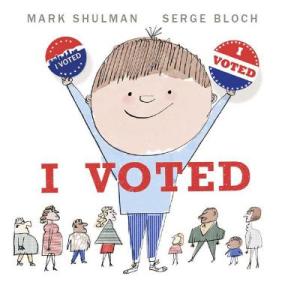
I Voted: Making a Choice Makes a Difference (Holiday House/Neal Porter, 2020) by Mark Shulman.
This book focuses on the idea of making a choice. It starts with the most basic of choices by asking what the reader likes best: ice cream or onions and apples or oranges? The concept slowly broadens by asking the reader to imagine a choice being made by more people such as choosing a class pet. In the simplest of terms that kids can easily understand, the book discusses facts about voting such as sometimes not getting what you want, ways to help people vote for what you want, and how a vote can be held. Broadening more, the topic shifts to grown-ups voting for leaders of their cities, towns, or states, why that is important and how to decide who to vote for. Kid-friendly and very accessible, this is a terrific vehicle for introducing the concept. Back matter includes Five Easy Steps for Voting and information on How Our Government Works. Serge Bloch’s cartoon illustrations make the book very appealing.

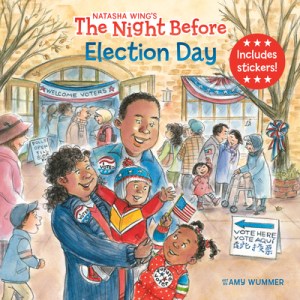
Natasha Wing’s The Night Before Election Day (Grosset & Dunlap, 2020) by Natasha Wing

This cheerful book is part of an extensive series told in the tradition of Clement Moore’s Night Before Christmas poem. Each book in the series tells the story of the night before a special event or festival. Here the event is Election Day and the children in the family are reminding their parents that school will be closed the next day so people can vote. Their classes have been decorating, everyone has been getting ready for months, and now the election is here. The basics of what is an election and the voting day process are covered here. Clearly stated yet retaining a child’s perspective, one of the chief joys of the book is the well-conveyed sense of excitement and importance of an election. This will be great to use in the classroom or at home in the fall as election time draws near. Extra nice to have a family of color at the center of the story. We love the idea of helping kids to understand how important AND exciting elections should be.

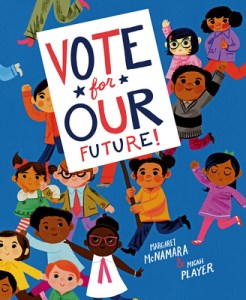
Vote for Our Future! (Schwartz & Wade, 2020) by Margaret McNamara

A diverse cast of children (and teaching staff) have the day off school in order for their elementary school to transform into a polling station. The children aren’t old enough to vote, but they figure out ways to perform other civic duties in this Get Out the Vote story. Their actions leading up to election day explain voting practices like registration, making a plan for election day, voting early or by mail, and the importance of voting. A gatefold shows a large crowd of people heading to the school to cast their votes in an effort to affect change. In addition to Micah Player’s colorful and lively illustrations throughout, the endpapers include images of political buttons encouraging voting. The end matter includes a list of Acts of Congress that improved life in the United States starting with the 1792 Postal Service Act signed into law by George Washington, and acts to protect national parks, Indian citizens, control air pollution, and protect civil rights, provide protection for Americans with disabilities, and access to affordable health care.

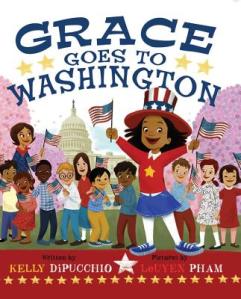
Grace Goes to Washington (Disney/Hyperion, 2019) by Kelly DiPucchio

The first book in this series, Grace for President (Little, Brown, 2008), explained the Electoral College as Grace tried to become the first female US president in her class’ mock election. This second book takes on the three branches of government as Grace’s student council struggles with deciding how to spend their fundraiser profits to best benefit their school. Everyone has a special interest (sports equipment, library books, or musical instruments). We all know how many adults in charge deal with these issues, but perhaps the kids can teach us something? Illustrated by the talented LeUyen Pham and including a field trip to Washington, D.C., an author’s note explaining the branches further, and a list of ideas for becoming an involved citizen, this book has a lot to offer an elementary classroom.

The Next President (Chronicle, 2020) by Kate Messner

And, while we wait to learn who our next president will be, take a stroll through presidential history with Kate Messner and Adam Rex. At any one time, we have approximately ten people alive who will become one of our next presidents, some who are still children and have no idea it will be them one day. Starting with George Washington, there were nine future presidents in the wing. In 1961 there were ten also, four of them just children (Bill Clinton, George W. Bush, newly born Barack Obama, and teenager Donald Trump). The following page has stirred some controversy, but careful readers will understand that Kennedy and Obama, and on another wall in the illustration, Hillary Clinton, are representing this text:

“The truth is America’s earliest presidents weren’t all that different from one another. Most were wealthy, white, Protestant men who might have been surprised if they’d been around to see a Catholic or an African American man elected president…or a woman nominated by a major party for the highest office in the land.”

An empty frame labeled “46” awaits the “next” president either this November or another four years from now. Adam Rex’s illustrations are magnificent and complement the interesting details and timelines that Messner researched and threaded together about what each president was doing earlier in their life before becoming America’s Commander in Chief. It’s an inspiring collection for children who wonder what their futures might hold.