Lynn: 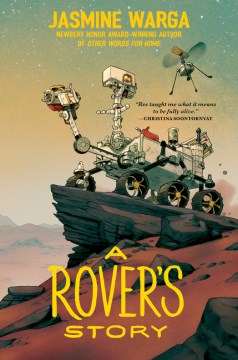 What does it mean to be human? Does it mean the ability to wonder, to hope or to be scared? Does it mean recognizing that you have emotions? Jasmine Warga’s newest book explores that important question and she does it in a way that is intriguing, unusual, and compelling. A Rover’s Story (Scholastic, Oct. 2022) began when Warga’s young daughter asked her to turn on the TV to watch the Mars Rover Launch in November 2022. After watching in fascination together, one of her daughters asked Warga, “Mama, do you think the robot is scared?” And a book was born.
Resilience is a robot intended to travel to Mars, take samples and photographs, send home information, and locate another rover that has gone silent. Readers meet Resilience in a NASA lab where workers, especially scientists Raina and Xander, work long into the night to prepare the little robot for its mission. Short chapters alternate at the beginning between Resilience as something happens to create awareness, Sophie (Raina’s daughter), and Journey, another rover in production. Warga skillfully develops all these fascinating characters, both Homosapien and robot as all of them experience the various emotions that make us all who we are.
Spanning over 17 years, the story follows Resilience and his eventual teammates, Fly, his chatty enthusiastic drone, Guardian, a satellite, and the various humans remaining behind. Adventures, catastrophes, loneliness, hope, courage, and, yes, fear, all play a fascinating part in the explorations, both physical and emotional, in this story. I started the book a bit wary of anthropomorphizing the robot but I blew past that at light-year speed. I fell head-over-wheels in love with all these characters and will think about Resilience for a long long time. This would be a great choice for a classroom read-aloud.
Cindy: “Zappedty, zip,” I don’t blame Warga for getting sucked into the lives of the Mars rovers. I was hooked after reading The Mighty Mars Rovers: The Incredible Adventures of Spirit and Opportunity (Clarion, 2012) by Elizabeth Rusch. Even though it was nonfiction, the rovers came alive in her writing and had me rooting for them as if they were human. The blurb on the advanced reader copy of A Rover’s Story describes it as The One and Only Ivan meets The Wild Robot. Having read and loved both of those stories for a similar age level, I would agree. There is much to be learned about what it means to be human in children’s books, and not just from the human characters. The teamwork between the scientists is equaled by that between Resilience, Fly, and Guardian. Sophie has her own worries, at first jealous of the time her mother gives to the rover, then concerned for the project once she meets Resilience and watches the launch, and then problems that aren’t so easily fixable as reprogramming a robot. This is a story that is sure to prompt some discussion amongst tweens, and it really would be a great read-aloud as Lynn suggests.
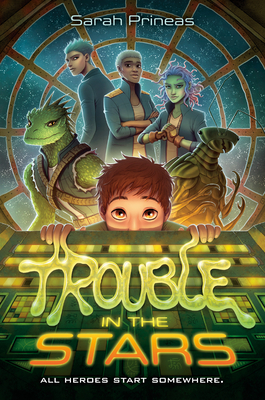 Sarah Prineas’ new book,
 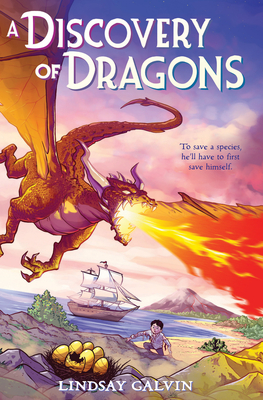 Simon Covington is an assistant to Charles Darwin on the USS Beagle, playing fiddle and labeling specimens on the scientist’s famous voyage to the Gallapagos Islands. When he is lost at sea after helping to rescue Darwin, he winds up on an unexplored island with an active volcano. He soon learns that the volcano is not the only thing breathing fire on the island. With the help of his fiddle (from which Simon hears advice and sarcasm) and a lizard he names Farthing, Simon manages rescue and returns to London. There he continues to help Darwin with his specimens but also to deal with his own—a set of eggs he rescued and that are now starting to hatch! Simon’s character is based on a real boy of the same name who aided Darwin on this voyage and details of Darwin’s life and work are woven into the story, but it remains an adventure focused on what may be the last dragon eggs in the world. Might Darwin have found dragons in addition to finches and tortoises if he’d looked in the right place? We may never know. I was willing to let the story unfold as a possibility. Young fans of dragon stories and young naturalists are going to enjoy this science-based adventure. Maybe it’s not fantasy at all….if the dragons are/were real? Hmmmmm….
 Cindy: I’ve recently added some bookshelves in my house (yay!), which prompted a reorganization of my collections. As I sorted and tried to purge some books, I also had my hands on old favorites that won’t be moved along. Some of my favorites come from award committees or special publisher events where I picked up personalized autographs from favorite authors. Lynn and I thought it might be fun to start an occasional feature of some of our autographed books and any stories that might accompany them. Well, at least those that we have permission to share. Let us know what you think.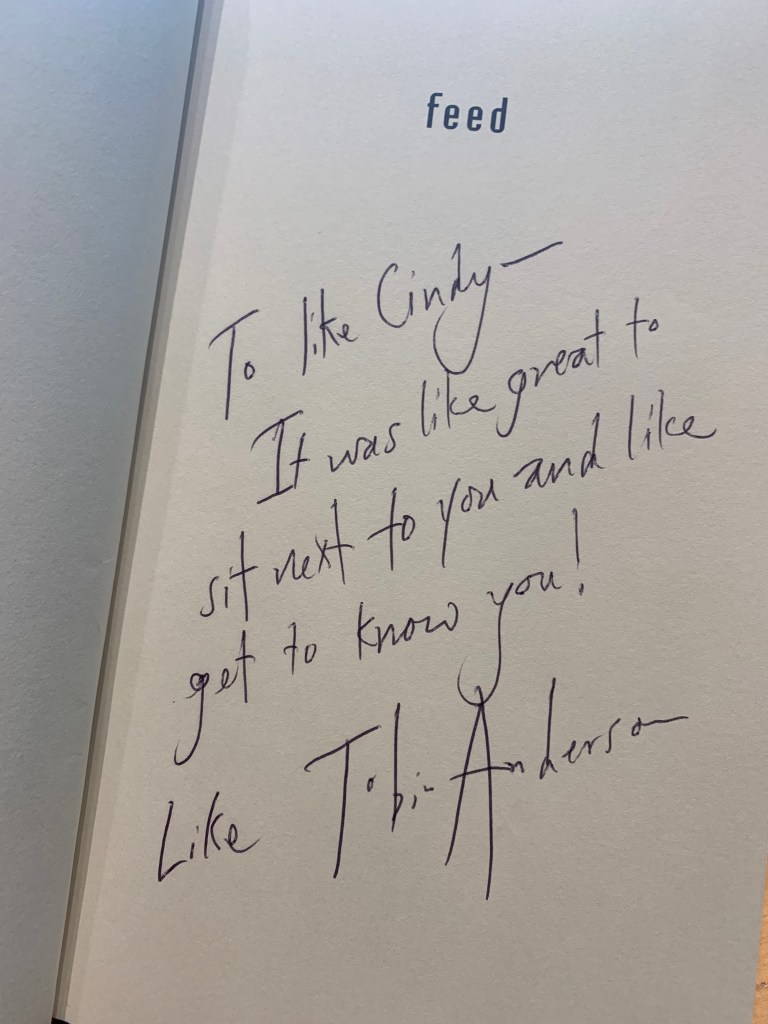
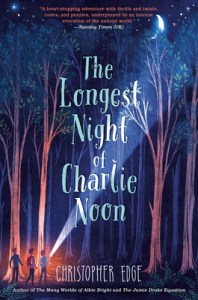 Cindy: I’ll say right off the top that I’m not convinced this book is entirely successful but I admire Christopher Edge for creating a story that is unique and thought-provoking.
 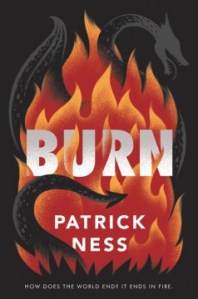 Lynn:
Lynn: 
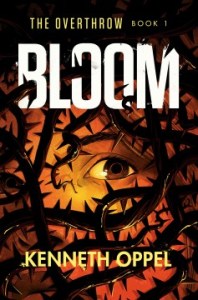 Lynn: Grab your heavy-duty garden shears and get ready for a wild ride with Kenneth Oppel’s new science fiction thriller,
  Earth has been made unlivable and the few who escaped are clinging to survival on the Mars station as food, supplies, and breathable air are running out. Told by 6th-grader Lan, a nick-of-time invitation arrives allowing these remaining humans to settle on the distant Planet Choom. Twenty years in stasis travel later, the human ship arrives only to be told that the government of Choom has changed its mind. Reluctantly, Choom officials agree to a test case—one “human reproductive unit” will be allowed to settle temporarily. Lan’s family is chosen with the future of humanity riding on their shoulders. “No pressure!”
 bookendsblog.net