Lynn: Train-lovers, big and small, will love Marsha Diane Arnold’s new picture book, Big Boy 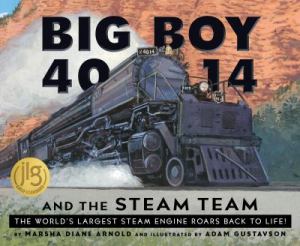 4014 and the Steam Team: the World’s Largest Steam Engine Roars Back to Life (Sleeping Bear Press, 2025). The Big Boys, 25 huge locomotives, were built between 1941 and 1944. They were used to pull extremely heavy loads through the Wasatch Mountains in Utah and were critical in hauling soldiers and military supplies during WWII. So long at 132 feet, the Big Boys had to be articulated to manage curves on the tracks. After the war, diesel locomotives began to replace steam, and Big Boy 4014 pulled her last load in 1959. Eventually, all but 8 were scrapped. 4014 sat in a museum in Pomona, California, for over 50 years.
But in 2013, something amazing happened. The Union Pacific Railroad wanted to celebrate the 150th Anniversary of the Golden Spike – the completion of the 2 ends of the first transcontinental railroad. A Big Boy was needed, and the “Steam Team” had only 6 years to get 4014 operational once more!
Since she sat more than a mile from any track, the first huge task was to move her somehow to the tracks. New tracks and a huge loader got 4014 connected to tracks, where two diesel engines then pushed and pulled her all the way to Cheyenne, Wyoming, and the Union Pacific Steam shop. The Steam Team went to work!
The story chronicles their efforts and ultimate success in getting 4014 rolling once again. Not only did she make the Celebration, she also started on a series of cross-country tours. allowing people around the country a chance to see her roaring past.
Adam Gustavson’s glorious illustrations take full advantage of the extra-wide pages with dynamic scenes and nearly steal the book. He uses perspective wonderfully, providing extraordinary views from above, below, close up, and far away.
Arnold’s text is perfectly suited for young readers but provides ample information for train fanatics. The sound effects make the book a wonderful read-aloud, as does the large size. A lengthy and fascinating Author’s Note with much more historical information and photos is included.
Let your readers roll with this outstanding book, which will be loved by readers of ALL ages.
 I have never wished to be 20 years younger any more intensely than while reading
  The iconic Hoover Dam is familiar to lots of us. Many young readers have visited the dam, driven over it or heard about it in the current news about lowering water levels. It is so familiar that perhaps the astonishing details of its development, construction and impact have been overlooked lately. Happily, Simon Boughton has remedied those issues with his new and fascinating book,
  winner Steve Sheinkin’s new book for teens,
  Did you know that the Mona Lisa is painted on wood and that it weighs over 200 pounds and that the thief could barely carry it down the stairs? Or that a locked and jammed door knob nearly stymied the thief—until a helpful Louvre plumber came along and opened it? Or that Da Vinci carried the Mona Lisa with him on the back of a mule on his journey over the Alps into France?
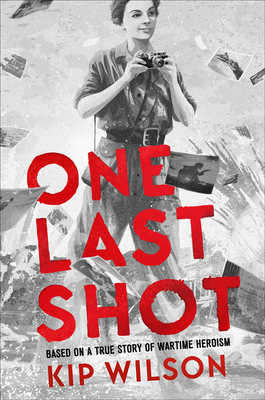 Lynn: One important tenet of reviewing books is that you review the book you have not the book you WISH you had. I’m running aground a bit on staying with that in my consideration of Kip Wilson’s new verse novel, One Last Shot: The Story of Wartime Photographer Gerda Taro (Harper/Versify, 2023).
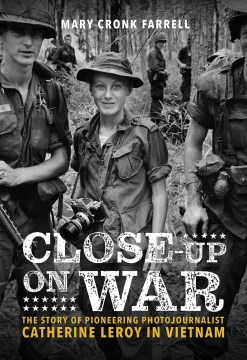 Did you ever wonder where the term “snapshot” comes from? Mary Cronk Farrell includes this tidbit (from the sound made as a picture was taken and the film advanced) in her outstanding new book, Close-Up on War: the Story of Pioneering Photojournalist Catherine Leroy in Vietnam (Abrams/Amulet, 2022). This fascinating book is also a snapshot – a captured picture of a pivotal time and the determined woman who recorded it on film for the world to see.
 Where were you in October 1962? I know a whole lot of you weren’t even on this planet yet but how much do you know about how close we came to annihilating this place we call home? I was a young teen at the time, going to junior high in Belmont, MA and I remember those days quite well. I think I especially remember them because I realized my father was grimly worried, even scared. We watched the reports on the news and when I asked my dad if there would be a war, all he would do was shrug. I remember too, the sigh of relief when Russia “blinked” but I also remember an overwhelming sense of helplessness at these events that could wipe out the world and there was nothing I could do.
 I couldn’t turn the pages fast enough, and I was holding my breath in places (when I wasn’t gasping) even though I knew the outcome. What I didn’t know was many of the details and stories behind the Cold War build-up, the dangerous rescue efforts after the Berlin Wall went up, and the last hour unlucky mishaps during the Cuban Missile Crisis, any one of which could have could have been more than disastrous, but for some added good luck. Obviously, this is a natural sell to teen readers who were fascinated by Sheinkin’s earlier YA book,
 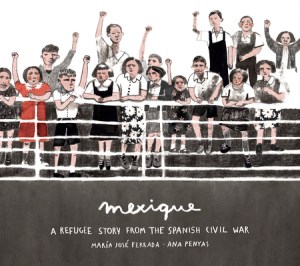 Cindy: When my middle school students and I read Alan Gratz’s novel,
 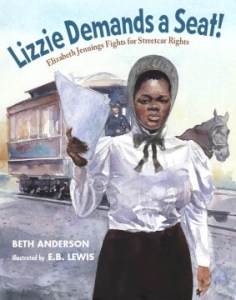 Lynn: Decades before Rosa Park refused to sit in the back of a bus, another brave determined woman demanded her rights on a streetcar in New York. Beth Anderson tells her inspiring story in
 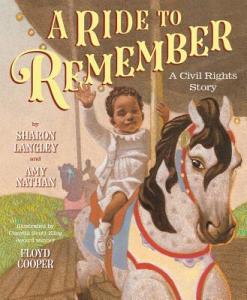 Cindy: Another African American girl who took an important seat is featured in
  bookendsblog.net